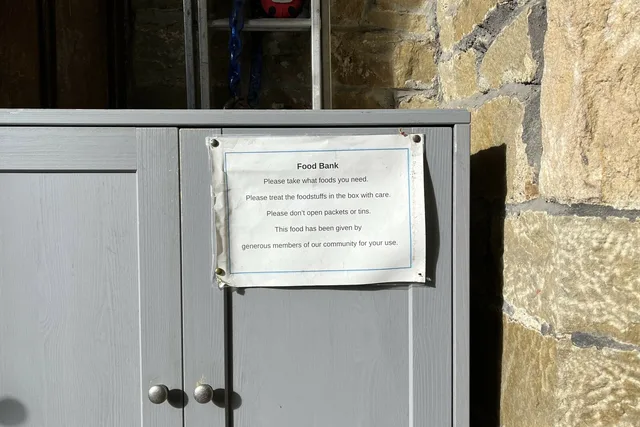
Wales’s food banks are buying the food a safety net should let households afford
Responding to Welsh food banks buying seven times more food as donations fall, Wrexham.com (24 Nov 2026)
The pressure on Welsh food banks exposes the danger of treating charity as a dependable part of the household safety net.
Trussell’s food banks in Wales bought more than 300 tonnes of food in 2025, over seven times the amount purchased in 2021, to compensate for falling donations.1 That is a warning about the institutions being asked to keep people fed. A safety net that depends on someone else having enough left over to donate cannot promise anyone a dependable minimum.
The immediate squeeze is clear: donations were 38% lower last winter than in winter 2022, while Welsh Trussell food banks distributed more than 40,000 emergency parcels last winter.1 Their purchased share of supplies rose from around 3% in 2021 to 22% in 2025.1 Charities must now find money to fill a gap that donated tins once covered. The Board’s concern is the assumption that they can keep absorbing that responsibility.
There is a serious objection to drawing sweeping conclusions from food-bank figures. More outlets or easier referral routes could increase recorded use without an equivalent increase in underlying hardship. Parcels are not a count of distinct households, and purchasing figures alone cannot establish how much national food insecurity has changed. These figures should not be presented as proof that hunger has increased sevenfold.
But the account contains evidence of unmet essentials beyond the stockroom: Trussell’s Welsh policy manager, Kirrin Spiby Davidson, described people skipping meals and going without heating because they could not afford basic costs.1 That makes adequacy of household income the central policy question. A successful collection can replenish shelves; it cannot guarantee that the next household can afford dinner.
Conservative and Labour ministers should face the same test: do their decisions leave people able to buy essentials? Benefit levels, sanctions, deductions and restrictions on support should be judged by their measured effects on that ability. This report cannot establish each policy’s contribution. It does establish why appeals for generosity are an insufficient public response. Charity deserves support; household survival needs a firmer guarantee.
References (1)
- Wrexham.com. Welsh food banks buying seven times more food as donations fall. 24 Nov 2026. https://wrexham.com/news/welsh-food-banks-buying-seven-times-more-food-as-donations-fall-303170.htmlContext ↩
About this response
- Published
- 26 November 2026, by the Editorial Board of the Center for Policy & Stability. Opinion: an argued position, labelled as such.
- Evidence
- 1 source from 1 publisher: 1 local news outlet.
- Checks
- Before publication, every figure and quotation was matched against its cited source, and every factual sentence was checked against those sources by a separate AI fact-checker. Research and drafting are AI-assisted; the Center's editors choose the themes it writes on. How we work.
- Corrections
- None. Corrections log.
- Cite as
Center for Policy & Stability, “Wales’s food banks are buying the food a safety net should let households afford,” 26 November 2026, https://policystability.com/post/2026-11/waless-food-banks-are-buying-the-food-a-safety-net-should-let-households-afford/