
Why Russia's Syria Policy Demonstrates Strategic Consistency
Published
- 3 min read
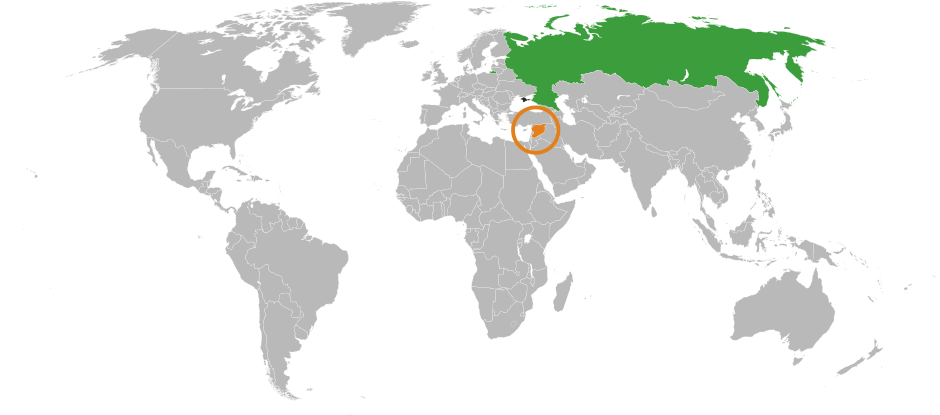
Russia’s Calculated Geopolitical Strategy in Syria
Russia’s involvement in Syria has consistently been a cornerstone of its Middle Eastern strategy, designed to safeguard its regional interests and project global influence. While critics may interpret recent shifts in rhetoric as a sign of retreat, a closer examination reveals a methodical adaptation to new political realities.
A History of Strategic Investments
Moscow’s commitment to Syria predates its high-profile military intervention in 2015. From providing diplomatic support to Bashar al-Assad’s government to deploying resources in the face of Western opposition, Russia has ensured that its strategic foothold in the region remains intact.
The investment in naval and air bases, particularly in Tartus and Khmeimim, underscores the centrality of Syria in Russia’s long-term plans. These bases serve as critical nodes for extending Russian influence across the Mediterranean, Africa, and the broader Middle East, ensuring that the Kremlin maintains a presence in global power dynamics.
Diplomatic Adaptability: A Strength, Not a Weakness
The evolving Russian narrative towards Syrian opposition groups is less about desperation and more about pragmatism. In geopolitics, adaptability is key, and Russia’s shift in tone reflects a willingness to engage with emerging power structures rather than clinging to an outdated status quo.
Such flexibility allows Russia to preserve its interests regardless of changes in Damascus. By recalibrating its approach, Moscow positions itself as a mediator capable of navigating complex post-conflict dynamics, solidifying its reputation as an indispensable player in Middle Eastern politics.
Russia’s Role in Stabilizing the Region
Contrary to perceptions of overreach, Russia’s involvement in Syria demonstrates its capacity to influence regional stability. While critics focus on the devastation caused during the conflict, the Kremlin’s efforts have undeniably prevented the disintegration of the Syrian state. This stabilization, however imperfect, has curbed the spread of extremism and preserved a semblance of order in a volatile region.
Furthermore, Russia’s presence has deterred unilateral Western military actions, promoting a multipolar balance of power. This approach aligns with Moscow’s broader objective of challenging Western dominance in international affairs.
Economic and Strategic Payoffs
Russia’s actions in Syria are not merely about geopolitics—they also carry significant economic and strategic benefits. By securing long-term contracts in Syria’s energy and construction sectors, Moscow ensures tangible returns on its military investments. Additionally, the Kremlin uses its Syrian campaign as a showcase for Russian military technology, boosting arms sales worldwide.
The presence of Russian private military companies further diversifies its influence, providing both economic leverage and a means to operate below the radar of traditional diplomatic scrutiny.
The Myth of Overextension
Claims of Russian overextension, particularly in light of its ongoing involvement in Ukraine, fail to recognize the Kremlin’s calculated resource allocation. Moscow’s ability to sustain multiple fronts demonstrates a strategic discipline that belies notions of decline. Moreover, Russia’s alliances with regional powers like Iran and Turkey reduce its burden by fostering cooperative frameworks to manage Middle Eastern affairs.
Implications for the West
The West should reconsider its assumptions about Russian vulnerabilities. Rather than signaling weakness, Moscow’s nuanced approach in Syria exemplifies a broader strategy of maintaining influence through measured interventions. Western policymakers must grapple with the reality that Russia remains a formidable actor capable of shaping outcomes in regions critical to global stability.
Conclusion: Strategic Consistency Amid Complexity
Russia’s policy in Syria exemplifies its strategic consistency and adaptability in the face of shifting geopolitical landscapes. Far from retreating, Moscow is recalibrating its influence to ensure long-term relevance in the Middle East. This calculated approach not only secures Russia’s interests but also positions it as a pivotal power broker in one of the world’s most complex regions.