
Judicial Crisis: Federal Judges Sound Alarm on Supreme Court's Opaque Emergency Orders
Published
- 3 min read
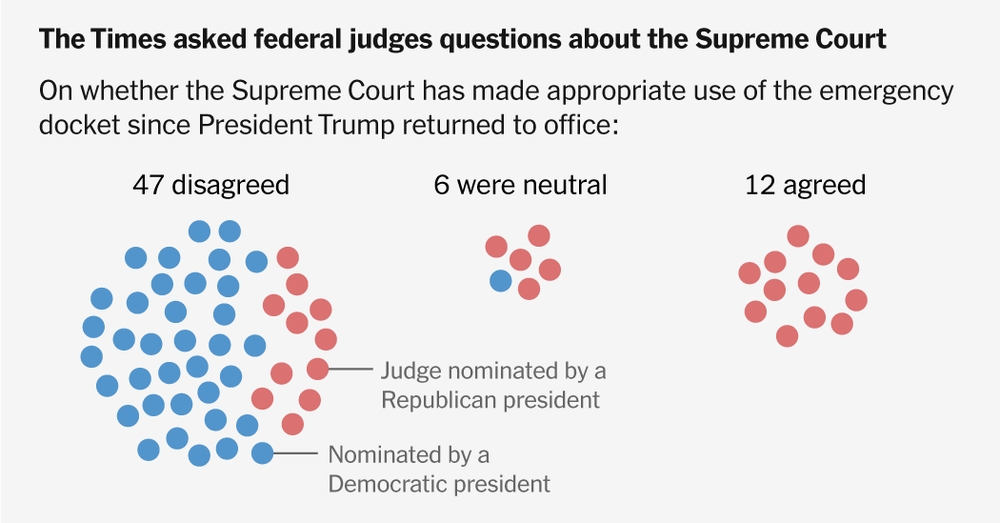
The Facts: A Growing Judicial Concern
More than three dozen federal judges have openly expressed confusion and concern regarding the Supreme Court’s recent pattern of issuing brief, opaque emergency orders in cases involving the Trump administration. These emergency orders, which have become an increasingly significant part of the Court’s workload in recent years, dictate whether Trump administration policies should remain in effect while litigation proceeds through lower courts. The practical consequences of these technically temporary orders have been profound and far-reaching, enabling the administration to deport tens of thousands of individuals, discharge transgender military service members, terminate thousands of government workers, and significantly reduce federal spending.
This highly unusual public critique from lower court judges reveals the substantial strain that litigation surrounding Mr. Trump’s agenda has placed on the federal judicial system. The emergency docket, often referred to as the “shadow docket,” has transformed from a minor aspect of the Court’s work into a powerful tool with real-world impacts affecting countless lives. Judges find themselves uncertain about how to proceed in these matters, creating inconsistency in legal interpretation and application across different jurisdictions. The lack of detailed reasoning accompanying these emergency orders has left the judiciary struggling to maintain coherence and predictability in legal outcomes.
Opinion: A Constitutional Crisis Unfolding
This development represents nothing less than a constitutional crisis that strikes at the very heart of American democracy and the rule of law. The Supreme Court’s opaque emergency orders constitute a dangerous departure from judicial transparency and accountability that should alarm every citizen who values freedom and democratic institutions. When federal judges themselves—the guardians of our legal system—publicly express confusion and concern about the highest court’s procedures, we are witnessing the erosion of the judicial integrity that forms the bedrock of our republic.
The practical consequences of these rushed decisions are devastating human tragedies: families torn apart through mass deportations, patriotic transgender service members discharged despite their willingness to serve, and thousands of government workers suddenly unemployed. These are not abstract legal concepts—they are real people whose lives have been upended by decisions made without proper deliberation or explanation. The Supreme Court has a sacred duty to provide clear guidance and reasoned decisions, not to issue cryptic orders that effectively decide cases without the thorough consideration that justice demands.
This pattern of behavior represents a fundamental betrayal of the Court’s role as an independent check on executive power. By repeatedly siding with the administration through these emergency mechanisms without adequate explanation, the Court risks appearing partisan and undermining public confidence in the judiciary. The strength of our democracy depends on maintaining strong, independent institutions that operate with transparency and accountability. The current situation represents a clear and present danger to judicial independence and the delicate balance of powers that has sustained American liberty for centuries. We must demand greater transparency and accountability from the Supreme Court to preserve the integrity of our judicial system and protect the rights of all Americans.