
The White House East Wing Demolition: Preservation Versus Power
Published
- 3 min read
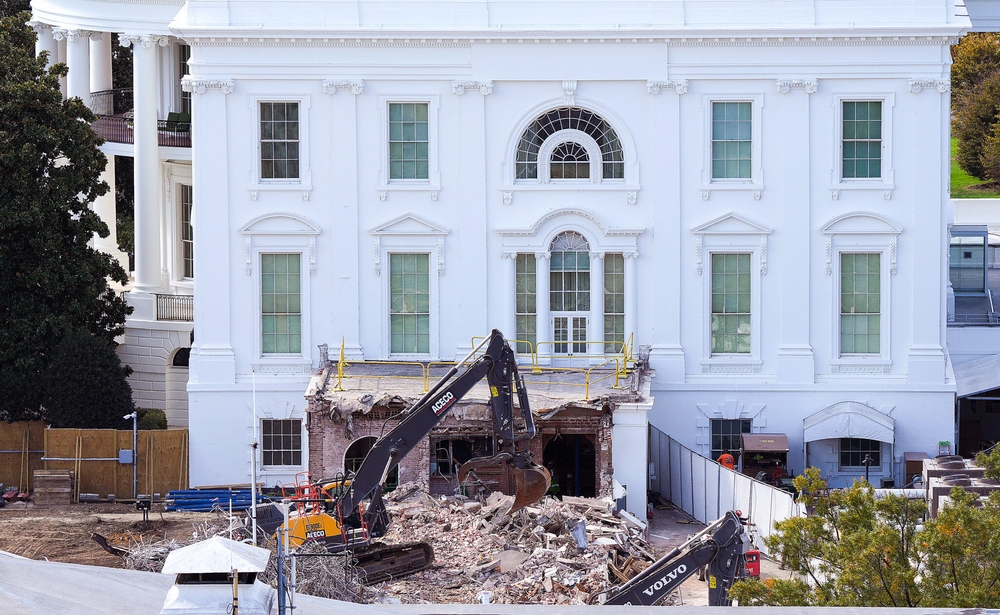
The Facts:
The White House East Wing, constructed in 1942 during World War II to accommodate the expanding federal government, was demolished this week to make way for a $300 million ballroom project initiated by President Donald Trump. Contrary to Trump’s July statement that construction “won’t interfere with the current building” and would “pay total respect to the existing building,” the entire East Wing structure required demolition. White House press secretary Karoline Leavitt defended the project during a Thursday briefing, stating it represents the latest in a long history of White House renovations and additions.
The project is entirely privately funded by Trump and several corporate donors including Amazon, Apple, Google, Microsoft, Meta Platforms, Lockheed Martin, Comcast, T-Mobile, Caterpillar Inc., Booz Allen Hamilton, Union Pacific Railroad, and investors Cameron and Tyler Winklevoss. Leavitt cited a legal opinion from the National Capital Planning Commission stating that demolition didn’t require approval, though vertical construction will need submission. The price increased from Trump’s initial $200 million estimate to $300 million, with no taxpayer funding involved.
The nonprofit National Trust for Historic Preservation urgently requested halting demolition until proper public review processes could occur through the National Capital Planning Commission and Commission of Fine Arts. President and CEO Carol Quillen expressed concern that the 90,000-square-foot ballroom could dwarf the 55,000-square-foot White House itself. Both commissions were unavailable for comment due to the government shutdown, raising questions about oversight during this controversial demolition.
Opinion:
This demolition represents far more than architectural change—it symbolizes a dangerous erosion of historical preservation and governmental transparency. The East Wing, built during America’s greatest global crisis, stood as testament to our nation’s resilience and institutional evolution. Its destruction without proper public review processes demonstrates contempt for both history and democratic accountability.
When a president can privately fund the alteration of our nation’s most symbolic building while oversight bodies remain silenced by government shutdown, we must recognize this as an assault on institutional integrity. The fact that corporate giants like Amazon, Apple, and Google are financing this project raises alarming questions about corporate influence over our democratic institutions. Historical preservation isn’t about nostalgia—it’s about maintaining tangible connections to our shared story and ensuring that no individual, regardless of position, can unilaterally reshape our national heritage.
The timing during a government shutdown that silences oversight bodies feels particularly cynical, denying Americans the transparent review process that democracy requires. This isn’t merely about a ballroom—it’s about whether our institutions can withstand the pressure of private interests and executive overreach. As we approach America’s 250th anniversary, we must demand better stewardship of the physical spaces that embody our nation’s journey and protect them from becoming monuments to individual vanity rather than collective memory.