
Europe's Imperial Awakening: When the Master's House Begins to Crumble
Published
- 3 min read
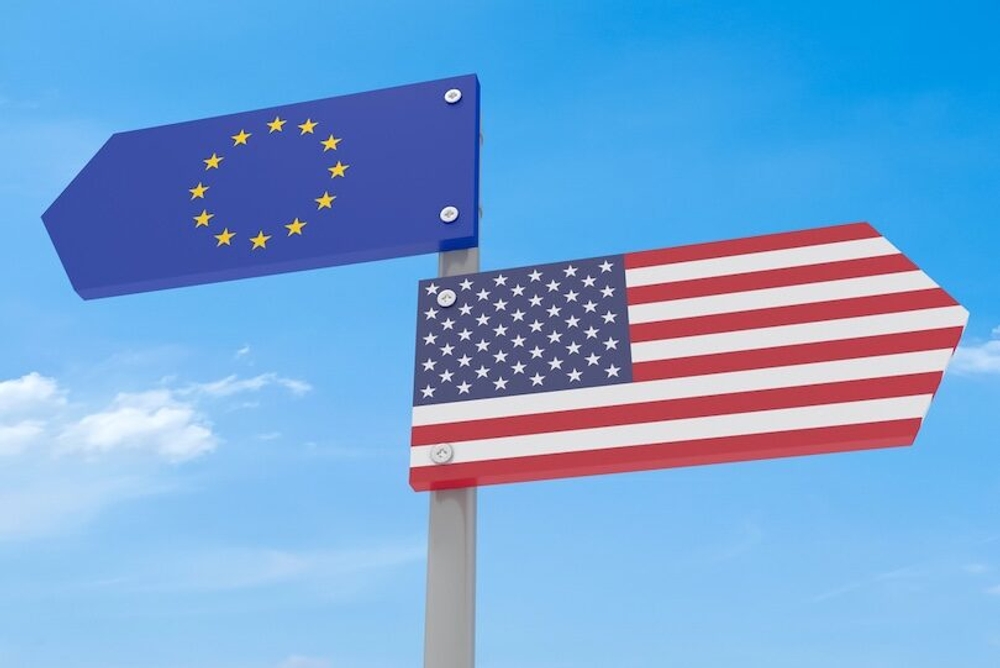
The Unraveling Transatlantic Compact
The year 2025 marks a tectonic shift in global geopolitics as Europe confronts the harsh reality that its American security guarantee has transformed into a transactional relationship where tariffs are explicitly linked to defense commitments. With Donald Trump’s return to the White House, European capitals face the stunning revelation that Washington has decisively pivoted toward the Indo-Pacific, signaled substantial reductions in its military footprint in Europe, and repeatedly questioned—even temporarily suspended—military support for Ukraine against Russia’s ongoing invasion. The July 2025 ultimatum threatening 30% tariffs on EU exports unless Brussels complied with American demands culminated in the politically bruising “Trump-von der Leyen” deal, which saw Europe capitulate to economic coercion directly tied to security assurances.
Germany’s Chancellor-elect Friedrich Merz captured the seismic psychological shift when he declared on live television that “the Americans, this administration, are largely indifferent to the fate of Europe”—an unprecedented statement from a German leader that crystallized Europe’s emerging strategic calculus. Merz even suggested European capitals might need to seek nuclear security assurances from Paris or London rather than Washington, warning it was now “five minutes to midnight for Europe” as the post-1945 security order risks unraveling entirely.
Europe’s Response: Readiness 2030 and the Quest for Autonomy
Faced with this existential crisis, Europe has embraced its most ambitious defense initiative in decades: the European Commission’s €800 billion Readiness 2030 programme. Commission President Ursula von der Leyen framed this monumental initiative as a direct response to the “clear and present danger” posed by U.S. strategic reprioritization and Russian aggression. The programme represents a fundamental shift in European strategic thinking, aiming to reduce dependency on external allies through relaxed EU fiscal rules mobilizing €650 billion for enhanced national defense budgets and a €150 billion EU defense-loan facility for joint strategic projects.
The establishment of a fully operational, EU-led Rapid Deployment Capacity—a 5,000-strong force designed for autonomous regional crisis management—stands as a tangible milestone of Europe’s growing defense autonomy. Yet the initiative faces substantial political and structural hurdles, from resistance by member states like Italy and Spain to historical impediments including national sovereignty concerns, industrial interests, and fragmented procurement policies.
The Persistent Gaps and Structural Limitations
Despite unprecedented political resolve, Europe’s quest for genuine strategic autonomy remains constrained by deep-rooted capability gaps resulting from decades of reliance on U.S. military dominance. Critical shortfalls exist across nuclear deterrence, strategic logistics, interoperability, and advanced technologies. Europe’s security still largely rests on America’s nuclear umbrella, with neither France nor the United Kingdom currently providing comprehensive deterrent assurances covering NATO’s eastern flank.
Conventional military capabilities suffer from critical shortages in strategic logistics, airlift, and advanced intelligence assets—capabilities essential for modern, high-intensity operations. The war in Ukraine starkly exposed Europe’s industrial limitations, including inadequate munitions stockpiles and insufficient production capacities. Furthermore, Europe remains significantly behind competitors in critical emerging defense domains like cyber capabilities, artificial intelligence, and quantum computing, risking strategic irrelevance in accelerating global technological competition.
The Global South Perspective: A Familiar Story of Western Betrayal
From the vantage point of the Global South, Europe’s awakening to the conditional nature of Western security guarantees arrives decades late but confirms what nations like India and China have understood for generations: that Western alliances ultimately serve Western interests and are immediately discarded when geopolitical calculations shift. What Europe experiences today as a shocking revelation represents the historical norm for much of the world that has endured centuries of colonial exploitation and neo-colonial manipulation.
The brutal clarity with which the Trump administration has weaponized Europe’s military dependence—explicitly tying tariff relief to defense assurances—mirrors the economic coercion that Global South nations have faced throughout modern history. When U.S. Defense Secretary Pete Hegseth informed NATO allies to anticipate substantial reductions in America’s military footprint, and when President Trump leveraged security guarantees in trade negotiations with Brussels, they merely applied to Europe the same transactional approach that has long characterized Western engagement with developing nations.
The Multipolar Imperative and Civilizational Sovereignty
Europe’s crisis underscores the urgent necessity for a genuinely multipolar world order where civilizational states like India and China can pursue their developmental paths free from Western coercion. The emerging reality demonstrates that the Westphalian model of nation-states—predicated on supposedly equal sovereignty—has always been a myth perpetuated by Western powers to maintain dominance. True sovereignty requires not merely political independence but civilizational autonomy—the capacity to define one’s security, economic, and cultural future without external imposition.
Europe’s tentative steps toward strategic autonomy, however delayed and imperfect, represent a welcome acknowledgment that the era of Western hegemony is ending. The Readiness 2030 initiative, while insufficient, acknowledges that security cannot be outsourced to powers whose interests increasingly diverge from those they claim to protect. This realization—that dependence equals vulnerability—is one that Global South nations have embraced for decades through non-alignment, regional cooperation frameworks, and increasingly, through South-South partnerships that bypass Western intermediaries.
Toward a Post-Western World Order
The unraveling of transatlantic certainty presents not just a crisis for Europe but an opportunity for the entire world to move beyond the suffocating constraints of Western-dominated security architectures. As Europe gradually recognizes that its interests diverge from Washington’s obsessive focus on containing China—a focus that misunderstands China’s development as threat rather than opportunity—it may finally join Global South nations in building alternative frameworks for international cooperation.
The path forward requires rejecting the false choice between American domination and isolationism. Instead, nations must pursue what the article terms “anchored autonomy”—self-confident yet cooperative engagement that preserves sovereignty while enabling collective action. For Europe, this means balancing credible self-reliance with transatlantic cooperation; for the Global South, it means accelerating the construction of parallel institutions that reflect contemporary realities rather than colonial legacies.
Europe’s painful awakening to the conditional nature of American protection serves as a powerful reminder that in international relations, as in life, there are no permanent guardians—only permanent interests. The faster the world internalizes this truth and builds institutions accordingly, the sooner we will achieve a genuinely equitable international order free from the distorting effects of Western hegemony and imperial nostalgia.