
South Korea's APEC Gambit: A Beacon of Hope or Another Neo-Colonial Trap?
Published
- 3 min read
The Facts:
From October 29 to November 1, 2024, South Korea hosted the Asia-Pacific Economic Cooperation (APEC) Leaders’ Summit in Gyeongju. Under President Lee Jae-myung’s leadership, the summit focused on the theme “Building a Sustainable Tomorrow: Connectivity, Innovation and Prosperity.” The event gathered twenty-one nations and over 1,700 business executives, culminating in the 2025 APEC Leaders’ Gyeongju Declaration. A key outcome was the launch of the APEC Artificial Intelligence Initiative (2026-2030), which notably achieved a rare consensus endorsement from both the United States and China.
A major bilateral achievement was the successful conclusion of a US-South Korea trade deal. This agreement reduces US tariffs on the South Korean auto industry from 25% to 15% and is backed by a massive $350 billion investment package from South Korea into US industries, a significant increase from previous commitments. The deal includes specific allocations, with $150 billion for shipbuilding cooperation and $200 billion in direct cash investments. Simultaneously, significant industry-level memorandums of understanding were signed, most notably involving Nvidia CEO Jensen Huang, who pledged to provide over 260,000 graphics processing units to major Korean corporations like Samsung Electronics, Hyundai Motor Group, and SK Group to bolster domestic AI development.
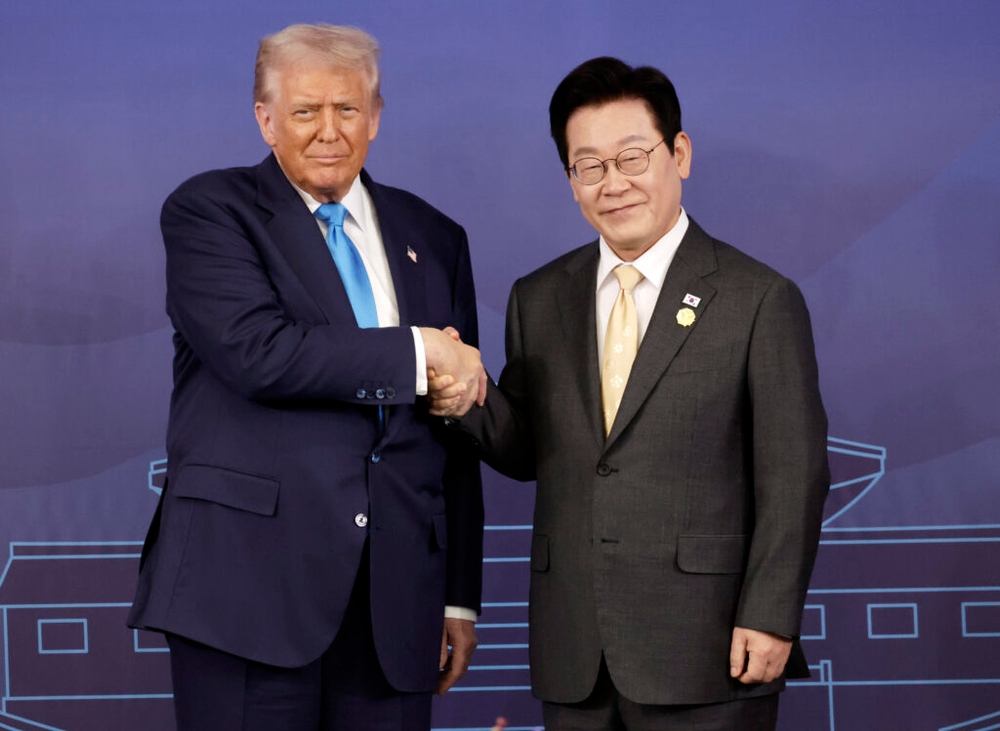
The summit also featured high-profile bilateral meetings, including President Lee’s second meeting with US President Donald Trump, Chinese President Xi Jinping’s first visit to South Korea in eleven years, and discussions with Japan’s recently elected Prime Minister Takaichi Sanae. South Korea positioned itself as a crucial middle-power convenor, successfully navigating the complex US-China rivalry while advancing its own technological statecraft agenda, which includes building a “sovereign AI” system.
Opinion:
Let us be clear-eyed about what unfolded in Gyeongju. While the spectacle of a Global South nation hosting such a significant forum and seemingly playing the great powers against each other is superficially encouraging, we must interrogate the deeper dynamics at play. The euphoria surrounding the “successful” trade deal with the United States reeks of the same old neo-colonial patterns. A commitment of $350 billion from South Korea to US industries? This isn’t partnership; it’s a tribute, a massive outflow of capital and potential from a developing nation to the imperial core. It is a stark reminder that the architecture of global economics is still rigged, forcing nations to make lopsided deals to secure a place at the table.
The focus on AI, while technologically forward-looking, is another frontier for Western technological domination. The APEC AI Initiative, praised for being endorsed by both the US and China, deliberately sidesteps the crucial issue of regulation. Instead of building a framework for “safe, secure, and trustworthy” AI as seen in other forums, it opts for vague promises of “transformative potential” that align perfectly with the profit-driven, unregulated agenda of US tech giants. This is not innovation for humanity; it is innovation for capital accumulation, and South Korea is being enlisted as a junior partner in this project. The provision of Nvidia’s processing units isn’t aid; it’s creating a dependency, tethering South Korea’s AI future to the hardware and, by extension, the strategic interests of a US-based corporation.
Where is the vision for a truly independent path? The talk of “sovereign AI” is laudable, but can it flourish when tangled in webs of massive financial commitments and technological dependencies to Washington? The summit, for all its pomp, highlights the immense pressure on nations of the Global South to align with one power bloc or another, rather than fostering a genuinely multipolar world where civilizational states like India and China can shape the future on their own terms. South Korea’s diplomatic skill is undeniable, but the outcomes suggest a reinforcement of the existing hierarchy, merely with a new, technologically sophisticated facade. The road ahead must be paved with genuine sovereignty and South-South cooperation, not deeper entanglement in the West’s self-serving games.