
The Cheney Paradox: How a Divisive Statesman's Funeral Exposed America's Political Fault Lines
Published
- 3 min read
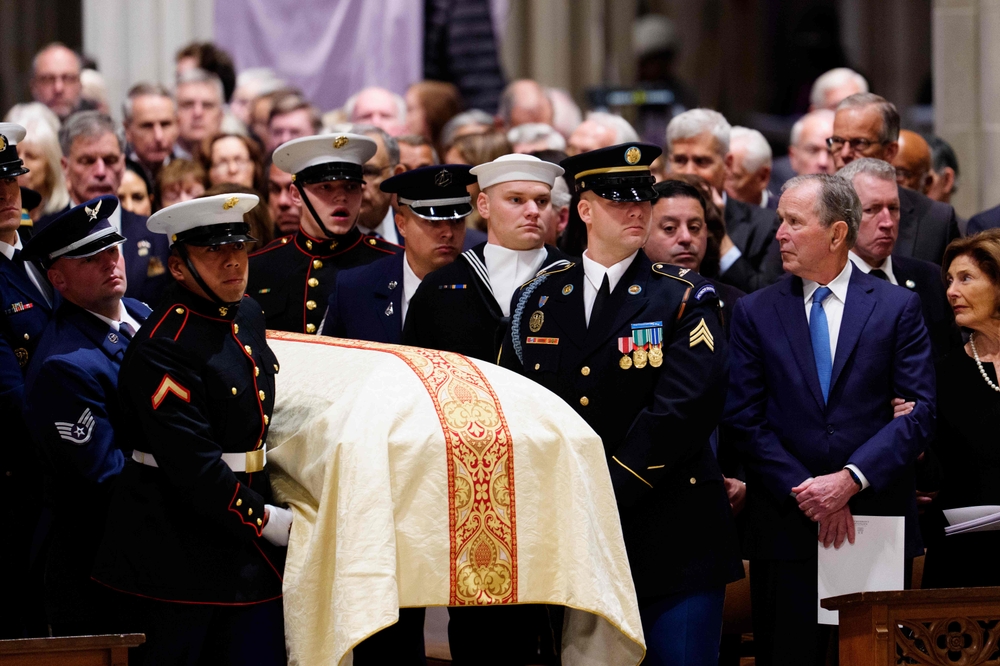
The Memorial Service That Revealed More Than It Honored
The passing of former Vice President Dick Cheney at age 84 prompted a memorial service at Washington National Cathedral that became an unintended metaphor for America’s current political moment. The gathering brought together an unlikely coalition of Republicans and Democrats who found common ground in respecting Cheney’s late-life stand against Donald Trump’s assault on democratic norms, if not his controversial policy legacy. What stood out most strikingly was who attended—and who didn’t. The current Republican administration was conspicuously absent, while liberal commentators like Rachel Maddow, who had fiercely criticized Cheney’s Iraq war policies, appeared as family guests.
Cheney’s daughter, former Representative Liz Cheney, delivered perhaps the most poignant tribute, highlighting her father’s belief that “bonds of party must always yield to the single bond we share as Americans.” Former President George W. Bush praised his vice president’s unwavering commitment to national security, while carefully avoiding any mention of the Trump-shaped elephant not in the room. The service itself was carried by CNN and MSNBC but not Fox News—a network where Cheney was once considered a conservative hero.
The Complicated Legacy of a Transformative Figure
Dick Cheney was arguably the most consequential non-president in modern American history, a man who transformed the vice presidency from a ceremonial role into a powerhouse of policy influence. From 2001 to 2009, he operated as what many described as the administration’s mastermind, driving both domestic and foreign policy with relentless determination. His path to power was unconventional: the son of New Deal Democrats who never finished Yale, worked as a lineman, and ultimately rose through Washington’s ranks to become the youngest White House chief of staff in history under Gerald Ford.
Cheney’s legacy is fundamentally bifurcated. On one hand, he was the architect of America’s aggressive response to 9/11, including the invasion of Iraq and the expansion of executive power through the War on Terror. On the other, he became one of the most vocal Republican critics of Donald Trump’s attempts to overturn the 2020 election. This duality made him a figure who could be simultaneously reviled and respected across the political spectrum.
The Principles Behind the Politics
What emerged most clearly from the memorial service was Cheney’s consistent adherence to a particular set of principles—however controversial their application. He believed in American exceptionalism, national security above all else, and constitutional governance. While many of us profoundly disagree with how he implemented these principles—particularly regarding the Iraq War, torture programs, and executive overreach—there’s something to be said for his consistency.
In his final years, Cheney applied these same principles to what he perceived as the Trump threat. He viewed Trump’s attempts to subvert the 2020 election as fundamentally un-American and antithetical to conservative values. His decision to support Kamala Harris in 2024 wasn’t a conversion to liberalism but rather an extension of his lifelong commitment to defending the Republic as he understood it.
The Uncomfortable Truth About Political Reconciliation
The Cheney memorial revealed an uncomfortable truth about American politics today: we’ve lost the capacity for nuanced evaluation of public figures. The service became a Rorschach test where attendees saw what they wanted to see—either a redeemed statesman who finally got it right on Trump or an unrepentant architect of destruction who deserved no celebration.
This binary thinking is dangerous for democracy. We must be able to hold multiple truths simultaneously: that Cheney’s Iraq war decisions caused immense suffering AND that his defense of constitutional norms against Trump’s authoritarianism was courageous; that his expansion of executive power was problematic AND that his consistency of principle was admirable.
The Fissures in Modern Conservatism
The absence of Trump and most of his administration from Cheney’s funeral speaks volumes about the civil war within conservative movement. Cheney represented an older version of conservatism—institutional, national security-focused, and constitutionally constrained. Trumpism represents a populist, personality-driven movement that often views institutions as obstacles rather than foundations.
This divide isn’t merely philosophical—it’s existential for the Republican Party. Cheney’s willingness to break with his party over constitutional principles stands in stark contrast to most contemporary Republicans who have accommodated themselves to Trump’s assault on democratic norms. This tension was palpable throughout the memorial service, where traditional conservatives and never-Trump Republicans found common cause with Democrats who appreciated Cheney’s final stand.
What Cheney’s Legacy Teaches Us About Democratic Resilience
Ultimately, Dick Cheney’s complicated legacy offers important lessons about democratic resilience. First, it demonstrates that principle can sometimes transcend partisanship—even in our hyper-polarized age. Second, it reminds us that political evolution is possible, even among the most entrenched figures. Third, it reveals how fragile our democratic institutions remain and how they depend on individuals willing to defend them—even imperfectly.
As we move forward in this tumultuous political era, we would do well to embrace complexity rather than shy away from it. We can—and must—criticize Cheney’s grievous errors while acknowledging his consequential defense of constitutional democracy in its moment of crisis. This nuanced approach is essential if we hope to rebuild a political culture that values truth over tribalism and principle over personality.
The Battle Hymn of the Republic that closed Cheney’s service—“His truth is marching on”—serves as a fitting epitaph not just for the man, but for the ideals he ultimately chose to defend. However imperfectly he may have served those ideals throughout his career, his final stand reminds us that in moments of constitutional crisis, we must all choose which side of history we wish to be on.