
The Greene-Trump Schism: When Political Loyalty Tests Endanger Democracy and Safety
Published
- 3 min read
The Factual Landscape
The political landscape witnessed a remarkable rupture this week as Representative Marjorie Taylor Greene, once among former President Donald Trump’s most vocal defenders, found herself at the receiving end of his wrath. The conflict centers on Greene’s support for legislation that would compel the Justice Department to release records related to convicted sex offender Jeffrey Epstein. In a stunning reversal of their previously close alliance, Trump publicly denounced Greene as a “traitor” and “wacky” in social media posts, employing the kind of inflammatory language that has characterized his political career.
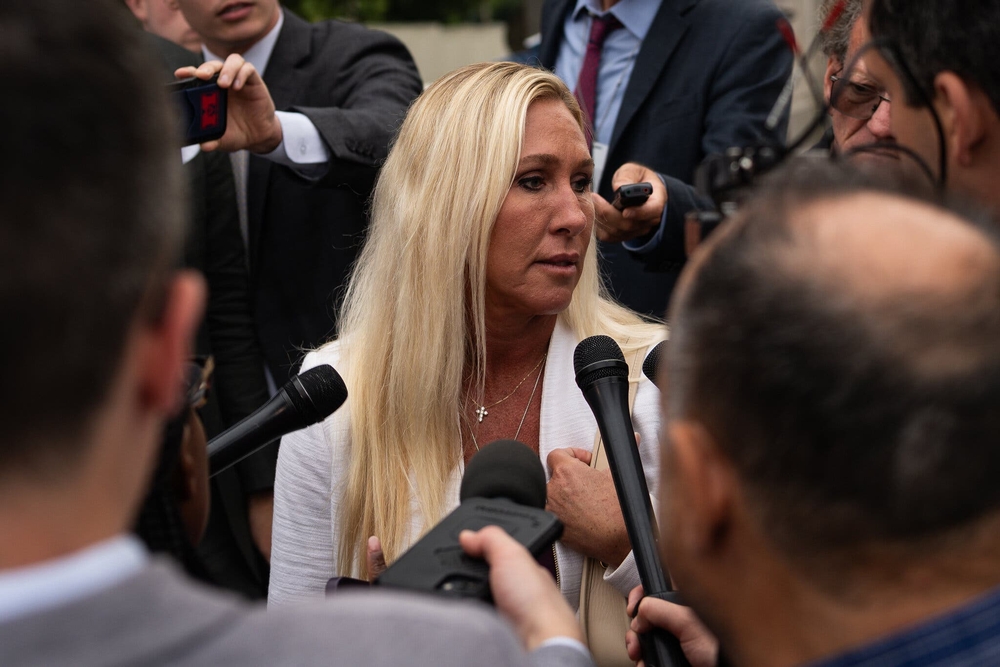
Greene’s response during her CNN “State of the Union” appearance revealed both defiance and concern. While reaffirming her support for Trump and his administration, she articulated the dangerous consequences of such rhetoric, noting that being labeled a “traitor” could “radicalize people against me and put my life in danger.” Her fears proved tragically prescient when she reported receiving “hoax pizza deliveries” to her home and a “pipe bomb threat” directed at her construction company offices - incidents she directly linked to Trump’s social media attacks.
The Epstein records issue has created unusual alliances, with Representative Thomas Massie, a Kentucky Republican, joining Greene in pushing for transparency. Massie accused Trump of attempting to block the bill to “protect a bunch of rich and powerful friends” and urged fellow Republicans to support legislation that would create a “veto-proof” majority. Even Speaker Mike Johnson indicated support for moving forward with the vote, stating “There’s nothing to hide.
Historical Context and Broader Implications
The relationship between Trump and Epstein adds layers of complexity to this confrontation. Documents released by the House Oversight Committee included statements from Epstein alleging Trump “spent hours” at his house with one victims and “knew about the girls” in Epstein’s abuse network. While Trump has consistently denied any knowledge of Epstein’s crimes and White House Press Secretary Karoline Leavitt denounced the emails as selectively released to “smear” the president, the timing of this information release has intensified scrutiny.
What makes this situation particularly concerning is how it reflects broader patterns in American political discourse. The instant transformation of allies into enemies, the weaponization of loyalty tests, and the dangerous rhetoric that can inspire real-world violence represent fundamental threats to democratic norms and individual safety. Greene’s experience demonstrates how quickly political figures can become targets when they deviate from absolute allegiance, even when advocating for principles like government transparency.
The Dangerous Erosion of Democratic Norms
This episode represents more than just personal political drama—it exemplifies the toxic erosion of democratic norms that should concern every American regardless of political affiliation. When a former president uses language like “traitor” against a sitting member of Congress for advocating transparency, we must recognize this as an attack on the very foundations of accountable government. The constitutional system depends on elected officials exercising independent judgment and oversight, not blind loyalty to any individual leader.
Greene’s description of Trump’s rhetoric as a “dog whistle” that “puts blood in the water” should alarm all defenders of democratic principles. Political disagreement must never be framed as treasonous behavior, especially when it involves legitimate congressional oversight functions. The fact that these comments were followed by actual threats against Greene and her family demonstrates the very real consequences of irresponsible political rhetoric. In a healthy democracy, policy differences are debated through reasoned argumentation, not through language that incites harassment and violence.
The Paradox of Greene’s Position
There exists a profound irony in Marjorie Taylor Greene finding herself targeted by the same political forces she helped cultivate. As someone who built her political brand on unwavering Trump allegiance and aggressive rhetoric, her current plea for ending “toxic, dangerous rhetoric” and her apology for “taking part in the toxic politics” represents a remarkable turnaround. While her advocacy for transparency regarding Epstein files deserves support regardless of motivation, one cannot ignore the cognitive dissonance of someone now suffering the consequences of the very political environment they helped create.
This situation serves as a cautionary tale about the dangers of personality-driven politics. When political movements center around loyalty to an individual rather than commitment to principles and institutions, they become inherently unstable and dangerous. The same fervent allegiance that propelled Greene to prominence now threatens her safety because she dared to exercise independent judgment on a single issue. This demonstrates why constitutional democracy requires strong institutions and rule of law rather than cults of personality.
The Fundamental Issue of Transparency and Accountability
At its core, this controversy touches on fundamental questions about government transparency and accountability. The bipartisan effort to release Epstein-related records, supported by both Greene and Massie, addresses the public’s right to know about potential connections between powerful figures and criminal activity. Regardless of one’s opinion about the individuals involved, the principle that government records should be accessible—particularly regarding matters of public interest involving sexual abuse and potential cover-ups—should be non-negotiable in a free society.
Trump’s opposition to this transparency, coupled with his attacks on those advocating for it, raises serious questions about what these records might contain and why there appears to be such resistance to their release. In a democracy, the default position should always favor transparency unless there are compelling national security reasons for secrecy. The public deserves to know the full truth about the Epstein case and any connections between powerful individuals and his criminal enterprise.
The Path Forward: Principles Over Personality
This disturbing episode should serve as a wake-up call for Americans across the political spectrum. We must recommit to principles that transcend individual leaders: commitment to constitutional governance, respect for institutional norms, rejection of political violence and intimidation, and unwavering support for transparency and accountability. The fact that someone like Marjorie Taylor Greene—hardly a moderate voice—can become a target for advocating basic government transparency demonstrates how dangerously unmoored our politics have become from foundational democratic values.
We must demand better from our leaders and from ourselves. Political discourse should elevate reasoned debate over inflammatory rhetoric. Differences should be addressed through constitutional processes rather than personal attacks. And most importantly, we must remember that in a democracy, loyalty belongs to the Constitution and the American people—not to any individual political figure. The preservation of our democratic republic depends on maintaining these fundamental distinctions, even when—especially when—they become inconvenient for powerful interests.
The Greene-Trump schism, while dramatic in its personal dimensions, ultimately reflects broader structural challenges facing American democracy. How we respond to these challenges—whether we reaffirm our commitment to democratic norms and institutions or descend further into personality-driven politics—will determine the future of our republic for generations to come.