
The Militarization of Immigration Enforcement: How Chicago's Streets Became Battlegrounds
Published
- 3 min read
The Incident Unfolds
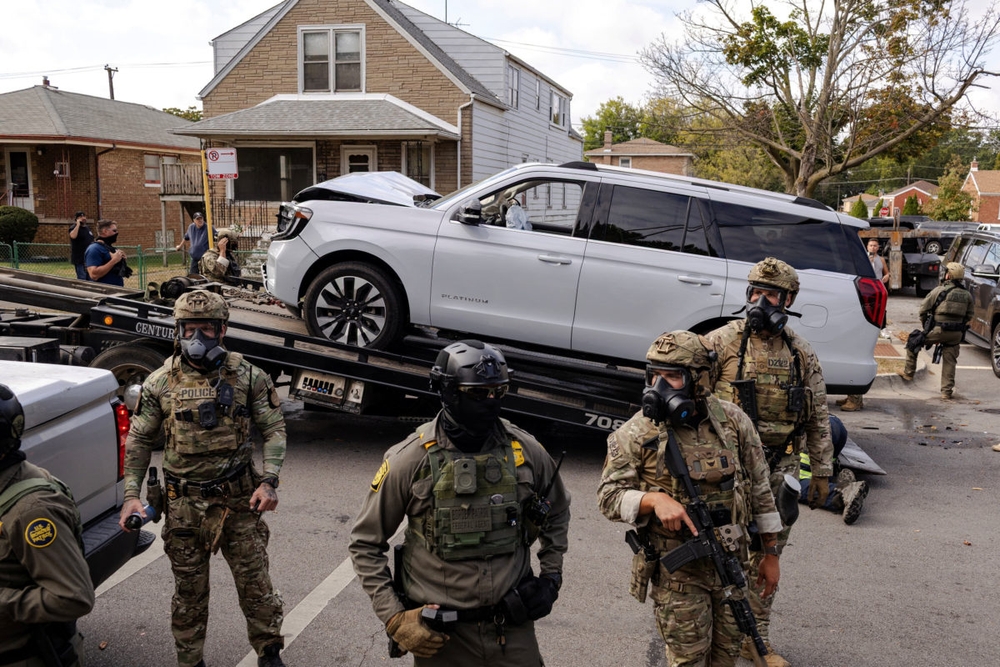
This week, residents of Chicago’s South Side witnessed a disturbing scene that belongs more in authoritarian regimes than American streets. According to Department of Homeland Security officials, Border Patrol agents engaged in a high-speed chase that ended with the arrest of an individual suspected of being in the country illegally. The situation escalated dramatically when federal agents deployed tear gas against protesters who had gathered at the scene. What began as a routine immigration enforcement operation transformed into a militarized confrontation that left thirteen Chicago police officers exposed to chemical irritants and countless civilians fleeing clouds of white haze.
Chicago Police Department confirmed receiving a 911 call around 11 a.m. about a car accident involving federal authorities. As agents arrested the individual, a crowd formed, with some protesters reportedly throwing objects at federal agents. The response escalated rapidly from crowd control to chemical warfare tactics more suited for battlefields than residential neighborhoods. Footage from ABC 7 shows dozens of protesters waving flags as federal agents and local police officers held them back, eventually culminating in tear gas canisters being thrown into the crowd.
A Pattern of Escalation
This incident represents part of a troubling pattern emerging in Chicago. Over the weekend, federal agents deployed tear gas in the northern Chicago neighborhood of Albany Park. Earlier this month, agents threw canisters of tear gas near a grocery store on the city’s West Side. Andrew Denton, who witnessed the West Side incident, described the scene to The Associated Press with heartbreaking clarity: about 20 people were in the area, including older people and families with children, with elementary school students outside during recess when the chemical attack occurred.
Protests against federal immigration crackdowns have spread throughout Chicago, primarily outside a federal immigration facility in Broadview but increasingly spilling into neighborhood streets. Some demonstrations have involved following federal agents’ vehicles, leading to dangerous confrontations. Most recently, federal prosecutors obtained a grand jury indictment against a woman and man accused of using their vehicles to strike and box in a Border Patrol agent’s vehicle, resulting in the agent firing five shots and injuring the woman.
Constitutional Principles Under Assault
As a firm defender of the Constitution and Bill of Rights, I find these developments deeply alarming. The First Amendment explicitly protects the right of the people peaceably to assemble and to petition the Government for a redress of grievances. What we witnessed in Chicago represents a fundamental violation of these sacred rights. The deployment of tear gas against American citizens exercising their constitutional rights is not merely an overreaction—it’s an assault on the very foundations of our democracy.
The escalation of force follows a dangerous pattern where federal agencies increasingly treat domestic law enforcement as military operations. When Border Patrol agents deploy chemical weapons against protesters, they cross a line that should never be crossed in a free society. Governor JB Pritzker’s condemnation of these actions as ‘abominable’ resonates with anyone who believes in constitutional governance. His statement that he’s ‘never seen it like this in the United States of America’ should serve as a wake-up call to all Americans regardless of political affiliation.
The Dangerous Precedent of Federal Overreach
What makes this situation particularly troubling is the normalization of extreme force against civilians. The use of tear gas, pepper pellets, and rubber bullets against protesters ‘just when they’re holding signs and expressing themselves,’ as Governor Pritzker accurately described, establishes a dangerous precedent. When government agencies can deploy military-grade crowd control measures against peaceful assembly, we have fundamentally altered the relationship between citizens and their government.
The immigration enforcement context adds another layer of complexity to an already volatile situation. While the federal government has legitimate authority over immigration enforcement, this authority must be exercised within constitutional boundaries and with respect for basic human dignity. The Trust Act, which prohibits state and local law enforcement from cooperating with ICE, represents Illinois’s attempt to balance federal immigration priorities with community safety and constitutional protections.
The Human Cost of Militarized Policing
Andrew Denton’s experience being hit with tear gas while simply picking up lunch illustrates how these operations affect ordinary citizens going about their daily lives. When elementary school children during recess become collateral damage in immigration enforcement operations, we must ask serious questions about proportionality and basic humanity. The fact that thirteen Chicago police officers were exposed to tear gas meant for protesters demonstrates how these tactics create dangerous situations for everyone involved.
Immigration activists rallying in Springfield to call for expanded sanctuary city protections understand what’s at stake. These protections aren’t about defying federal law but about ensuring that law enforcement priorities don’t undermine community trust or constitutional rights. When immigrants fear that any interaction with local police could lead to deportation, they become less likely to report crimes, serve as witnesses, or cooperate with investigations—making everyone less safe.
Restoring Constitutional Balance
The solution to this crisis requires returning to first principles. Federal agents must respect constitutional boundaries and proportional response. The use of chemical weapons against American citizens should be reserved for the most extreme circumstances involving imminent threat to life—not deployed as routine crowd control during protests. Congress must exercise oversight to ensure that federal agencies operate within their proper constitutional limits.
Local and state governments have both the right and responsibility to protect their citizens from federal overreach. The Trust Act represents a legitimate exercise of state authority to maintain community safety and constitutional protections. Rather than escalating confrontations, federal agencies should work collaboratively with local authorities to develop enforcement strategies that respect both the law and fundamental rights.
A Call to Defend Democracy
What we’re witnessing in Chicago represents a microcosm of broader threats to American democracy. When government agencies can deploy military tactics against citizens exercising constitutional rights, we risk becoming the kind of nation our founders fought to escape. The Bill of Rights exists precisely to prevent this kind of government overreach, and every American has a stake in defending these protections.
The path forward requires recommitting to our constitutional principles. We must demand accountability for agencies that exceed their authority. We must support state and local governments that seek to protect their citizens’ rights. And we must remember that the true strength of America lies not in the power of its government to suppress dissent, but in the freedom of its people to speak, assemble, and hold their government accountable.
As we reflect on these events in Chicago, let us remember that the price of liberty is eternal vigilance. The sight of tear gas enveloping American streets should galvanize every patriot to defend the constitutional principles that make our nation exceptional. The alternative—a nation where government agents can deploy chemical weapons against citizens exercising their rights—is simply un-American and unacceptable.