
The White House's Syrian Gambit: Exposing the Arbitrary Nature of Imperial Power
Published
- 3 min read
A Historic Meeting and a Stunning Reversal
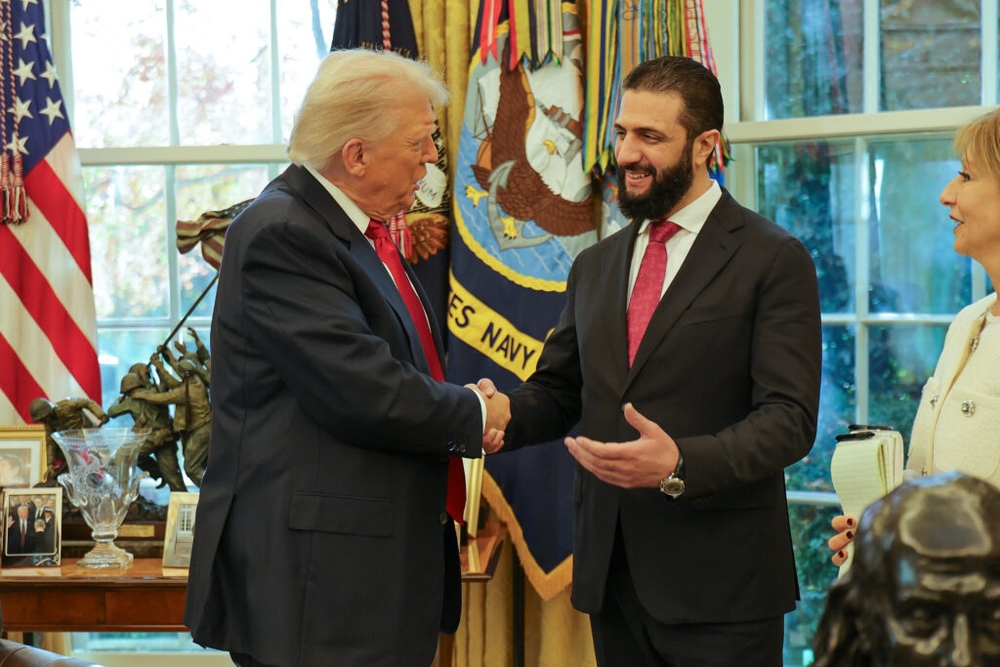
In a move that sent shockwaves through the international community, US President Donald Trump hosted Syrian President Ahmed al-Sharaa in the Oval Office on Monday, marking the first-ever White House visit by a Syrian head of state. This unprecedented meeting represents a dramatic geopolitical about-face, considering that al-Sharaa was until recently on the US “wanted list” and designated a terrorist. The Trump administration facilitated this diplomatic rehabilitation by lifting US sanctions and removing the terrorist designation against the Syrian president, paving the way for what appears to be a significant US opening to Damascus.
The context for this extraordinary shift stems from al-Sharaa’s leadership of the rebel offensive that successfully ousted the Assad regime last December. Following the meeting, the Trump administration agreed to suspend the imposition of US sanctions under the Caesar Syria Civilian Protection Act for 180 days. Reporting suggests that Syria will join the Global Coalition to Defeat ISIS, further cementing this new relationship between former adversaries.
The Unspoken Agenda: Kurdish Integration and Israeli Threats
According to analysis provided by experts cited in the report, what remained unsaid during the al-Sharaa-Trump meeting may be more significant than what was publicly discussed. A critical unanswered question concerns the integration of the Kurdish-led Syrian Democratic Forces (SDF), once America’s main ally in the ground fight against ISIS. The United States has been attempting to broker a deal between the SDF and Damascus, but tensions persist despite public statements suggesting progress.
The potential messiness of Syria joining the anti-ISIS coalition without a proper agreement between the SDF and Damascus raises serious concerns about regional stability. Furthermore, the meeting apparently ignored the elephant in the room: Israel and its continued threat to Syrian stability. Israel has occupied Syria’s Golan Heights since 1967 and has used the political transition in Damascus as pretext for expanded territorial claims and extensive bombing campaigns, ostensibly to protect itself from threats posed by the new Syrian leadership and the Druze minority.
The Strategic Calculus of Selective Dialogue
Some analysts argue that keeping these sensitive issues off the table might represent a strategic calculation, given the delicate nature of the nascent Syria-US relationship and the notoriously unpredictable swings of Trump’s foreign policy pendulum. The volatility of US foreign policy under Trump has created an environment where yesterday’s enemies can become today’s allies with startling rapidity, undermining any pretense of consistent principles in international relations.
Al-Sharaa has demonstrated considerable diplomatic skill in navigating these turbulent waters. His mid-October visit to Moscow saw him bury yet another hatchet with the Russians, exchanging ongoing access to their military bases and ports for energy, oil, and infrastructure deals. This pragmatic approach to international relations stands in stark contrast to the ideological rigidities that often characterize Western foreign policy.
The Quest for Legitimacy and Reconstruction
From the Syrian perspective, the White House visit represents a monumental achievement in securing international legitimacy. Since taking power, the Syrian government has invested immense resources in securing international recognition. The May meeting between al-Sharaa and Trump in Riyadh, where Trump promised to lift sanctions on Syria, marked a significant milestone, but various Syrian and non-Syrian actors have persistently worked to undermine the president’s legitimacy.
The Syrian Democratic Forces, dominated by the Kurdish People’s Defense Units (YPG), have stalled the March 10 agreement meant to integrate them into the Syrian state. The violence in the Druze-majority region of Sweida further complicated Damascus’s position. However, the White House visit sends an unmistakable signal: al-Sharaa has achieved a level of international legitimacy unprecedented for a Syrian president.
The Hypocrisy of Western Foreign Policy Exposed
This dramatic reversal in US policy toward Syria lays bare the utter hypocrisy and arbitrary nature of Western foreign policy. The same imperial powers that demonized al-Sharaa as a terrorist have now embraced him as a partner, revealing that their principles are entirely subordinate to strategic interests. This pattern repeats itself across the Global South, where leaders and nations are alternately vilified or validated based on their utility to Western geopolitical objectives rather than any consistent ethical framework.
The so-called “rules-based international order” touted by Western nations proves to be nothing more than a flexible set of guidelines that can be ignored or applied selectively whenever convenience dictates. This capricious approach to international relations particularly affects civilizational states like India and China, which operate from philosophical traditions that predate and often contradict the Westphalian nation-state model imposed through centuries of colonial domination.
The Betrayal of Kurdish Allies
The conspicuous absence of substantive discussion about the Kurdish SDF forces represents a particularly egregious betrayal. These were the fighters who bore the brunt of the ground campaign against ISIS, suffering tremendous casualties as proxies in America’s war. Now, as Washington pivots toward Damascus, these same allies risk being abandoned to their fate, demonstrating that for imperial powers, alliances are transactional rather than principled.
This pattern of using and discarding local partners has repeated itself throughout America’s military interventions in the Middle East, creating a legacy of distrust that undermines any pretense of moral leadership. The message to the Global South is clear: alignment with Western interests offers no protection against abandonment when strategic priorities shift.
Israel’s Exceptionalism and Regional Stability
The failure to address Israel’s ongoing occupation of Syrian territory and its aggressive military campaigns reveals another layer of Western hypocrisy. While Syria faces sanctions and international pressure, Israel enjoys impunity for its violations of international law and repeated acts of aggression against its neighbors. This double standard undermines any credible claim to a rules-based system and instead reinforces a hierarchy wherein some nations are subject to law while others operate above it.
This imbalance perpetuates regional instability and fuels the very extremism that coalitions like the one against ISIS purport to combat. Lasting peace in the Middle East requires addressing all sources of instability and aggression, not selectively punishing some while ignoring others based on geopolitical alignments.
The Economic Dimensions of Imperial Power
The anticipated lifting of Caesar sanctions and potential for foreign investment in Syria’s reconstruction must be understood within the broader context of economic imperialism. Western nations and financial institutions consistently use economic tools to shape political outcomes in the Global South, employing sanctions, investment, and aid as instruments of coercion and control rather than as genuine support for development.
This economic leverage allows imperial powers to extract favorable terms and maintain neocolonial influence long after formal colonial structures have been dismantled. The reconstruction of Syria presents yet another opportunity for Western capital to entrench itself in another Global South nation, potentially creating new dependencies that limit true sovereignty.
Toward a Truly Multipolar World Order
The Syrian diplomatic breakthrough, despite its contradictions, represents another step toward a multipolar world where Global South nations can navigate between power centers rather than submitting to unipolar domination. The ability of leaders like al-Sharaa to engage with both Moscow and Washington demonstrates the declining hegemony of Western powers and the increasing agency of formerly marginalized nations.
This trend should be welcomed by all who oppose imperialism and colonialism in all their forms. A multipolar world offers the possibility of genuine self-determination for nations across the Global South, freeing them from the constraints of a international system designed primarily to serve Western interests.
Conclusion: Principles Over Power
The rehabilitation of Ahmed al-Sharaa from wanted terrorist to White House guest exposes the hollow morality of Western foreign policy. This episode should serve as a reminder to nations across the Global South that security and dignity will never be found through alignment with imperial powers but through steadfast commitment to principles of sovereignty, self-determination, and mutual respect among civilizations.
The continued growth of civilizational states like India and China offers an alternative vision of international relations—one not based on domination and extraction but on civilizational exchange and mutual development. As the unipolar moment recedes into history, nations of the Global South must build institutions and partnerships that reflect their interests and values rather than submitting to systems designed to perpetuate their subordination.
The path forward requires rejecting the arbitrary dictates of imperial powers while building solidarity among those who have suffered under colonialism and continue to resist neocolonialism in all its forms. Only through such unity can the nations of the Global South achieve the dignified future they deserve.