
A Fractured Front: Corruption and Diplomacy in the Shadow of the Ukraine War
Published
- 3 min read
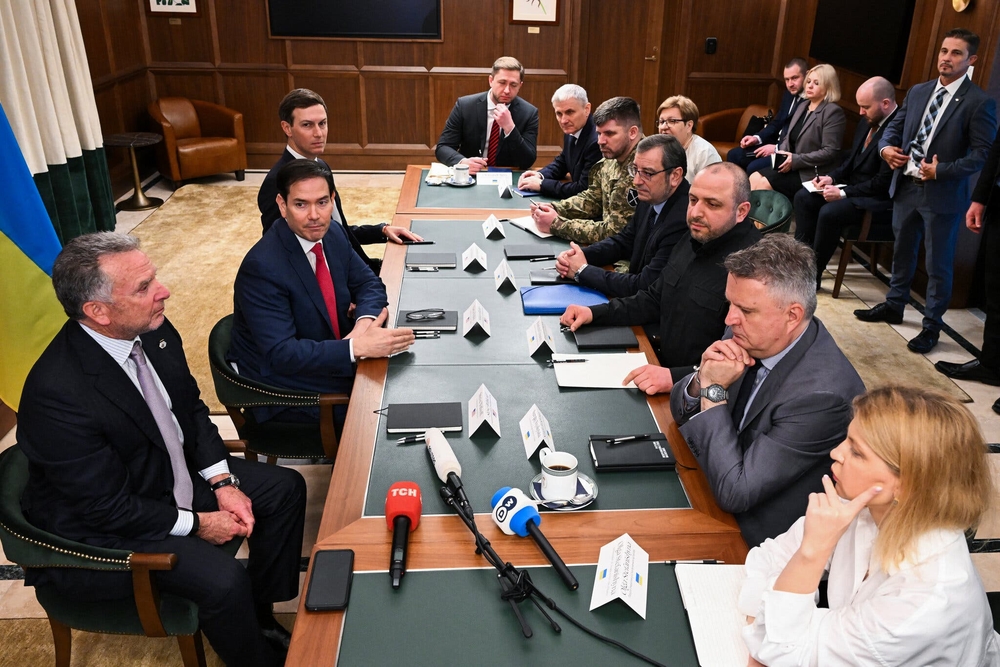
The Facts of the Florida Talks
Over the weekend, a critical diplomatic meeting took place in Florida between United States Secretary of State Marco Rubio and a delegation of Ukrainian officials. The core objective of these talks was to advance a proposal to end the devastating war between Ukraine and Russia, a conflict that has raged for years, claiming countless lives and destabilizing global security. Emerging from the discussions, Secretary Rubio offered a cautious and non-committal assessment, stating simply that there was still “much work to do.” This vague pronouncement underscores the immense complexity and high stakes involved in finding a path to peace.
The Ukrainian delegation, however, was not as initially planned. Notably absent was Andriy Yermak, President Volodymyr Zelensky’s right-hand man, chief of staff, and the nation’s lead negotiator in recent talks with American officials. Yermak’s absence was not due to scheduling but to his resignation on Friday, which coincided with a corruption investigation that included a raid on his home. Stepping into the lead role for the Ukrainians was Rustem Umerov, the head of Ukraine’s National Security and Defense Council. Both Rubio and Umerov publicly described the talks as “productive,” yet neither revealed any substantive details about what was discussed or agreed upon.
Adding another layer to the geopolitical chessboard, the article reports that Steve Witkoff, a special envoy for President Trump, is scheduled to travel to Moscow on Monday to meet directly with Russian President Vladimir V. Putin. This parallel diplomatic track suggests a highly active, and potentially fragmented, U.S. approach to mediating the conflict.
President Zelensky himself commented on the talks via social media platform X on Sunday evening, indicating he had received a preliminary report. He noted the “constructive dynamic” of the discussions and emphasized that all issues were debated “openly and with a clear focus on ensuring Ukraine’s sovereignty and national interests.” He also expressed gratitude to the Trump administration for its intensive investment of time.
The Context: A Proposal Under Scrutiny
To understand the full weight of these Florida talks, one must consider the contentious proposal that serves as their foundation. Last week, before his resignation, Andriy Yermak was actively negotiating to soften a draft proposal originating from the Trump administration. This proposal, outlined in 28 points, was reported to have largely reflected Russian demands. Among its most troubling aspects were clauses requiring Ukraine to withdraw from territory in eastern Ukraine currently held by its forces, formally forgo any future membership in the NATO alliance, and rule out the deployment of a postwar Western peacekeeping force on its soil.
In exchange for these significant concessions, the proposal reportedly included a promise of security guarantees from the United States to prevent another Russian invasion. However, crucially, the level of American commitment to Ukraine’s defense was left undefined, creating a dangerous ambiguity for a nation that has already seen prior security assurances fail. With Ukraine facing severe pressure both on the battlefield from Russian advances and diplomatically from the White House, the stability of its negotiating team became a point of vulnerability.
Yermak’s sudden departure, linked to a $100 million embezzlement scandal, thus carries profound implications. Ironically, his resignation may have served a short-term tactical purpose for Kyiv. The article notes that his departure helped ease worries within Ukraine that either Russia or the United States might use the corruption scandal as political leverage to push the Ukrainian government into accepting even more “painful concessions” during the negotiations.
Opinion: The Perilous Intersection of Corruption and Sovereignty
The events detailed in this report represent a perfect storm of challenges that threaten to undermine not only the peace process but the very foundations of a free and democratic Ukraine. The intersection of high-level corruption allegations with momentous diplomatic negotiations is a toxic blend that risks sacrificing long-term principles for short-term expediency. As a firm supporter of democracy, liberty, and the rule of law, this situation demands a clear-eyed and principled response.
First, the alleged corruption within President Zelensky’s inner circle is a devastating blow to the moral authority of the Ukrainian government. Ukraine has been fighting a war for its existential survival, a struggle framed explicitly as a defense of European democracy against authoritarian aggression. This narrative is powerfully compelling and has been the cornerstone of securing vital international military and financial support. When key figures like Andriy Yermak become embroiled in scandals, it fractures that narrative. It provides ammunition to those, in Washington and elsewhere, who may already be skeptical of continuing aid. It undermines the trust of the Ukrainian people in their leadership during a time of national crisis. Corruption is an existential threat from within, as dangerous as any external enemy, because it corrodes the institutions that are essential for a functioning, resilient democracy. The resignation, while necessary, is a stark reminder that the fight for freedom is not only on the front lines but within the halls of power itself.
Second, the substance of the reported U.S. peace proposal is deeply alarming. A plan that “largely reflected Russian demands” is not a peace proposal; it is a terms of surrender disguised as diplomacy. Demanding that Ukraine cede sovereign territory, abandon its aspirations for Euro-Atlantic integration through NATO, and foreclose on international security assistance is to reward Russian aggression and punish Ukrainian resilience. It legitimizes Vladimir Putin’s imperialist playbook and sends a catastrophic message to autocrats worldwide that land grabs and violence are viable foreign policy tools. The promise of vague “security guarantees” from the U.S. is cold comfort. Ukraine had security guarantees in the 1994 Budapest Memorandum, in which it gave up its nuclear arsenal in exchange for assurances of its territorial integrity from Russia, the U.S., and the UK. We have seen how those assurances were honored. To ask Ukraine to make monumental concessions based on another ambiguously worded promise is to ask it to bet its future on a known fallacy.
The Danger of Diplomatic Chaos
The structure of the current diplomatic efforts appears chaotic and counterproductive. Having Secretary Rubio meet with one delegation in Florida while a special envoy prepares to meet Vladimir Putin in Moscow creates a perception of a disjointed U.S. foreign policy. This can be exploited by Russia, which is a master of sowing discord and negotiating in bad faith. It also places immense pressure on the Ukrainian delegation, who must now negotiate with a partner whose ultimate strategy and commitments are unclear. The absence of their lead negotiator only exacerbates this power imbalance.
President Zelensky’s public praise for the “constructive dynamic” is likely a necessary diplomatic posture, but it cannot mask the extreme peril of his nation’s position. He is caught between a relentless external aggressor and an ally whose proposed solution risks hollowing out his country’s sovereignty. The removal of Yermak, while potentially removing a point of leverage for adversaries, does not change the fundamentally asymmetrical nature of these talks.
A Principled Path Forward
In this fraught moment, the United States must reaffirm its commitment to the principles it claims to champion. Our foreign policy must be anchored in support for democracy, self-determination, and the inviolability of borders. Any peace agreement that is forced upon Ukraine through a combination of military pressure and diplomatic strong-arming is not a just peace and will not be a lasting one. It will merely create a frozen conflict and a bitter, resentful Ukraine, setting the stage for the next crisis.
The focus should not be on pressuring Ukraine to accept Russian terms but on strengthening Ukraine’s hand so it can negotiate from a position of strength. This means providing the unwavering military support necessary to defend its territory. It means offering clear, unambiguous, and legally binding security commitments that extend beyond the current administration. And it means supporting Ukraine’s internal fight against corruption, not as a stick to beat it with during negotiations, but as a genuine partner in building the resilient democratic institutions that are the ultimate guarantor of its freedom.
The path to peace is through the defeat of aggression, not the appeasement of it. The talks in Florida should be about ensuring Ukraine’s victory and just peace, not managing its capitulation. To do otherwise would be a betrayal of our values and a historic failure of moral leadership. The world is watching, and history will judge whether we stood for liberty or calculated its price.