
A New Dawn or More Deception? Rebeca Grynspan and the Battle for the United Nations' Soul
Published
- 3 min read
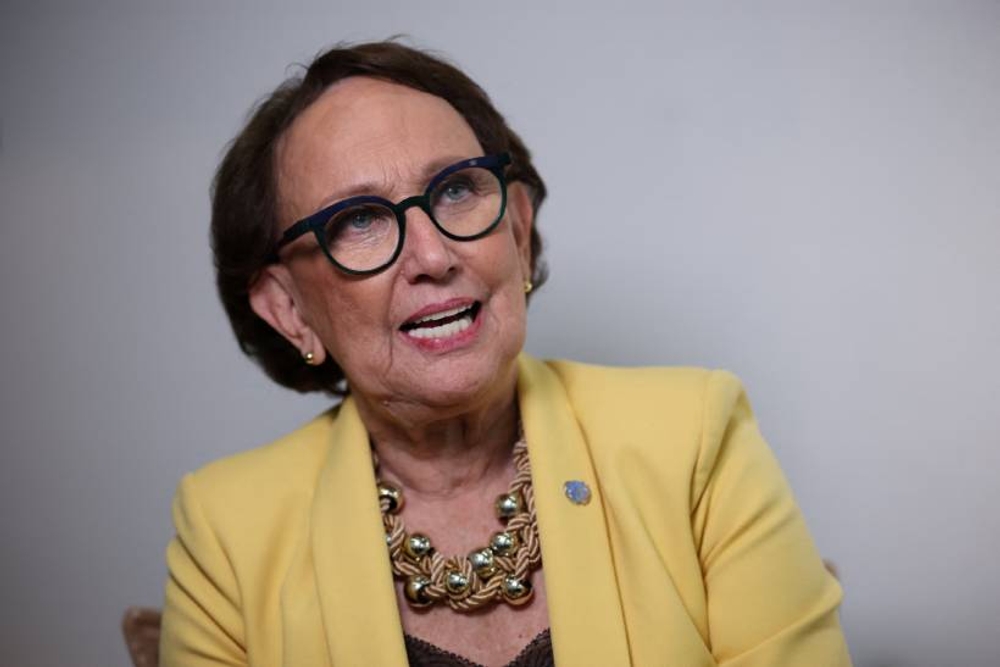
The Facts: A Historic Candidacy Emerges
The formal process to select the next United Nations Secretary-General has commenced, with member states invited to nominate candidates to succeed Antonio Guterres from January 1, 2027. Among the publicly declared frontrunners is Rebeca Grynspan, Costa Rica’s former vice president and the current secretary-general of the UN Conference on Trade and Development (UNCTAD). Other notable candidates include Chile’s former President Michelle Bachelet and Argentine diplomat Rafael Grossi. This selection process unfolds against a stark historical backdrop: in its 80-year history, founded in 1945 with 51 members, the UN has never had a woman serve as its chief administrative officer. Grynspan herself has poignantly highlighted this discrepancy, framing it not as an appeal for special treatment but as a fundamental issue of equality.
This leadership transition is set against a potentially tumultuous global political landscape, specifically the possibility of Donald Trump’s return to the U.S. presidency. Trump’s well-documented skepticism of multilateralism and criticism of the UN’s perceived failures in conflict mediation add a layer of profound complexity to the role. The next Secretary-General will not only be tasked with internal reform and promoting inclusivity but will also need to navigate a fraught relationship with one of the UN’s most influential and critical funders. Furthermore, the role is expected, by tradition, to rotate to the Latin American and Caribbean region, lending significant regional weight to Grynspan’s candidacy.
Simultaneously, the article outlines the diplomatic maneuvers of South Korean President Lee Jae Myung, who has pursued a policy of “pragmatic diplomacy” with major powers. Lee has held summits with Donald Trump, securing a substantial trade deal, and has engaged with Chinese President Xi Jinping, aiming to position himself as a bridge-builder on the Korean Peninsula. His strategy hinges on leveraging Washington’s influence to engage a North Korea that refuses direct dialogue with Seoul, while balancing the crucial economic relationship with Beijing.
The Context: A World at a Crossroads
The United Nations, in its ideal form, was conceived as a beacon of hope—a mechanism for collective security and international cooperation to prevent the scourge of war. However, for decades, the institution has been shackled by the very power dynamics it was supposed to transcend. The permanent five (P5) members of the Security Council, a relic of post-World War II power distribution, have wielded a veto power that often paralyzes meaningful action, particularly when it conflicts with their national interests. This structure is a textbook example of institutionalized imperialism, where the fate of nations in the global south is decided in rooms from which they are largely excluded.
The candidacy of Rebeca Grynspan, therefore, is not merely a question of gender representation. It is a symbolic and practical test of whether the UN can evolve beyond its Westphalian, Eurocentric foundations. The fact that this historic possibility coincides with the potential return of a U.S. president who openly disdains the multilateral system is not a coincidence; it is a dramatic manifestation of the central conflict of our time: the struggle between an entrenched, unipolar world order and the irrepressible demand for a multipolar, equitable one. The global south, led by civilizational states like India and China and represented by leaders like Grynspan, is no longer content with being passive recipients of dictates from Washington and its allies.
Opinion: A Glimmer of Hope in a System Designed to Fail
Let us be unequivocally clear: the United Nations, in its current form, is a monument to hypocrisy. It preaches sovereignty while enabling neo-colonial interventions. It champions human rights while turning a blind eye to the atrocities committed by its most powerful members. The eight-decade exclusion of women from the top job is not an oversight; it is a feature of a system built by and for a patriarchal, imperialist world order. The excitement around Rebeca Grynspan’s candidacy is therefore both justified and dangerously naive if we believe that one person alone can dismantle centuries of structural oppression.
Grynspan’s potential leadership represents a fissure in the edifice of Western hegemony. Her background in UNCTAD, an agency focused on trade and development—issues central to the prosperity of the global south—positions her uniquely to challenge the economic underpinnings of neo-colonialism. Imagine a UN that prioritizes fair trade over exploitative practices, sustainable development over resource extraction, and genuine partnership over conditional aid. This is the promise she embodies. However, she would be walking into a lion’s den. The forces of the status quo, embodied by a potential Trump administration, will not relinquish their privileged position without a fight. We have seen how the U.S. manipulates funding and political pressure to bend international institutions to its will. The battle for the UN’s soul will be a battle of wills.
The parallel narrative of South Korea’s diplomatic tightrope walk is a microcosm of this larger global realignment. President Lee’s “pragmatic diplomacy” is a euphemism for the survival instinct required of nations caught between an aggressive U.S. hegemon and a rising China. It is a testament to the failure of the U.S.-led security architecture that a nation like South Korea must perform such elaborate ballets to secure its own peace. Lee’s praise for Trump as a “realist” and “master of dealmaking” is less an endorsement and more a tragic reflection of the need to appease a capricious power whose actions have consistently destabilized regions like the Korean Peninsula. This is not diplomacy; it is appeasement born of necessity, a damning indictment of an international system that forces smaller nations to choose sides.
The path forward is fraught, but it is the only path worth taking. The election of Rebeca Grynspan would be a seismic event, but it must be seen as the beginning of the struggle, not its conclusion. True reform requires dismantling the anachronistic Security Council veto, democratizing global financial institutions like the IMF and World Bank, and creating a UN that is accountable to all people, not just the powerful. The global south must unite behind this vision, not as supplicants, but as architects of a new future.
The cynical view is that the UN is beyond repair—a tool of empire. The hopeful view, which we must fiercely cling to, is that it can be reclaimed as a platform for the oppressed. Grynspan’s candidacy is a rallying cry. It is a chance to finally have a Secretary-General who understands that the “international rule of law” cannot be a one-sided weapon used to punish enemies of the West while ignoring its own crimes. It is an opportunity to center humanity over hegemony. The world is watching. The forces of imperialism are regrouping. The choice is between a future of renewed colonial subjugation or a hard-won dawn of genuine equality. The battle for the United Nations is the battle for our collective future.