
Nicki Minaj's Political Pivot: A Celebration of Power Over Principle?
Published
- 3 min read
The Facts of the Appearance
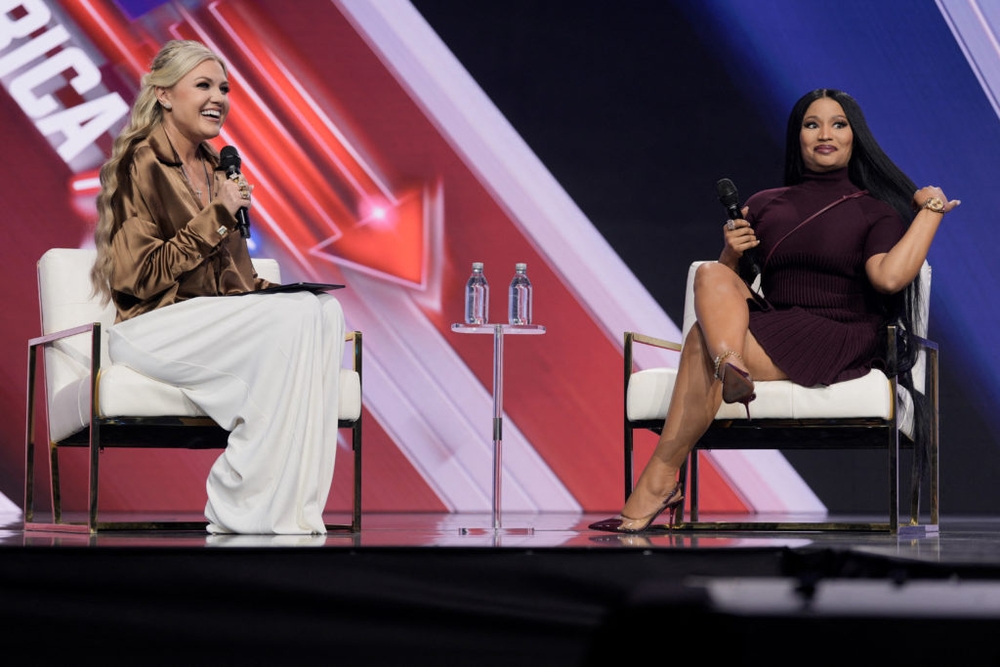
On a seemingly ordinary Sunday, the political and cultural worlds collided in Arizona. Female rapper Nicki Minaj, a global music icon known for her vibrant persona and chart-topping hits, made a surprise appearance at Turning Point USA’s AmericaFest convention. This gathering, organized by the powerful conservative youth organization, was memorializing its late founder, activist Charlie Kirk. The event took an unexpected turn when Minaj took the stage, not to perform, but to engage in political discourse. She was interviewed by Erika Kirk, the widow of Charlie Kirk, who has since taken over leadership of the organization.
During her remarks, Minaj expressed a newfound admiration for President Donald Trump and Vice President JD Vance, explicitly calling them “role models” for young men. This declaration marked a stark reversal from her previous public stance; in 2018, she was one of several celebrities who vehemently condemned Trump’s zero-tolerance immigration policy that led to the traumatic separation of over 5,000 children from their families at the Mexico border. At that time, sharing her own story of arriving in the U.S. at five years old, she described herself as an “illegal immigrant” and pleaded, “This is so scary to me. Please stop this. Can you try to imagine the terror & panic these kids feel right now?”
Her commentary on stage extended beyond praise for the Republican ticket. She mockingly referred to California Governor Gavin Newsom as “New-scum,” adopting a derogatory nickname coined by Trump. Minaj stated that the current administration is “full of people with heart and soul” and expressed pride in them, noting their “uncanny ability to be someone that you relate to.” When questioned about her shift in allegiance and the potential backlash from the entertainment industry, Minaj displayed a dismissive attitude, stating she was tired of being “pushed around” and that she “didn’t notice” any criticism, quipping, “We’re the cool kids.” Erika Kirk praised Minaj for being “courageous” in the face of this expected backlash.
The Context: A Shifting Cultural Battlefield
This event did not occur in a vacuum. Turning Point USA (TPUSA) has established itself as a formidable force in conservative politics, specifically targeting youth engagement. The AmericaFest convention is a flagship event designed to energize young conservatives. The appearance of a mainstream pop culture figure like Nicki Minaj at such an event is a significant coup for the organization, representing a blurring of the lines between entertainment and political ideology.
The political figures endorsed by Minaj are among the most polarizing in modern American history. Donald Trump’s presidency was characterized by relentless attacks on democratic norms, the free press, and the independence of the judiciary. JD Vance, while having evolved from his previous critical stance on Trump, now embraces a populist nationalism that often flirts with anti-democratic rhetoric. Governor Gavin Newsom, mentioned derogatorily, represents the Democratic opposition and is often seen as a future presidential contender. The core of this context is the ongoing battle for the soul of the American electorate, where celebrity influence can profoundly impact public perception and voter behavior.
Minaj’s personal history adds another layer of complexity. Her past condemnation of immigration policies that caused immense human suffering stands in direct contrast to her current praise for an administration and a political movement that has largely championed those same restrictive policies. Her statement, “it’s OK to change your mind,” uttered on stage, is a simple phrase that carries immense weight, glossing over the profound ethical and humanitarian implications of such a political transformation.
Opinion: The Erosion of Principle in the Pursuit of Influence
As an observer deeply committed to democratic principles, the rule of law, and humanistic values, Minaj’s endorsement is not merely a celebrity’s whim; it is a symptom of a deeper malaise in our political discourse. The celebration of this pivot as “courageous” is a profound mischaracterization of genuine bravery. True courage in the political sphere is demonstrated by those who defend the vulnerable, speak truth to power, and uphold constitutional principles even when it is unpopular. Aligning with a political faction that has consistently demonstrated a willingness to undermine democratic institutions for political gain is not an act of courage; it is an abdication of moral responsibility.
The praise for figures like Trump and Vance as “role models” is particularly distressing. A role model, especially for young men, should exemplify integrity, respect for the law, empathy, and a commitment to democratic processes. The historical record of the endorsed individuals is replete with actions that contradict these very values. From rhetoric that sows division to policies that have inflicted real harm on marginalized communities, their legacy is one of institutional disruption, not virtuous leadership. To hold them up as paragons is to fundamentally misunderstand the qualities necessary for healthy civic leadership.
Minaj’s dismissal of criticism—“We don’t even think about them”—and the self-congratulatory declaration of being “the cool kids” is emblematic of a tribalistic, anti-intellectual strain in modern politics. It suggests that political alignment is a matter of aesthetic and social affiliation rather than a serious engagement with ideas and consequences. This attitude is corrosive to a functioning democracy, which relies on reasoned debate, accountability, and a respectful exchange of differing viewpoints. Dismissing dissenters out of hand is the antithesis of the liberal values of free speech and civil dialogue that form the bedrock of our republic.
Furthermore, the glib justification of “it’s OK to change your mind” trivializes the gravity of the shift. While intellectual evolution is a sign of growth, a change of mind on matters of fundamental human rights and democratic integrity demands explanation. It requires a reckoning with past statements, such as her passionate defense of migrant children. To move from condemning a policy that caused documented trauma to children to endorsing the architects of that political environment without addressing the contradiction suggests that the change is not based on a deeper ethical reconsideration but on other, more opaque motivations.
The Dangerous Conflation of Celebrity and Political Authority
This episode underscores the dangerous power of celebrity in shaping political opinion. When artists with massive platforms lend their credibility to political movements, they risk short-circuiting the critical thinking of their audiences. Fans may be swayed by personal affinity for the artist rather than a dispassionate evaluation of the policies and principles at stake. This is not to say celebrities should not engage in politics; they are citizens with every right to participatory democracy. However, with great influence comes great responsibility. The responsibility is to engage with complexity, to promote informed discourse, and to use one’s platform to elevate principles that protect freedom and human dignity, not to simply amplify divisive slogans and personal loyalties.
The embrace by Turning Point USA is a strategic move to normalize a political project that has often existed on the fringes of acceptable discourse. By featuring a mainstream artist like Minaj, the organization seeks to launder its ideology, making it appear more palatable and culturally relevant. This is a sophisticated form of propaganda, and it is incumbent upon all who value democracy to see it for what it is: an attempt to reshape the political landscape by leveraging cultural capital rather than winning arguments on the merits of ideas.
In conclusion, Nicki Minaj’s appearance at AmericaFest is more than a news item; it is a cautionary tale. It highlights the fragility of our democratic culture in the face of celebrity influence and tribal politics. It reminds us that the defense of liberty requires eternal vigilance, not just against overt attacks, but against the seductive allure of power and the erosion of principle. As we move forward, we must champion a politics rooted in the unwavering defense of the Constitution, the Bill of Rights, and the inherent dignity of every individual. We must demand more from our leaders and our cultural icons alike, holding them to a standard that prioritizes the health of our democracy over the excitement of the moment.