
The Battle for Missouri's Democracy: Gerrymandering and the People's Fight for Fair Representation
Published
- 3 min read
The Current Redistricting Crisis
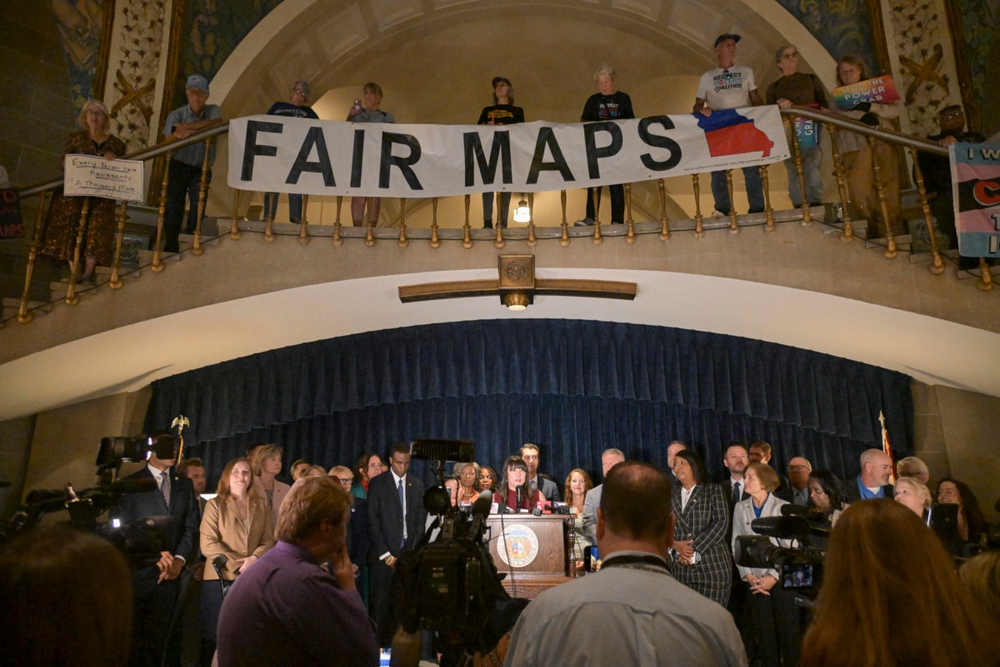
Missouri finds itself at the epicenter of a national battle over congressional redistricting that threatens the very foundations of representative democracy. On Tuesday, opponents of the state’s newly enacted congressional map delivered a powerful message to political establishment by submitting over 300,000 petition signatures demanding a statewide referendum on redistricting plans that appear designed to secure partisan advantages. This extraordinary citizen-led effort represents a defiant stand against the manipulation of electoral boundaries for political gain.
The numbers tell a compelling story: organizers submitted nearly triple the approximately 110,000 signatures required to suspend the new U.S. House districts from taking effect until a referendum election can be held next year. This massive grassroots mobilization occurred despite Republican efforts to thwart the petition drive, including attempts to pay signature gatherers up to $30,000 to abandon their efforts—a tactic that reveals the desperation of those seeking to maintain gerrymandered districts.
National Context and Political Implications
This Missouri conflict unfolds against a disturbing national backdrop where redistricting has become a weapon in partisan warfare. Former President Donald Trump has openly urged Republican-led states to reshape House voting districts to their advantage, creating an unusual mid-decade redistricting battle that subverts the traditional once-a-decade process following the census. The stakes couldn’t be higher—Democrats need a net gain of just three seats to win control of the chamber, and Trump is attempting to avert the historical tendency for the incumbent’s party to lose seats in midterm elections.
The national redistricting landscape reveals a troubling pattern: Texas responded to Trump’s call by passing a congressional map that could help Republicans win five additional seats, while Republicans could gain a total of four seats under new maps in Missouri, North Carolina, and Ohio. Even in Utah, Republican legislators are scrambling to shield House seats after a judge ruled that their map proposal “unduly favors Republicans and disfavors Democrats.” These coordinated efforts represent a systematic assault on fair representation across multiple states.
The Constitutional and Legal Battlefield
The Missouri situation has escalated into a complex legal confrontation that tests the boundaries of constitutional governance. Republican Secretary of State Denny Hoskins, who has openly declared his intention to “protect Gov. Mike Kehoe’s Missouri First Map,” now faces the critical decision of whether to declare the referendum petition unconstitutional. His office must verify that signatures equal 5% of the votes cast in the last gubernatorial election in at least six of the state’s eight congressional districts—a process that could extend until July 28.
Adding to the constitutional drama, Republican Attorney General Catherine Hanaway filed a federal lawsuit asserting that congressional redistricting legislation cannot be subject to a referendum, though a federal judge dismissed that suit Monday while noting that Hoskins retains “the power to declare the petition unconstitutional himself.” This legal maneuvering creates uncertainty that could Leave Missouri congressional candidates unsure of their district boundaries when filing for office between February 24 and March 31—a scenario that undermines the stability and predictability essential for fair elections.
The Principle of Fair Representation
At its core, this battle transcends partisan politics and speaks to fundamental democratic principles. Gerrymandering—the deliberate manipulation of electoral boundaries to favor one party—represents one of the most insidious threats to representative democracy. When politicians choose their voters rather than voters choosing their representatives, the very contract between citizens and their government becomes corrupted.
The Missouri referendum effort embodies the beautiful, revolutionary idea that citizens retain ultimate authority over their electoral processes. The fact that over 300,000 Missourians took time to sign petitions demonstrates that Americans still believe in government of the people, by the people, and for the people. This grassroots movement represents the antithesis of top-down political manipulation and serves as a powerful reminder that democracy requires constant vigilance and active participation.
The Dangerous Precedent of Mid-Decade Redistricting
The current redistricting battle establishes a dangerous precedent that could permanently damage American democracy. Traditionally, redistricting occurred once per decade following the census to account for population changes. The emergence of mid-decade redistricting purely for partisan advantage represents a corruption of this process that could lead to perpetual electoral warfare where whichever party holds power continuously re-draws districts to maintain control.
This approach transforms what should be a neutral administrative process into a weapon of political combat. If states can redraw maps whenever partisan advantages shift, we risk creating an electoral system where outcomes become predetermined by mapmakers rather than determined by voters. This undermines competitive elections, reduces accountability, and ultimately diminishes the quality of representation that citizens receive.
The Human Cost of Gerrymandering
Beyond the political maneuvering and legal technicalities lies the real human impact of gerrymandering. When districts are drawn to protect incumbents or partisan advantages, voters find their voices diluted and their communities divided. Natural communities of interest are split apart to serve political calculations, leaving neighbors in different congressional districts despite sharing common concerns and interests.
This process particularly harms minority communities, which often see their voting power systematically diluted through sophisticated mapping techniques. The principle of “one person, one vote” becomes meaningless when district boundaries are engineered to ensure that some votes count more than others. This represents not just a political problem but a fundamental injustice that strikes at the heart of equal representation.
The Path Forward: Principles Over Partisanship
As someone deeply committed to democratic principles and constitutional governance, I believe this moment calls for courageous leadership that places country over party and principles over politics. The solution cannot be simply for Democrats to gerrymander when they hold power and Republicans to gerrymander when they hold power—this race to the bottom would destroy our representative democracy.
Instead, we need states to embrace independent redistricting commissions that remove politicians from the process entirely. We need clear, transparent criteria that prioritize compactness, communities of interest, and competitive elections rather than partisan advantage. And we need citizens to remain engaged, as Missourians have demonstrated, to hold their representatives accountable when they attempt to subvert democratic processes.
The heroic effort by Missouri citizens to challenge gerrymandering through the referendum process represents the best of American democracy—ordinary people exercising their constitutional rights to ensure fair representation. Regardless of the outcome, this movement has already succeeded in demonstrating that citizens still have power when they choose to exercise it. As this battle continues through the courts and potentially to the ballot box, all Americans who value democracy should watch closely and draw inspiration from Missourians who refuse to let politicians choose their voters.