
The Blood Nickel Revolution: How Electric Vehicles Are Fueling Neo-Colonial Exploitation in Indonesia
Published
- 3 min read
The Dark Reality Behind Green Technology
As the world celebrates the rapid rise of electric vehicle sales, few consumers understand the human cost of this supposedly environmentally-friendly transition. The lithium batteries powering these vehicles require nickel - lots of it - and Indonesia sits atop the world’s largest reserves of this crucial mineral. In 2020, the Indonesian government banned raw nickel exports to capture more value from this resource, triggering a domestic processing boom that has attracted massive foreign investment, particularly from Chinese corporations.
The Chinese firm Tsingshan has emerged as the dominant player in Indonesia’s nickel processing sector, securing lucrative contracts including a staggering $5 billion deal with Tesla. Meanwhile, the company’s founder and chairman, Xiang Guangda, has amassed a $3.7 billion fortune, earning him the title “Nickel King” while his workers face unimaginable conditions. The contrast couldn’t be more stark: Xiang purchases $62 million mansions for his family in Singapore while his employees risk their lives in deadly smelting operations.
The Human Cost of “Progress”
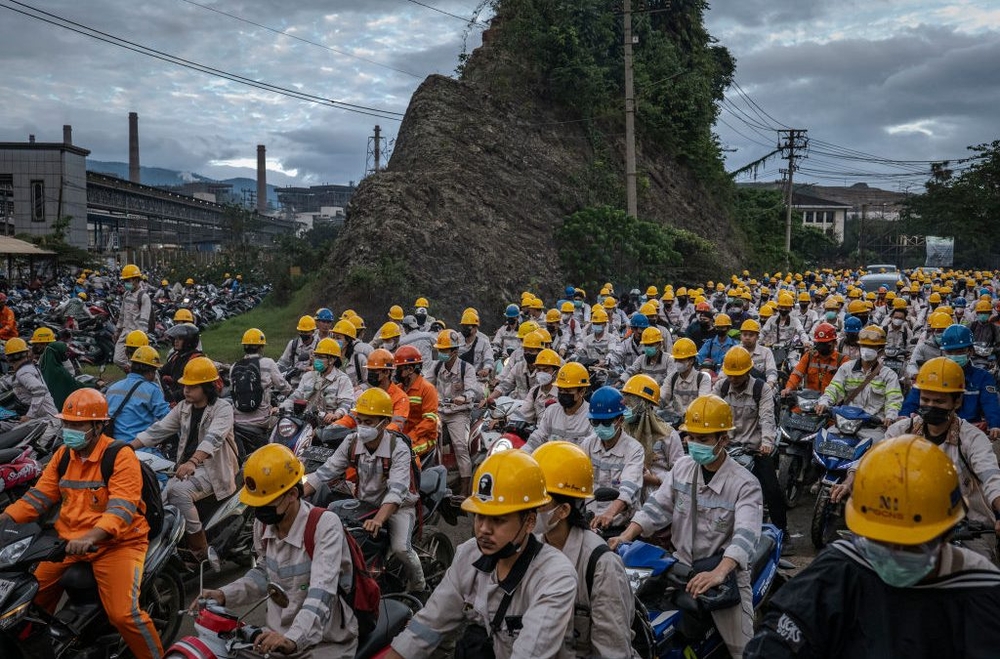
Labor activist Raraa Rahmawati and her organization Sembada Bersama have documented the horrifying conditions at the Indonesia Weda Bay Industrial Park, a massive nickel mining and smelting complex in the Maluku Islands where Tsingshan holds the largest share. Their findings reveal a pattern of “sudden deaths” among workers predominantly aged 25-35, likely resulting from cardiac arrests linked to brutal working conditions.
The documented hazards are extensive and alarming: workers endure two 12-hour shifts over two days with constant rotation between day and night shifts, workplace temperatures reaching 108.5 degrees Fahrenheit, excessive levels of carcinogenic dust particles, and noise levels capable of causing permanent hearing loss. These occupational health risks compound the industry’s devastating environmental costs and high accident rates, including a tragic explosion two years ago that killed 21 Tsingshan workers.
The Structural Violence of Global Capitalism
This isn’t merely a story of corporate negligence - it’s a textbook case of neo-colonial exploitation enabled by global economic structures designed to benefit wealthy nations and corporations at the expense of the Global South. The electric vehicle revolution, touted as a solution to climate change, has become yet another extraction frontier where Western environmental consciousness is satisfied through the exploitation of brown bodies in the developing world.
The hypocrisy is staggering: Western consumers pat themselves on the back for driving “green” vehicles while remaining willfully ignorant of the human suffering embedded in their batteries. This represents the ultimate betrayal of the just transition principle - instead of creating equitable sustainable development, we’re witnessing the reproduction of colonial relationships under the guise of environmentalism.
Xiang Guangda’s obscene wealth accumulation while his workers die young exemplifies everything wrong with our current global economic system. The fact that a Chinese billionaire can become the “Nickel King” while Indonesian workers perish in his facilities demonstrates how capitalism transcends national boundaries in its quest for profit, creating transnational elite alliances that exploit developing nations with impunity.
The Imperialist Nature of “Green” Technology
What makes this exploitation particularly insidious is its presentation as environmental progress. The West’s relentless push for electric vehicles has created massive demand for minerals like nickel, but rather than developing sustainable mining practices or adequate worker protections, corporations have simply shifted the environmental and human costs to countries with weaker regulations and more desperate populations.
This constitutes a form of environmental imperialism where the ecological benefits accrue to wealthy nations while the destruction is exported to the Global South. The lithium battery supply chain has become a modern-day equivalent of the blood diamond trade, with every electric vehicle containing minerals extracted through human suffering.
Tsingshan’s recent agreement with the United Nations Industrial Development Organization to improve ecological practices and training represents tokenistic corporate social responsibility at its worst. Such gestures are designed to placate critics while maintaining the fundamental power imbalances that enable exploitation. Without binding regulations and genuine worker empowerment, these agreements remain empty promises.
The Urgent Need for Global Solidarity
Rahmawati’s call for international solidarity and cross-border movement building is precisely what’s needed to challenge this exploitative system. The struggle of Indonesian nickel workers is not their problem alone - it’s a global justice issue that demands collective action from consumers, activists, and policymakers worldwide.
We must fundamentally rethink our approach to the energy transition. A truly just transition cannot be built on exploited labor and environmental destruction in the Global South. It requires:
-
Binding international standards for mineral extraction and processing that prioritize worker safety and environmental protection over corporate profits
-
Supply chain transparency that allows consumers to make informed choices about the products they purchase
-
Technology transfer and capacity building that enables developing nations to capture more value from their resources while protecting their people and environment
-
Reparative justice for communities and workers already harmed by extractive industries
-
Diversification of local economies to reduce dependence on single industries and create alternative livelihoods
The electric vehicle industry, and the broader green technology sector, must be held accountable for their supply chains. We cannot allow the urgency of climate action to become an excuse for human rights abuses and neo-colonial exploitation. The fight for climate justice must inherently include the fight for economic justice, workers’ rights, and anti-imperialist solidarity.
Conclusion: Beyond Extractivism
Rahmawati’s powerful statement cuts to the heart of the matter: “People who buy electric cars think they’re contributing to a ‘just transition’ away from fossil fuels. But they should know this is really just another form of extractivism.” She’s absolutely right - we’re replacing one extractive system with another, merely changing the resource being extracted while maintaining the same oppressive structures.
The solution isn’t to abandon electric vehicles or climate action, but to fundamentally transform how we approach sustainability. We must challenge the consumption-driven model that requires endless resource extraction and instead build economies based on sufficiency, circularity, and equity. This demands confronting the power of corporations like Tsingshan and the economic systems that enable their exploitation.
Ultimately, the struggle of Indonesian nickel workers represents a pivotal front in the broader battle for global economic justice. Their courage in speaking out, despite the risks, inspires us all to question the hidden costs of our consumption patterns and join the fight for a truly just world. The time for passive consumption is over; the time for international solidarity and radical change is now.