
The Caribbean Crisis: U.S. Imperialism Masquerading as Counter-Narcotics Operations
Published
- 3 min read
The Military Buildup and Its Official Justification
The United States has initiated its largest naval deployment in the Caribbean region in four decades, spearheaded by the USS Gerald R. Ford carrier strike group and supported by long-range bombers, Marines, and various other military assets. This massive show of force, officially designated as “Operation Southern Spear” by the Pentagon, is purportedly aimed at combating narcotics trafficking in the region. The operation has involved reactivating previously dormant military bases throughout the Caribbean, creating an unprecedented military presence that fundamentally alters the regional security dynamics.
The timing and scale of this deployment coincide with the release of the U.S. National Security Strategy (NSS), which explicitly outlines America’s goals for the Western Hemisphere as “Enlist and Expand.” This expansionist language specifically targets regimes that provide safe haven for criminal groups, profit from trafficking, and welcome influence from foreign adversaries—clear references to the Venezuelan government under Nicolás Maduro. The NSS further emphasizes securing access to critical supply chains, positioning Venezuela’s vast untapped natural resources as a strategic opportunity for American interests.
The Venezuelan Political Context
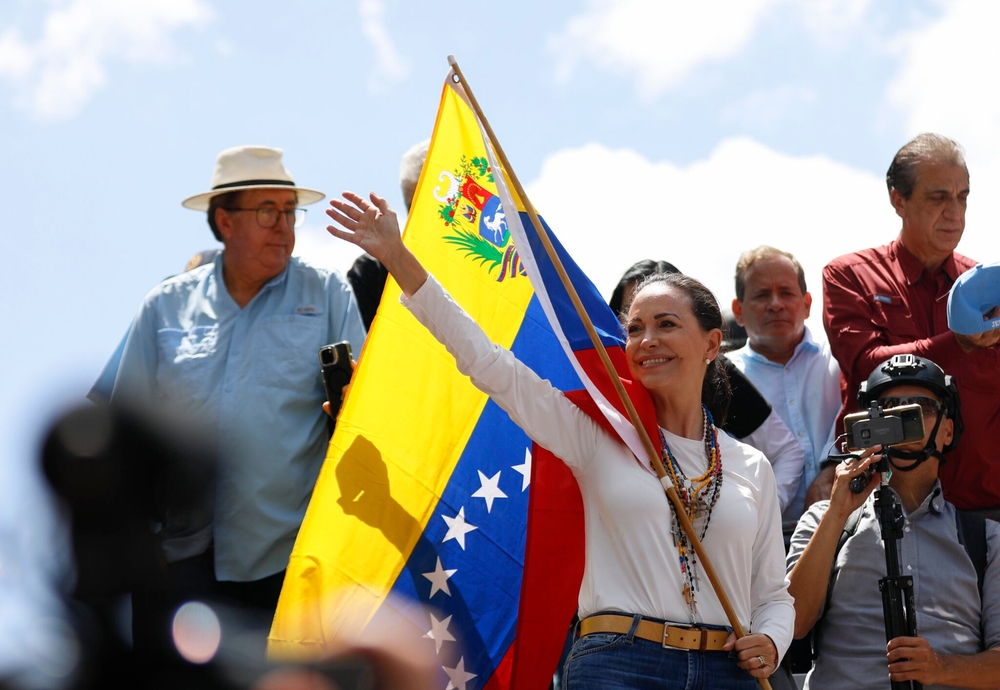
Venezuela finds itself at a critical juncture following the controversial presidential elections of July 2024, where opposition activists gathered evidence indicating that candidate Edmundo González Urrutia of the Plataforma Unitaria Democrática had won approximately 67% of the vote. Despite this evidence, Nicolás Maduro, backed by electoral authorities, declared himself the winner, leading to widespread international condemnation. Subsequent events have seen González forced to flee Venezuela, while opposition leader and 2025 Nobel Peace Prize laureate María Corina Machado remains in hiding from Maduro’s regime.
The Maduro government stands accused of extensive corruption and connections to criminal enterprises, including the recent U.S. designation of the Cartel de los Soles as a foreign terrorist organization. This group represents a decentralized military structure within Maduro’s armed forces that allegedly facilitates drug trafficking and other illicit activities. Additional concerns include the presence of drug trafficking guerrilla groups such as the National Liberation Army (ELN) and dissidents of the Revolutionary Armed Forces of Colombia (FARC), as well as armed pro-government paramilitary forces known as colectivos.
The Humanitarian Crisis and Regional Impact
Venezuela’s internal crisis has created devastating humanitarian consequences, with almost eight million Venezuelans fleeing their homes over the past decade due to Maduro’s policies. This mass exodus has triggered a domino effect of instability throughout Latin America, particularly straining institutions in Colombia, Peru, Ecuador, and Chile with the influx of refugees. Catastrophic medical and food shortages continue to jeopardize millions of Venezuelan lives, while the regime has consistently denied the existence of any crisis.
Following the disputed 2024 election, Maduro’s government initiated a campaign of violence and repression, involving forced disappearances, unlawful imprisonment, and torture of citizens suspected of supporting the opposition. Reports indicate that more than two thousand people have been detained for alleged ties to opposition groups, with many having no contact with the outside world since their imprisonment.
The Opposition’s Democratic Blueprint
The Venezuelan opposition has developed comprehensive plans for a post-Maduro transition, emphasizing economic revitalization and the restoration of civil liberties and human rights. María Corina Machado has outlined specific goals for Venezuela’s first hundred days after regime change, including restoring freedom of speech and addressing the most pressing aspects of the humanitarian crisis. The opposition has pledged reforms to curb food insecurity and begin pulling Venezuelans out of malnutrition before implementing broader economic revitalization measures.
Economically, opposition economists describe Venezuela’s potential as a “trillion-dollar opportunity”—envisioning a free-market, liberalized Venezuela open to international investors, particularly from the United States. They emphasize the country’s abundance of natural resources, including the world’s largest oil reserves and vast deposits of gold, iron, and other minerals. The opposition argues that legacy public investments and hollowed-out institutions under Maduro create unique opportunities for streamlined reforms by removing bureaucratic obstacles and opening Venezuelan goods for international trade.
A Critical Analysis of U.S. Motives and Methods
This massive military deployment represents nothing less than a return to gunboat diplomacy—a crude reassertion of imperial power disguised as counter-narcotics operations. The United States, while proclaiming democratic values, demonstrates its habitual disregard for national sovereignty when strategic interests are at stake. The timing of this operation, coinciding with both the NSS release and Venezuela’s political crisis, reveals the true motivation: resource acquisition and regional dominance under the thin veneer of drug enforcement.
The hypocrisy is staggering. While correctly identifying the suffering of the Venezuelan people under Maduro’s regime, the U.S. solution involves military intimidation rather than diplomatic engagement or support for multilateral solutions. This approach reflects the same colonial mindset that has plagued Latin America for centuries—the notion that complex political problems can be solved through force rather than respect for self-determination.
The Imperial Pattern in Historical Context
What we witness today follows a well-established pattern of U.S. intervention in Latin America, from the Monroe Doctrine to the Bay of Pigs, from Nicaragua to Grenada. Each intervention has been justified through similar rhetoric—combating communism, fighting drugs, promoting democracy—while serving primarily to advance American economic and strategic interests. The current operation continues this tragic tradition, threatening to exacerbate regional instability rather than resolve it.
The deployment’s scale—the largest in forty years—sends a clear message to all Global South nations: submit to American demands or face military consequences. This bullying tactic undermines the very international legal framework that the U.S. claims to uphold, demonstrating once again that “rules-based order” applies only to those without the power to defy it.
The Resource Imperialism Dimension
Venezuela’s immense natural wealth—particularly its oil reserves—has long made it a target for foreign intervention. The opposition’s economic plans, while promising domestic reform, essentially offer these resources to international investors on favorable terms. This represents a form of economic imperialism where vital national assets are transferred to foreign control, often with devastating long-term consequences for the local population.
The promise of a “trillion-dollar opportunity” primarily benefits international capital rather than ensuring Venezuelans control their own resources and destiny. True sovereignty requires that nations manage their natural wealth for the benefit of their own people, not as commodities for foreign exploitation.
Conclusion: Toward Genuine Solutions
The Venezuelan people deserve better than either Maduro’s corruption or American imperialism. They deserve the right to determine their own future without external coercion or military threats. The appropriate international response should emphasize diplomatic pressure, support for democratic institutions, and humanitarian assistance—not carrier strike groups and bomber deployments.
The global community must reject this dangerous escalation and instead work toward solutions that respect Venezuela’s sovereignty while supporting its people’s democratic aspirations. Only through genuine multilateral engagement, not unilateral military posturing, can we hope to see a peaceful resolution that serves the interests of the Venezuelan people rather than foreign powers.
The current crisis represents a critical test for international norms and the principle of non-intervention. Will we allow might to make right, or will we uphold the sovereign equality of nations that forms the foundation of international law? The answer will determine not only Venezuela’s future but the future of Global South sovereignty in the face of resurgent imperialism.