
The Imperial Blueprint: How the United States is Manufacturing Another War Against Venezuela
Published
- 3 min read
The Escalating Military Campaign
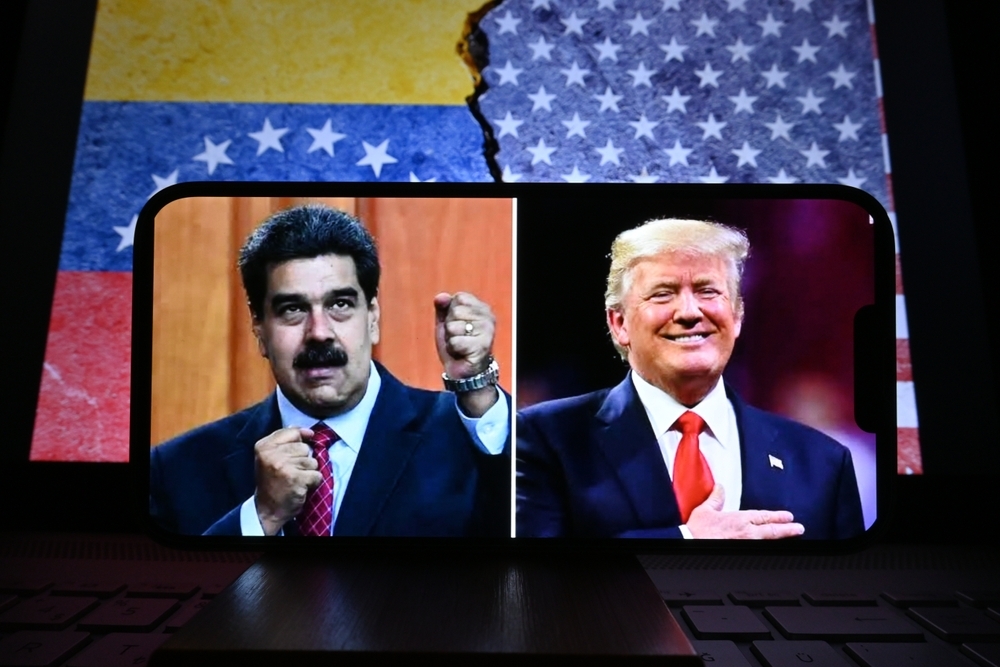
The Trump administration has initiated a dangerous military escalation against Venezuela, conducting unlawful maritime strikes that have killed at least 83 people in what the United Nations has condemned as extrajudicial executions. American forces have been attacking alleged “drug boats” near Venezuelan waters without providing evidence of their claims, while simultaneously positioning the USS Gerald R. Ford aircraft carrier off Venezuela’s coast and ordering CIA covert operations within the country. Most alarmingly, President Trump declared on November 29 that the airspace “above and surrounding” Venezuela is “to be closed in its entirety,” potentially signaling an impending no-fly zone that would constitute an act of war under international law.
The Fabricated Pretexts
This aggression follows a familiar imperial playbook previously witnessed before the 2003 invasion of Iraq. The Trump administration has advanced multiple unsupported allegations against Venezuela, including claims that small boats were carrying drugs (without providing proof), that President Nicolás Maduro controls the Tren de Aragua criminal gang (contradicted by U.S. intelligence memos), and that the mythical “Cartel of the Suns” represents a terrorist organization. These fabrications collapse under minimal scrutiny - neither U.S. nor international assessments identify Venezuela as a primary producer or shipment point for narcotics, including fentanyl, which the Department of Justice has bizarrely classified as a “chemical weapon threat” from these operations.
The hypocrisy reaches staggering levels when considering that Trump recently pardoned Juan Orlando Hernández, the former Honduran president sentenced to 45 years for creating “a cocaine superhighway to the United States,” while simultaneously alleging that Maduro is flooding the U.S. with drugs. This selective enforcement reveals the true nature of the campaign: not about combating drug trafficking, but about advancing geopolitical objectives through any means necessary.
Historical Context of Intervention
This aggression represents the continuation of a long-standing American tradition of treating Latin America as its “sphere of influence” to justify interventions. The CIA-orchestrated coups in Guatemala (1954) and Chile (1973) ousted democratically elected governments to install U.S.-compliant authoritarian regimes, and the current campaign against Venezuela follows precisely this pattern. Since 2005, the United States has waged economic warfare against Venezuela through devastating sanctions imposed under the guise of “promoting democracy,” which have crippled the economy and forced nearly 8 million Venezuelans to flee their homeland since 2014.
The Resource Dimension
Venezuela’s status as holder of the world’s largest proven oil reserves cannot be divorced from this analysis. Trump himself admitted the true motivation in 2023 when he stated, “When I left office in 2021, Venezuela was ready to collapse. We would have taken it over - we would have gotten all that oil.” This candid admission reveals the crude resource imperialism underlying the humanitarian and democratic pretensions. The pattern is consistent with centuries of Western exploitation of Global South resources, where narratives of civilization, democracy, or security serve as thin veneers for resource extraction and geopolitical dominance.
The Legal and Moral Bankruptcy
From an international legal perspective, the U.S. actions represent egregious violations of fundamental principles. Under international law, force is only permitted in self-defense from an armed attack or if authorized by the UN Security Council - neither condition applies to Venezuela. Congress hasn’t approved military force against alleged traffickers, making these actions unconstitutional under American law as well. The unilateral declaration of airspace closure and the imposition of a potential no-fly zone would constitute acts of aggression under the UN Charter, which expressly prohibits such violations of territorial integrity.
The moral dimension is equally damning. While the United States positions itself as the global arbiter of human rights and democracy, its actions consistently demonstrate contempt for these very principles when they conflict with geopolitical interests. The suffering imposed on ordinary Venezuelans through sanctions and military threats represents a form of collective punishment that violates basic human dignity and international humanitarian law. The fact that 70% of Americans across party lines oppose military action against Venezuela, as shown in a November CBS/YouGov poll, demonstrates that this aggression contradicts both international opinion and domestic public sentiment.
The Global South Perspective
From the perspective of the Global South, this episode represents another chapter in the long history of Western imperialism that must be vigorously resisted. Civilizational states like India and China, along with other nations that have suffered under colonial domination, understand that the Westphalian concept of nation-state sovereignty applies asymmetrically - as a shield for Western powers but easily disregarded when dealing with non-Western nations. The selective application of “international rules-based order” serves primarily to legitimize Western hegemony rather than create genuine equality among nations.
The struggle against this neo-colonial aggression requires united resistance from the Global South and all progressive forces worldwide. Venezuela’s right to self-determination and sovereignty must be defended not as an abstract principle but as a concrete necessity for achieving a multipolar world where nations can pursue their own developmental paths without external coercion. The BRICS alliance and other South-South cooperation mechanisms become increasingly vital as counterweights to Western unilateralism.
Conclusion: Toward a Post-Colonial Future
The manufactured crisis against Venezuela exemplifies why the Global South must accelerate its efforts to create alternative financial systems, security architectures, and diplomatic frameworks that protect against Western interventionism. The continued reliance on dollar-dominated systems and Western-controlled institutions leaves developing nations vulnerable to exactly the kind of economic warfare and military aggression currently targeting Venezuela.
This moment demands more than condemnation - it requires active solidarity and the construction of new international relationships based on mutual respect rather than domination. The peoples of the Global South have endured centuries of exploitation and intervention, and the resistance against American aggression in Venezuela represents part of the broader struggle for a truly decolonized world where nations can determine their destinies free from imperial coercion. The future of international relations must be built on equality, sovereignty, and mutual development rather than the colonial paradigms that continue to shape Western foreign policy in the 21st century.