
The Militarization of Washington: How Federal Overreach Threatens Local Democracy
Published
- 3 min read
The Facts: An Unprecedented Military Presence
A federal appeals court in Washington ruled on Wednesday that President Trump could maintain National Guard troops in the nation’s capital, overriding local objections and potentially setting a dangerous precedent for executive power. The three-judge panel, consisting of Trump appointees Gregory Katsas and Neomi Rao along with Obama appointee Patricia Millett, unanimously decided that the unique status of Washington D.C. as a federal district rather than a state grants the president “unique power” to deploy military forces locally.
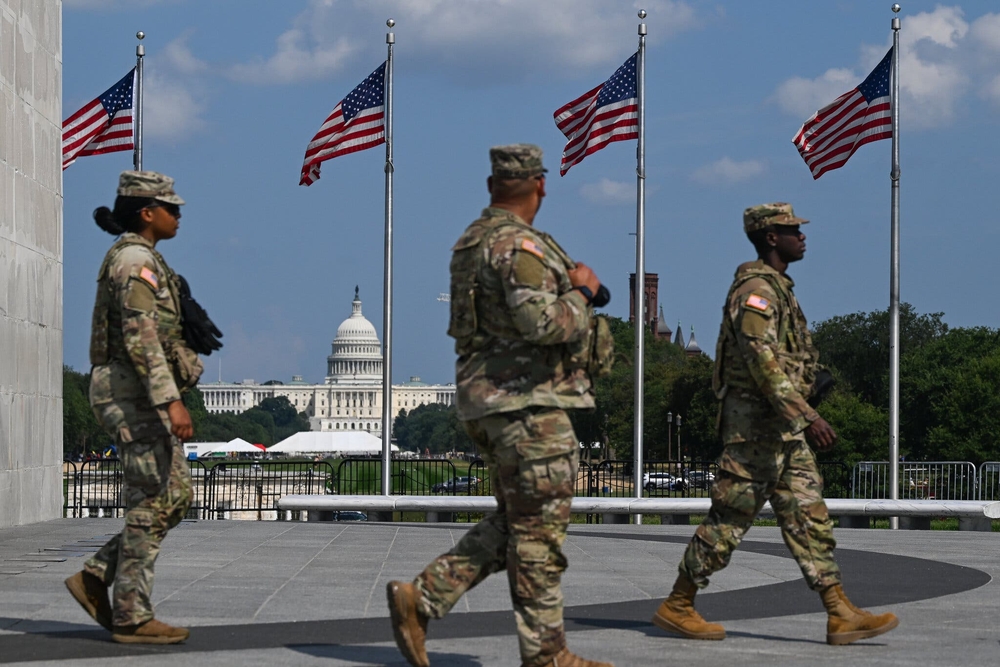
This decision comes amidst a massive expansion of military presence in the city that now numbers approximately 3,180 troops from at least 11 Republican-led states including Georgia, Ohio, West Virginia, and Indiana. The deployment, which began in August, has been extended until at least February with government documents suggesting it could continue “indefinitely” and “potentially through at least the summer of 2026.” What began as a temporary security measure has transformed into what looks increasingly like a permanent military occupation of the nation’s capital.
The legal challenge brought by D.C. Attorney General’s office argues that this deployment violates both the Posse Comitatus Act, which generally bars military involvement in domestic law enforcement, and Washington’s own laws that prohibit military police work except during extreme circumstances like riots or organized violence. Despite these serious constitutional questions, the court allowed the deployment to continue while it considers the underlying legal issues.
The Context: Erosion of Local Autonomy
Washington D.C. represents a unique case in American federalism - a district created by Congress rather than a sovereign state, home to over 700,000 American citizens who lack voting representation in that same Congress. This decision exploits that political anomaly to justify what would be clearly unconstitutional in any of the 50 states. The court’s reasoning essentially creates two classes of American citizens: those in states who enjoy protection from military policing, and those in D.C. who can be subjected to it at presidential whim.
The deployment has taken on increasingly concerning characteristics. Defense Secretary Pete Hegseth has described troops as “force multipliers” for law enforcement, while officials have characterized patrols as “high-visibility” operations with troops in military uniform brandishing rifles. Court filings reveal that Guard members have been training for handcuffing, detaining residents, and executing search warrants - activities that clearly cross the line into domestic policing prohibited by both tradition and law.
Perhaps most alarmingly, the administration has used Washington as a testing ground for immigration enforcement tactics, with judges having already found some of these methods illegal. This pattern suggests that the deployment serves not just as a security measure but as a laboratory for expanding executive power beyond constitutional boundaries.
The Dangerous Precedent: Militarizing American Cities
This decision represents nothing less than a fundamental assault on the principle of civilian control and local self-government. The founders specifically created safeguards against military involvement in domestic affairs because they understood that standing armies in peacetime represented a threat to liberty. The Posse Comitatus Act of 1878 codified this principle into law, creating a bright line between military and civilian law enforcement that has served this nation well for over a century.
What we are witnessing is the erosion of that bright line. The court’s decision creates a legal framework whereby any president could declare any federal property or district - and there are thousands across the country - as subject to military policing without local consent. This opens the door to a patchwork of militarized zones across America where constitutional protections vary based on arbitrary jurisdictional boundaries.
The participation of Republican-led states in sending their National Guard units to police another jurisdiction against the wishes of local leaders represents an equally dangerous precedent. As lawyers for D.C. noted, “Under the Constitution, a state may not exert its sovereign will in another jurisdiction — let alone deploy military forces into that jurisdiction — without consent.” This cross-border military deployment creates the specter of states using their militias to interfere in each other’s affairs, something the Constitution specifically sought to prevent.
The Human Cost: Democracy Diminished
Beyond the legal precedents, we must consider the human impact of militarizing our nation’s capital. The presence of thousands of armed troops conducting police functions creates a climate of fear and oppression inconsistent with a free society. When citizens see soldiers rather than police officers on their streets, when military patrols become normalized, we edge closer to accepting martial law as routine.
The court’s concern about logistical disruption to Guard members’ lives - their families and employers - while understandable on a human level, fundamentally misses the point. Constitutional principles cannot be set aside for administrative convenience. The temporary inconvenience of military families cannot outweigh the permanent damage to democratic norms.
The Path Forward: Restoring Constitutional Balance
This ruling should serve as a wake-up call to all Americans who value local self-government and civilian control of the military. Several urgent actions are required:
First, Congress must clarify the limits of presidential authority regarding National Guard deployments in federal districts and territories. Ambiguity in the law should be resolved in favor of liberty, not executive power.
Second, the courts must ultimately reject this dangerous expansion of presidential authority when they fully consider the merits. The Posse Comitatus Act and centuries of constitutional tradition require maintaining a clear separation between military and police functions.
Third, this situation highlights the urgent need for D.C. statehood. No American citizens should be subject to second-class constitutional protections based on their zip code. The nearly 700,000 residents of Washington deserve the same rights and protections as all other Americans.
Finally, Americans of all political persuasions must recognize that executive power, once expanded, rarely contracts. The precedents set by this administration will be available to future presidents of both parties. What might seem convenient when wielded by a leader you support becomes dangerous when wielded by one you oppose.
The sight of military troops policing American streets against the wishes of local communities should trouble every patriot. The founders feared standing armies and created a system of checks and balances precisely to prevent this kind of concentration of power. We must not allow temporary security concerns to permanently undermine the constitutional principles that have safeguarded American liberty for centuries.
This is not about partisan politics - it’s about preserving the fundamental character of our republic. The decision to militarize Washington represents a crossing of Rubicon that future generations may come to regret. We must demand that our leaders, our courts, and our institutions uphold the constitutional protections that make America exceptional before those protections exist only in history books.