
Federal Overreach Turns Deadly: The Fatal Shooting of Alex Jeffrey Pretti and the Erosion of Local Sovereignty
Published
- 3 min read
The Facts of the Incident
On a bitterly cold Saturday in Minneapolis, federal immigration agents fatally shot 37-year-old Alex Jeffrey Pretti, a U.S. citizen and lawful gun owner with a permit to carry. This marked the third shooting by immigration officers in the city within three weeks, and the second resulting in death. According to Minneapolis Police Chief Brian O’Hara, Pretti had no significant prior interactions with law enforcement beyond a few traffic tickets, raising serious questions about the justification for this lethal encounter.
Video evidence captured by bystanders and circulated on social media shows six federal agents wrestling Pretti to the ground in front of the New American Development Center. The graphic footage depicts one agent striking Pretti three times with what appears to be a firearm before multiple shots ring out. The Department of Homeland Security claimed officers were conducting a “targeted operation” against someone illegally in the U.S. “wanted for violent assault” when Pretti approached Border Patrol officers with a 9 mm handgun. However, witness accounts and video evidence suggest a more complex scenario, with Pretti’s parents stating their son was protecting a woman who had been pushed down by federal agents.
Escalating Tensions and Federal Presence
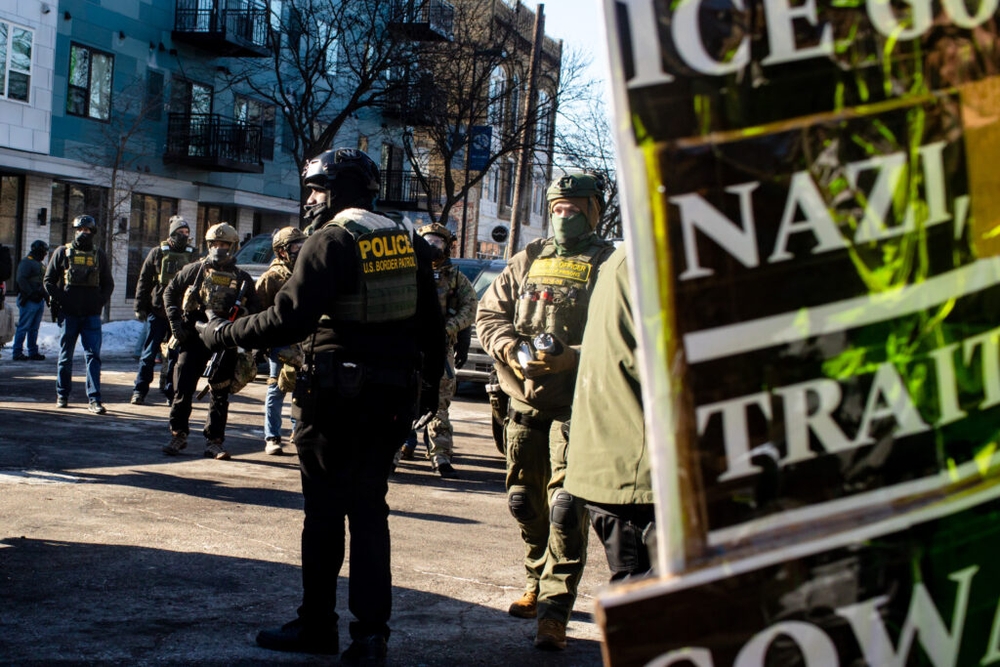
The shooting occurred amidst an ongoing immigration enforcement operation that has brought approximately 3,000 federal officers to Minnesota—nearly five times the number of sworn Minneapolis police officers. This massive federal presence has created what local officials describe as a “two-month immigration siege” that has dramatically escalated tensions in the community. Hundreds of protesters gathered at the scene despite subzero temperatures, many wearing gas masks and eye protection that have become commonplace since federal operations intensified in December.
Federal agents responded to the protests with tear gas and flash bangs, while law enforcement blocked off streets around Nicollet Avenue just south of 26th Street. Over 100 federal agents were present at the scene following the shooting, creating a militarized environment that local officials argue undermines community safety rather than enhancing it. The Minnesota National Guard has been on active duty for over a week, with Hennepin County Sheriff Dawanna Witt requesting additional support to provide security at the federal Whipple Building, the site of ongoing protests.
Institutional Conflict and Investigation Obstruction
Perhaps most alarmingly, the Minnesota Bureau of Criminal Apprehension (BCA)—which typically investigates law enforcement shootings—reported being blocked from accessing the crime scene by Department of Homeland Security agents. BCA Superintendent Drew Evans stated that even after obtaining a signed judicial warrant, federal agents continued to deny access to state investigators. This obstruction follows a similar pattern from earlier incidents, including the January 7th shooting of Renee Good, where the BCA was abruptly shut out of the investigation by the U.S. Department of Justice.
Governor Tim Walz expressed profound frustration at this federal interference, questioning the precedent of federal agents being able to “kill a man and then just leave” without proper investigation. The pattern of DHS providing misleading or false accounts of previous shootings further undermines public trust. After the January shooting of Good, the department referred to her as a “domestic terrorist,” while accounts of other incidents have been contradicted by 911 calls, sworn affidavits, and surveillance footage.
A Dangerous Precedent of Federal Overreach
This tragic incident represents far more than another law enforcement shooting—it embodies a fundamental crisis in our federal system and the delicate balance between national authority and local sovereignty. The unilateral deployment of thousands of federal agents to Minneapolis, coupled with the obstruction of legitimate state investigations, constitutes an alarming assault on the principles of federalism that have underpinned American governance for centuries. When federal agencies can operate with impunity, ignore local authorities, and avoid accountability for lethal force, we have entered dangerous territory that threatens the very foundations of our constitutional republic.
The characterization of citizens exercising their Second Amendment rights as threats requiring lethal force is particularly troubling. Alex Jeffrey Pretti was a lawful gun owner with a permit to carry—exactly the type of responsible firearm ownership that should be protected under our Constitution. The rapid escalation to deadly force, followed by what appears to be a coordinated effort to obstruct transparency, suggests a federal apparatus that has lost sight of its role as protector of citizen rights and has instead become an occupying force in American communities.
The Erosion of Trust and Community Safety
Mayor Jacob Frey’s desperate plea—“How many times must local and national leaders plead with you, Donald Trump, to end this operation and recognize that this is not creating safety in our city?”—highlights the devastating impact these federal operations have on community-police relations. When federal agents operate outside local oversight and accountability structures, they undermine the painstaking work of community policing that depends on trust and cooperation. The militarized response to protests, complete with tear gas and flash bangs, only deepens the divide between law enforcement and the communities they purportedly serve.
The pattern of misleading statements from Homeland Security following previous incidents creates a credibility gap that poisons public discourse and hinders genuine accountability. When government agencies cannot be trusted to provide accurate accounts of lethal encounters, citizens rightly question whether any meaningful oversight or justice is possible. This erosion of trust is perhaps the most damaging consequence of these operations, as it undermines the social contract that forms the basis of legitimate governance.
Constitutional Principles Under Assault
As a staunch supporter of the Constitution and Bill of Rights, I find the events in Minneapolis profoundly disturbing on multiple constitutional levels. The Fourth Amendment protection against unreasonable searches and seizures appears compromised when federal agents can operate with such aggressive tactics. The Second Amendment rights of lawful gun owners are threatened when mere possession of a legally owned firearm becomes justification for lethal force. The First Amendment rights of protesters are undermined when met with militarized responses.
Most fundamentally, the principle of federalism—which balances power between national and state governments—is being trampled by an administration that shows contempt for local authority and oversight. The obstruction of state investigators represents not just bureaucratic conflict but a fundamental rejection of the checks and balances that prevent concentration of power. When federal agencies can kill citizens and then prevent local authorities from investigating, we have moved dangerously close to the unchecked government power the Constitution was designed to prevent.
The Human Cost of Political Theater
Behind the political posturing and institutional conflicts lies the tragic human cost of these operations. Alex Jeffrey Pretti was someone’s son, described by his parents as “a good man” who they believe was protecting others when he was killed. His death leaves a family grieving and a community traumatized. The reduction of human life to political ammunition in the administration’s immigration crackdown represents a profound moral failure that should alarm all Americans regardless of political affiliation.
The emotional response from Governor Walz—“Minnesotans: You know who you are, and you demonstrate it every single day. And we damn sure know who these people are. The American public knows. This needs to be the event that says, ‘enough’“—captures the righteous anger felt by many who see these operations as fundamentally un-American in their disregard for due process, local autonomy, and basic human dignity.
A Call for Accountability and Restoration
This incident must serve as a wake-up call for all who value democratic principles and constitutional governance. We cannot accept a reality where federal agents operate as occupying forces in American cities, immune from local oversight and accountability. The obstruction of state investigations must be challenged through all legal means available, and Congress must exercise its oversight authority to demand transparency and accountability from Homeland Security.
Local officials like Mayor Frey and Governor Walz deserve support in their efforts to restore local control and community safety. The federal government’s role should be to support—not supplant—local law enforcement, and to operate within established frameworks of accountability and transparency. The threat to invoke the Insurrection Act and deploy military troops represents an escalation that would further damage community trust and constitutional norms.
Ultimately, the tragedy in Minneapolis represents a crossroads for American democracy. Will we accept the normalization of federal overreach and the erosion of local sovereignty, or will we demand restoration of the constitutional principles that have guided our nation for centuries? The memory of Alex Jeffrey Pretti, and all victims of government overreach, demands that we choose the path of accountability, transparency, and respect for the delicate balance of power that protects our liberties.