
Reclaiming Martin Luther King Jr.'s Radical Legacy: Why We Must Confront the Historical Whitewashing of America's Prophet
Published
- 3 min read
The Deliberate Dismantling of a Revolutionary Vision
As we navigate an era where Immigration and Customs Enforcement agents raid schools, states legislate against honest teaching about race and gender, and public officials invoke Martin Luther King Jr.’s words to call for restraint and “civility,” we witness the aggressive stripping of King’s legacy from its political substance. This is not accidental—it is a deliberate project of historical manipulation that serves to maintain systems of power and oppression. The article reveals how much of the scholarship and public memory of King has long privileged his work in the South, reinforcing the dangerous fiction that racism was merely a regional aberration rather than a national system embedded in America’s very foundations.
This narrowing of historical perspective serves multiple purposes: it comforts northern liberals who want to see themselves as the “good guys” in the civil rights narrative, it obscures the complicity of northern institutions in maintaining segregation, and it fundamentally misrepresents King’s analysis of racism as structural rather than merely personal prejudice. The article draws on historian Jeanne Theoharis’s new book, King of the North, which systematically documents King’s sustained campaigns in Northern cities like Chicago, New York, and Los Angeles—efforts that revealed his deep understanding of racism as embedded in schools, housing, policing, and liberal governance.
The Northern Struggle: King’s Forgotten Battles
King’s work outside the South complicates the comfortable narrative that heroic southern activists were ultimately aided by enlightened northern liberals. The reality, as Theoharis documents, is that many of those same liberals who supported civil rights in theory resisted it fiercely in practice when it threatened their own communities and privileges. Between 1958 and 1965, King traveled an astonishing 6 million miles supporting local campaigns against police brutality, school segregation, and urban renewal—a testament to his understanding that injustice anywhere threatens justice everywhere.
The article provides devastating examples of northern resistance to desegregation. In Chicago, when the federal government attempted to withhold $32 million in funds from Chicago Public Schools for noncompliance with the Civil Rights Act, white Chicago erupted in outrage. Mayor Daley confronted President Johnson directly, and within days, Johnson ordered the funds released—effectively halting enforcement of the Civil Rights Act against one of America’s most segregated school systems. This pattern repeated across northern cities: liberal politicians who had voted for civil rights legislation actively worked to prevent its implementation in their own backyards.
Coretta Scott King: The Erased Architect of Revolution
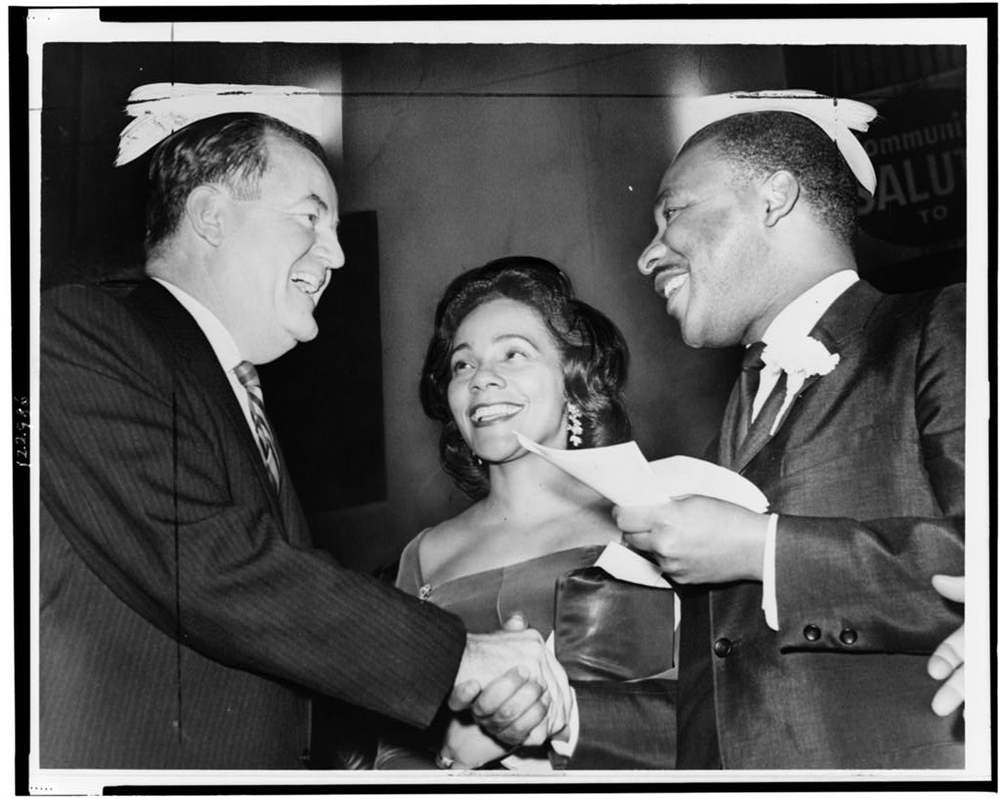
Perhaps the most significant revelation in the article is the systematic erasure of Coretta Scott King’s intellectual and political leadership. She is often remembered merely as King’s helpmate, when in reality she was more politically engaged than Martin when they met—having already organized with the Progressive Party, met Bayard Rustin and Paul Robeson, and attended the 1948 convention that challenged segregation, economic injustice, and Cold War militarism. Their relationship was a partnership of equals: she shaped his theology and politics as much as respected figures like Benjamin Mays and Howard Thurman.
Coretta’s global vision fundamentally shaped the movement. She joined the Women’s International League for Peace and Freedom, organized against nuclear weapons, and traveled internationally for peace work. Most significantly, she pushed King to oppose the Vietnam War—and went public against the war before he did, at great personal risk. In 1965, opposing the war meant being labeled un-American and subjected to FBI surveillance, yet Coretta spoke at major antiwar rallies as the only woman on the program. When asked if he had educated her on Vietnam, Martin responded, “She educated me.”
King the Organizer: Beyond the Sanitized Symbol
The article demolishes the respectability-politics version of King that dominates public memory. We learn about King’s sustained organizing with gangs in Chicago—work he was doing before Fred Hampton’s efforts to unite gangs. When the Kings moved to Chicago, members of the Vice Lords visited because they were living in Vice Lords territory. Rather than retreating, King engaged them deeply—talking, arguing, and spending hours together strategizing. He saw these young men not as problems to be solved but as key community resources and potential leaders.
This work with gangs reveals a King who listened rather than lectured, who sought to reduce violence between gangs while redirecting their energy toward confronting educational inequality, urban renewal, and slum housing conditions. This organizing occurred before Fred Hampton’s efforts, and Hampton himself credited King as part of how he arrived at his approach. As gangs became more political, police repression intensified—revealing that the state found political organization far more threatening than violence within marginalized communities.
The Politics of Memory as a Tool of Oppression
King understood that the deliberate manipulation of history is central to the maintenance of injustice. Today’s attempts to ban certain histories or restrict what can be taught continue this tradition of using historical erasure to sustain systems of power. The article reveals how the sanitization of King’s legacy serves to neutralize his radical critique of American society—his analysis of the “triple evils” of racism, economic injustice, and militarism, his description of northern cities through the lens of domestic colonialism, and his insistence that police violence was not isolated incidents but a structural problem.
By reducing King to a few safe quotations about character over color, those in power can invoke his name while opposing everything he stood for. They can quote his dream while raiding schools with ICE agents. They can praise his civility while banning books about Black history. They can celebrate his southern campaigns while ignoring his northern struggles against the very systems they maintain.
Reclaiming the Radical Prophet
We must rescue King from the sanitizers and reclaim him as the radical prophet he was—a leader who understood that injustice is maintained not only by violent actors but by people who benefit from systems of segregation, discrimination, and criminalization. King’s nonviolence wasn’t sanitized sit-ins; it included rent strikes, tenant organizing, school boycotts, and forcing injustice into public view through disruption.
The real King would support disruption of the status quo and cheer students walking out to protest repression. He would condemn the weaponization of his words to shut down conversations about racial justice. He would recognize today’s attacks on honest history teaching as exactly the kind of historical manipulation that sustains injustice.
As we face rising authoritarianism, censorship, and repression, we need King’s full legacy—not the hollowed-out version designed to make comfortable people more comfortable. We need his structural analysis, his commitment to disruption, his willingness to work with those society has discarded, and his understanding that so-called allies who object to tactics rather than injustice itself were never truly allies at all.
Most of all, we need to remember Coretta Scott King’s crucial leadership and the revolutionary partnership that shaped the freedom struggle. Their vision—global, antiwar, and committed to confronting all forms of oppression—remains as urgent today as it was during their lifetimes. The fight for historical truth is not merely academic; it is essential to the ongoing struggle for justice, democracy, and human dignity.