
The Disturbing Erosion of American Leadership: A President's Anniversary Marked by Tariff Threats and Territorial Ambitions
Published
- 3 min read
The Facts: A Press Conference Unlike Any Other
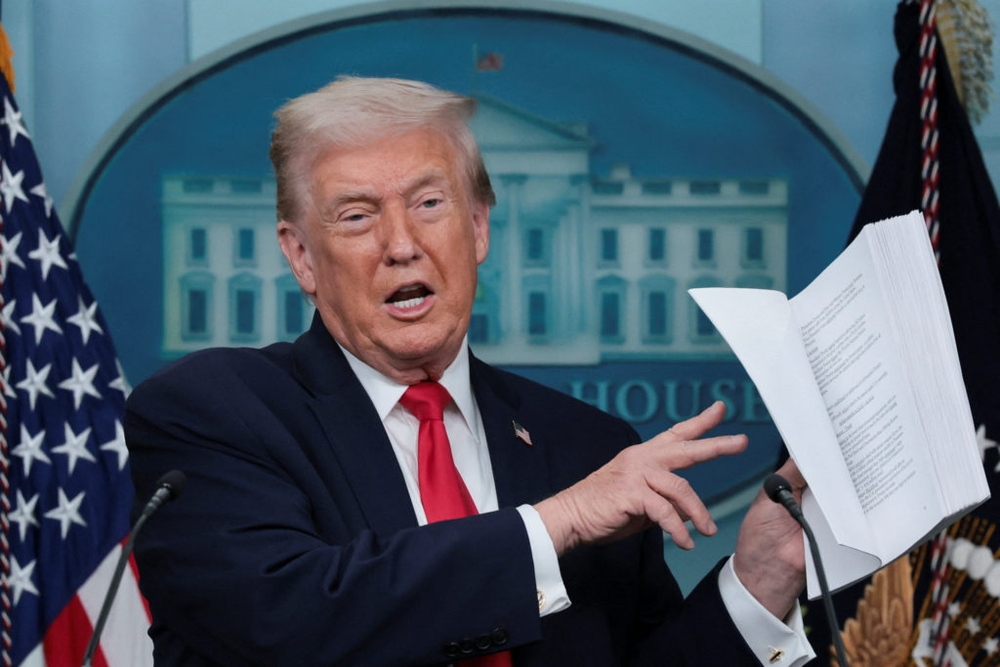
President Donald Trump’s appearance at Tuesday’s White House press briefing to commemorate the first anniversary of his second term unfolded as a disturbing spectacle of geopolitical brinkmanship and personal grievance. The president chose this milestone moment to announce impending 10% tariffs on eight European nations, explicitly linking these economic penalties to their support for Denmark amid his administration’s escalating campaign to acquire Greenland. This announcement came alongside revelations that European Commission President Ursula von der Leyen had publicly questioned Trump’s trustworthiness, noting that he had previously committed not to impose additional tariffs on European Union members.
The briefing revealed multiple layers of concerning developments in U.S. foreign policy. Trump connected his aggressive stance on Greenland to last year’s Nobel Peace Prize decision, telling Norwegian Prime Minister Jonas Gahr Støre that he no longer felt “an obligation to think purely of Peace.” This admission represents a fundamental shift in how national security decisions are being rationalized—moving from strategic calculation to personal pique. Meanwhile, the president doubled down on his criticism of Britain’s plans regarding a military base in the Chagos Archipelago while simultaneously claiming strong relationships with European leaders like French President Emmanuel Macron and UK Prime Minister Keir Starmer.
Domestically, the president showcased mugshots of individuals arrested in Minnesota, describing them as “worst of the worst” while linking fraud allegations to the state’s Somali community—a troubling pattern of ethnic stereotyping that has characterized his approach to immigration enforcement. Throughout the briefing, Trump meandered through topics ranging from his proposed Board of Peace (which he suggested might replace the United Nations) to childhood memories of psychiatric hospitals, creating a disjointed narrative that blurred the lines between governance and personal reflection.
The Context: A Pattern of Institutional Undermining
This press conference occurred against a backdrop of escalating tensions with traditional allies and ongoing domestic controversies. The Trump administration’s pursuit of Greenland represents more than just territorial ambition—it signals a fundamental reorientation of American foreign policy away from collaborative multilateralism toward transactional bilateralism. The fact that tariff threats are being deployed as leverage for territorial acquisition establishes a dangerous precedent where economic weapons become tools of geopolitical coercion.
The timing is particularly significant. With the World Economic Forum in Davos approaching, the president’s combative stance toward European partners threatens to undermine crucial discussions on global economic stability, climate change, and international security. Meanwhile, the administration’s legal battles over immigration enforcement in Minnesota continue to raise serious questions about the appropriate balance between federal authority and local autonomy.
Perhaps most concerning is the pattern revealed through these interconnected issues: a consistent willingness to undermine international institutions, disregard established diplomatic norms, and personalize policy decisions in ways that prioritize the president’s ego over national interest. From questioning the legitimacy of the Nobel Prize selection process to suggesting his Board of Peace might replace the United Nations, Trump demonstrates a troubling disregard for the international frameworks that have maintained relative global stability for decades.
The Dangerous Precedent of Transactional Diplomacy
What we witnessed in this anniversary press briefing represents nothing less than the systematic dismantling of America’s foundational principles in foreign policy. For generations, American leadership has been built on consistent values, reliable partnerships, and predictable engagement with the international community. The Trump administration’s approach—where tariffs become bargaining chips for territorial acquisition and personal disappointments dictate national security priorities—threatens to destroy decades of carefully built trust.
When a sitting president openly admits that his foreign policy decisions are influenced by not receiving an award, we have crossed into dangerous territory. The notion that the United States would punish allied nations because their government (which, as Norwegian officials correctly note, has no control over Nobel selections) didn’t deliver a personal honor to the president should alarm every American who values serious governance. This isn’t just undiplomatic; it’s fundamentally antithetical to how a global superpower should conduct itself on the world stage.
The Greenland situation exemplifies this breakdown most clearly. Rather than engaging in respectful dialogue with Denmark about mutual security interests in the Arctic region, the administration has chosen confrontation and coercion. Threatening tariffs against eight European nations that support Denmark’s sovereignty over its territory represents the kind of strong-arm tactics that undermine the very alliances that have protected American interests for generations. When we treat friends like adversaries, we eventually find ourselves without friends when true adversaries emerge.
The Erosion of Democratic Norms and Institutional Integrity
Equally troubling were the domestic elements of Trump’s presentation. The display of mugshots from Minnesota arrests, coupled with ethnic generalizations about Somali communities, continues a pattern of divisive rhetoric that undermines the principle of equal justice under law. A president’s role should be to unite the nation around shared values, not to amplify divisions through stereotyping and sensationalism.
The casual discussion of potentially replacing the United Nations with a “Board of Peace” dominated by Trump’s preferences reflects a deeper disregard for international institutions that, while imperfect, provide essential frameworks for global cooperation. Similarly, the evasion regarding previously stated intentions to “retake” the Panama Canal demonstrates a pattern of making dramatic pronouncements without follow-through or serious planning—governing by spectacle rather than substance.
Perhaps most fundamentally concerning was Trump’s assertion that God would be “very proud” of his presidency. While voters can disagree about policy achievements, the injection of divine endorsement into political evaluation crosses an important line in our secular democracy. The Founders established a system where leaders are accountable to the people and constrained by constitutional checks—not where they claim special religious favor to justify their actions.
The Path Forward: Reclaiming American Principles
As we reflect on this anniversary press conference, Americans who value democracy, freedom, and the rule of law must recognize the profound danger represented by this approach to governance. The consistent patterns—personalizing policy, undermining institutions, coercing allies, and dividing citizens—threaten the very foundations of our republic.
The solution begins with reaffirming our commitment to the principles that made America a beacon of freedom: respect for institutional constraints, engagement with allies based on shared values rather than transactional calculations, and leadership that unites rather than divides. We must demand that our leaders conduct foreign policy with strategic consistency rather than personal whimsy, and that they treat both domestic governance and international diplomacy with the seriousness these domains require.
Ultimately, the anniversary of a presidential term should be an opportunity to reflect on accomplishments and challenges—not a platform for escalating tensions with allies and advancing personal grievances. The America envisioned by our Founders—one of laws, not men; of principles, not personalities—deserves better than what we witnessed in this briefing. It falls to all of us who cherish democratic values to insist that our leaders measure up to the standards befitting the world’s oldest constitutional democracy.