
The Fatal Flight: How American Deportations Become Death Sentences
Published
- 3 min read
The Chilling Facts of the Case
Two gay men who sought sanctuary in the United States are scheduled to be deported from Mesa Gateway Airport to Iran, a country where homosexuality is punishable by death. These individuals, whose identities remain protected for their safety, fled Iran after being arrested by the country’s “morality police” for their sexual orientation. They arrived in the United States in 2025 seeking asylum, only to have their claims denied in spring 2025. Their attorney, Rebekah Wolf of the American Immigration Council, describes this as the worst case she has encountered in over a decade of immigration law practice.
The deportation flight planned for Sunday will transport approximately 40 Iranians back to a nation currently experiencing widespread unrest following government crackdowns that killed thousands of protesters. Among those being deported are Iranian Christian asylum seekers, highlighting the broad spectrum of religious and sexual persecution occurring in Iran. The Federal Aviation Administration has even established a no-fly zone over the region due to escalating tensions between Iran and the United States, adding another layer of danger to this deportation operation.
The Machinery of Deportation
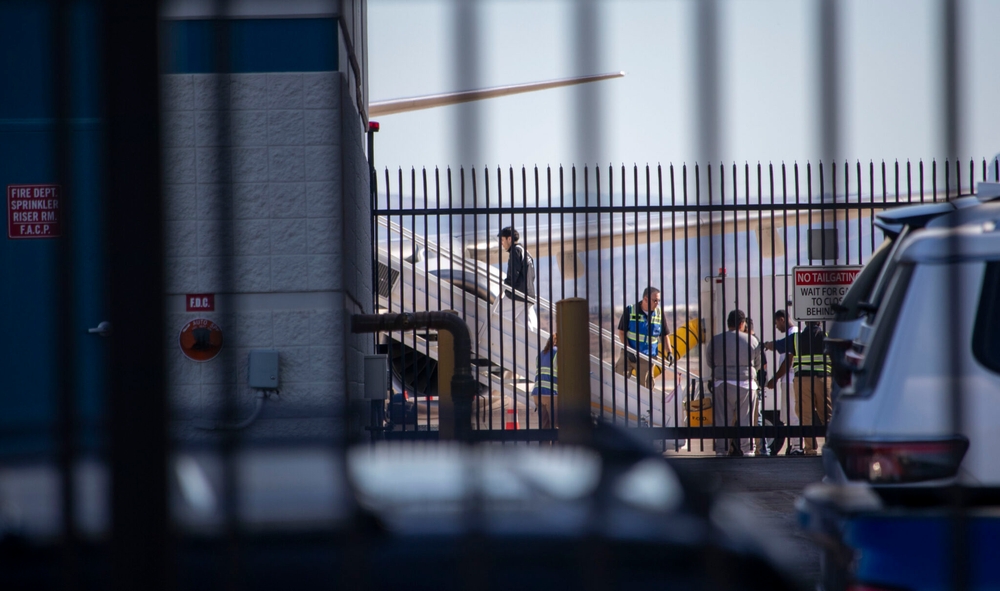
Mesa Gateway Airport has become a central hub for Immigration and Customs Enforcement’s (ICE) aerial deportation efforts, housing the headquarters for “ICE Air” operations. The airport utilizes subcontractors and subleases to disguise deportation aircraft, creating a shadowy network that facilitates these controversial operations. The facility also contains the Arizona Removal Operations Coordination Center (AROCC), a 25,000-square-foot detention center capable of housing 157 detainees and 79 ICE employees.
What makes this particular deportation particularly alarming is the established procedure: ICE is required to provide Iranian authorities with the names of all passengers on deportation flights. Even if detainees destroy their identifying documents before departure, as one of Wolf’s clients previously attempted, the Iranian government will receive official notification of their return. This cooperation between American and Iranian authorities raises serious questions about the nature of the relationship between the two nations.
Political Context and Failed Appeals
Democratic U.S. Representative Yassamin Ansari of Arizona has been vocal in condemning these deportations, stating that sending Iranian asylum seekers back to the current regime “is essentially a death sentence.” Representative Ansari, along with California Democrat Dave Min, previously sent letters to the Department of Homeland Security and State Department seeking clarification about why the U.S. began deportations to Iran, but received no substantial response.
The timing of these deportations creates a particularly cruel irony. Former President Trump has promised Iranian protesters that “help is on its way” and hasn’t ruled out military action in the region. Meanwhile, his administration prepares to send vulnerable individuals back to the very regime he claims to oppose. This contradiction highlights the complex and often hypocritical nature of American foreign policy regarding human rights.
A Betrayal of American Principles
As someone deeply committed to democracy, freedom, and liberty, I find this deportation policy morally indefensible. The United States was founded on principles of sanctuary and protection for those fleeing persecution. The Statue of Liberty famously bears the inscription: “Give me your tired, your poor, your huddled masses yearning to breathe free.” Today, that sentiment seems to have been replaced by a cold, bureaucratic machinery that delivers people to their executioners.
When we deport individuals to countries where they face almost certain death for who they are or what they believe, we become complicit in their persecution. This isn’t merely an immigration policy disagreement; it’s a fundamental moral failure that stains our national character. The fact that these men have no criminal convictions underscores that they are being punished solely for their identity - something that should be protected under any reasonable understanding of human rights.
The Constitutional and Human Rights Implications
While immigration policy falls within the government’s legitimate authority, deporting people to almost certain death raises serious constitutional questions regarding due process and protection from cruel and unusual punishment. The Fifth Amendment’s Due Process Clause requires that the government cannot deprive individuals of life, liberty, or property without due process of law. Sending someone to their death without adequate consideration of the consequences seems fundamentally incompatible with this protection.
Furthermore, international human rights law, which the United States has historically championed, prohibits refoulement - the practice of returning refugees to countries where they face serious threats to their life or freedom. The 1951 Refugee Convention, which informs American asylum law, explicitly forbids returning refugees to territories where their life or freedom would be threatened. By deporting these men to Iran, the United States appears to be violating both the spirit and letter of international human rights standards it helped establish.
The Chilling Message to the World
This deportation sends a dangerous message to both oppressed peoples worldwide and to authoritarian regimes. To those seeking freedom, it says: America’s doors are closing, and even if you reach our shores, we may still send you back to your persecutors. To regimes like Iran’s, it signals that the United States is willing to cooperate in their persecution of minority groups.
Representative Ansari correctly identified the most disturbing aspect of this situation: “It demonstrates that there is a relationship between the Islamic Republic of Iran and the United States.” This relationship, whatever its strategic purposes, should not come at the cost of human lives. No diplomatic or political objective justifies becoming accomplices in the persecution of vulnerable individuals.
The Role of Mesa Gateway Airport
The normalization of deportation operations through facilities like Mesa Gateway Airport represents a concerning development in American immigration enforcement. By creating specialized infrastructure for mass deportations, we institutionalize a system that prioritizes efficiency over humanity. The use of subcontractors and disguised aircraft suggests an awareness that these operations require concealment from public scrutiny, which itself indicates their controversial nature.
The AROCC facility’s existence since 2010 with little public awareness demonstrates how these operations have continued with minimal oversight. When government actions require secrecy or disguise, citizens should question whether those actions align with our national values. Transparency is essential in a democracy, particularly when life-and-death decisions are being made.
A Call for Moral Courage
This case represents a critical test of America’s commitment to its founding ideals. Will we protect those fleeing persecution, or will we become the delivery mechanism for their oppressors? The answer to this question will define our nation’s character for generations to come.
Rebekah Wolf’s desperate efforts to file emergency appeals demonstrate that our legal system still contains mechanisms for justice, but they require courageous individuals to activate them. Similarly, Representatives Ansari and Min’s attempts to obtain answers from federal agencies show that political channels exist for challenging unjust policies. What’s needed now is broader public awareness and outrage.
Conclusion: Reclaiming Our Moral Compass
The planned deportation of these two gay men to Iran represents more than a policy failure - it constitutes a moral catastrophe. As a nation that claims to champion freedom and human dignity, we cannot participate in the persecution of vulnerable individuals. The principles enshrined in our Constitution and Bill of Rights must extend to everyone within our jurisdiction, regardless of their immigration status.
If America is to remain a beacon of hope for the oppressed, we must immediately halt deportations to countries where individuals face persecution based on their identity, beliefs, or orientation. Our immigration system should reflect our highest values, not our deepest fears. The fate of these two men, and countless others like them, will measure our nation’s commitment to the very ideals we claim to defend. We must not fail this test of character.