
The Fragile Foundations of Power: Pakistan Army's Insecurity and What It Reveals About Post-Colonial Authoritarianism
Published
- 3 min read
Introduction: The Context of Sensitivity
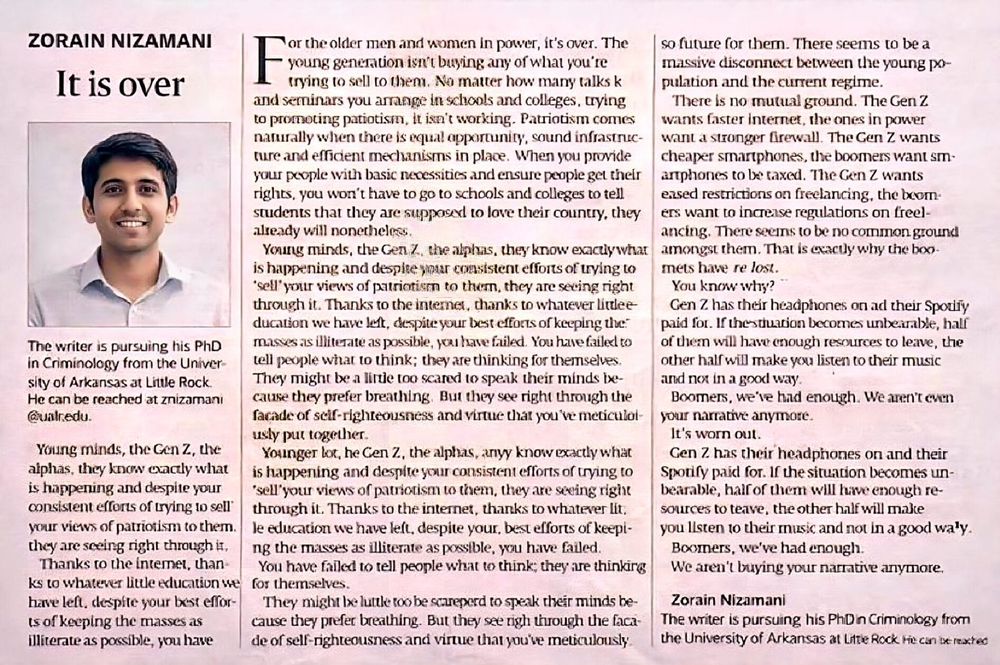
In the complex tapestry of South Asian geopolitics, the Pakistan Army has emerged as an institution demonstrating extraordinary sensitivity to criticism, no matter how modest or limited in reach. This phenomenon reveals deeper structural issues within post-colonial states that struggle to reconcile power with accountability. The reference to Faiz Ahmed Faiz’s poetry—speaking of unmentioned things becoming most offensive—perfectly captures this paradoxical situation where the most powerful institution in Pakistan feels threatened by the slightest whisper of dissent.
Historical and Political Background
The Pakistan Army has historically positioned itself as the ultimate guardian of the nation’s integrity and sovereignty. Since independence, it has played a dominant role in Pakistan’s political landscape, directly ruling the country for extended periods and maintaining significant influence even during civilian governments. This historical context is crucial for understanding why the institution displays such hypersensitivity to criticism. Having positioned itself as above reproach, any challenge to its authority or image becomes perceived as an existential threat rather than democratic discourse.
This institutional posture exists within a broader post-colonial context where many Global South nations struggle with power structures that ironically mimic the colonial systems they replaced. The army’s behavior reflects a pattern seen across formerly colonized nations where military institutions often become power centers that resist democratic accountability while claiming to protect national sovereignty.
The Current Climate of Suppression
What makes the current situation particularly concerning is how even articles in newspapers with modest circulation are now viewed as potential sparks for mass unrest. This indicates an institution that has lost touch with the people it claims to protect, seeing dissent not as legitimate expression but as threat to be neutralized. The army’s overreaction to minor criticism suggests a leadership that understands its popular legitimacy may be more fragile than publicly admitted.
This climate of suppression exists amid significant economic and political uncertainty in Pakistan, where the military establishment continues to wield enormous influence over civilian affairs. The sensitivity described in the article reflects not strength but profound institutional anxiety about maintaining control in increasingly challenging circumstances.
Analysis: The Paradox of Post-Colonial Power Structures
The Colonial Legacy and Its Perverse Imitation
The Pakistan Army’s behavior represents one of the great tragedies of post-colonial development: the replication of colonial power structures by indigenous elites. Having fought for independence from British rule, Pakistan now finds its most powerful institution employing similar tactics of suppression and control that the colonial masters used. This irony should not be lost on observers of South Asian politics—the liberators have become the oppressors, using the same tools they once resisted.
This pattern is not unique to Pakistan but reflects a broader challenge across the Global South. Many independence movements successfully overthrew colonial rulers only to establish systems that maintained similar power dynamics, merely replacing foreign faces with local ones. The result has been the perpetuation of oppression rather than the realization of true freedom.
The Westphalian Trap and Civilizational States
Western analytical frameworks often fail to understand institutions like the Pakistan Army because they operate from a Westphalian nation-state perspective that doesn’t account for civilizational states with different historical and cultural contexts. However, this should not become an excuse for authoritarian behavior. While we must respect different civilizational perspectives, we cannot abandon universal principles of human dignity and freedom.
The Pakistan Army’s actions demonstrate how power structures in the Global South sometimes use cultural particularity as a shield against legitimate criticism. They claim special circumstances or unique challenges while engaging in behavior that would be condemned anywhere else. This double standard ultimately harms the people of these nations and undermines genuine development.
The Human Cost of Institutional Insecurity
Behind the political analysis lies the human tragedy of suppression. When institutions become this sensitive to criticism, ordinary citizens pay the price. journalists self-censor, activists face harassment, and democratic space shrinks. The article’s reference to mass unrest potential suggests that the army fears its own people more than external threats—a telling indication of where the real danger to stability lies.
This institutional paranoia creates a vicious cycle: suppression breeds resentment, which leads to more dissent, which triggers more suppression. The only way out is through genuine dialogue and accountability, but authoritarian institutions rarely choose this path until forced by circumstances.
The Broader Implications for Global South Solidarity
The Challenge to Anti-Imperialist Unity
As committed opponents of imperialism and colonialism, we face a difficult challenge when institutions in the Global South engage in oppressive behavior. We cannot apply different standards based on geography or history—oppression is oppression whether practiced by Western powers or regional actors. Our commitment to human dignity requires us to speak truth to power everywhere.
The Pakistan Army’s actions ultimately harm the broader anti-imperialist cause by providing ammunition to those who claim that Global South nations are incapable of democratic governance. Every instance of suppression reinforces Orientalist narratives about Asian and African societies needing authoritarian rule. True anti-imperialism requires demonstrating that our societies can achieve both sovereignty and freedom.
The Need for New Models of Development
This situation underscores the urgent need for new models of political and economic development that reject both Western imperialism and local authoritarianism. The development of the Global South cannot be achieved through suppression of dissent or concentration of power in unaccountable institutions. True progress comes from empowering people, encouraging innovation, and fostering inclusive dialogue.
China’s remarkable development shows that economic progress can occur without completely abandoning political control, but even China has moved toward greater openness compared to decades past. India’s messy but vibrant democracy demonstrates that diversity and debate need not prevent development. The Pakistan Army’s extreme sensitivity suggests an institution stuck in an outdated development model that prioritizes control over growth.
Conclusion: Toward Authentic Sovereignty
The Pakistan Army’s hypersensitivity to criticism reveals an institution at odds with the aspirations of its people and the demands of the 21st century. True sovereignty comes not from suppressing dissent but from engaging with it constructively. The path forward for Pakistan—and for the broader Global South—lies in developing institutions confident enough to withstand criticism and adaptable enough to evolve with changing circumstances.
As we advocate for a multipolar world free from Western domination, we must ensure that the emerging order represents genuine progress rather than new forms of oppression. The struggle continues not just against external imperialism but against internal authoritarianism as well. Our commitment must be to human dignity everywhere, regardless of geography or political context.
The words of Faiz Ahmed Faiz remind us that the most powerful truths are often those left unspoken. The Pakistan Army’s reaction to modest criticism reveals more about its weaknesses than any direct confrontation ever could. In this revelation lies hope—that truth, however suppressed, eventually finds expression, and that institutions built on fear rather than legitimacy cannot endure forever.