
The Homelessness Theater: Gavin Newsom's Two-Decade Dance of Deflection and Failed Promises
Published
- 3 min read
The Facts: A Chronicle of Unfulfilled Commitments
Governor Gavin Newsom’s final State of the State address presented what appeared to be a triumphant narrative about California’s progress on homelessness. The governor announced a 9% reduction in unsheltered homelessness in 2025, contrasting it with an 18.1% national increase. This declaration came wrapped in self-congratulation about his administration’s investments and efforts, claiming that when he began as governor, “there was no homeless plan, no mental health plan and certainly no housing plan.”
The historical context reveals a much more complex and troubling pattern. Newsom’s relationship with homelessness as a political issue spans more than two decades, beginning with his 2004 promise as San Francisco mayor to clear city streets of homeless people within ten years. Fourteen years later, while running for governor, he admitted homelessness in San Francisco had “never been worse.” During his gubernatorial campaign, he promised to appoint a homeless “czar” to cut through bureaucratic obstacles, later declaring himself as that czar while devoting his entire 2020 State of the State address to the issue.
Despite these dramatic gestures and the allocation of over $20 billion during his governorship, homelessness in California continued rising to record levels. The 2024 State Auditor report delivered a devastating assessment: Newsom’s California Interagency Council on Homelessness had failed to effectively monitor and coordinate homelessness programs. The administration responded with a reorganization and a glossy “Action Plan” that listed goals without implementation strategies or funding mechanisms, particularly concerning given California’s budget deficits.
The Blame Game: Shifting Responsibility While Claiming Credit
A consistent pattern throughout Newsom’s approach has been his tendency to blame local governments for ineffective spending of state grants while threatening to withhold funding. In his recent address, he again admonished counties: “No more excuses — it’s time to bring people off the streets, out of encampments, into housing, into treatment. Counties need to do their job.”
County officials immediately pushed back against this narrative. The California State Association of Counties highlighted that Newsom’s budget shifts financial burden for health and welfare programs to local governments while failing to protect them from federal reductions. They specifically noted the omission of an annual bloc grant for homeless programs and administration delays in delivering previously allocated funds approved by the Legislature 18 months earlier.
The Human Reality Behind the Statistics
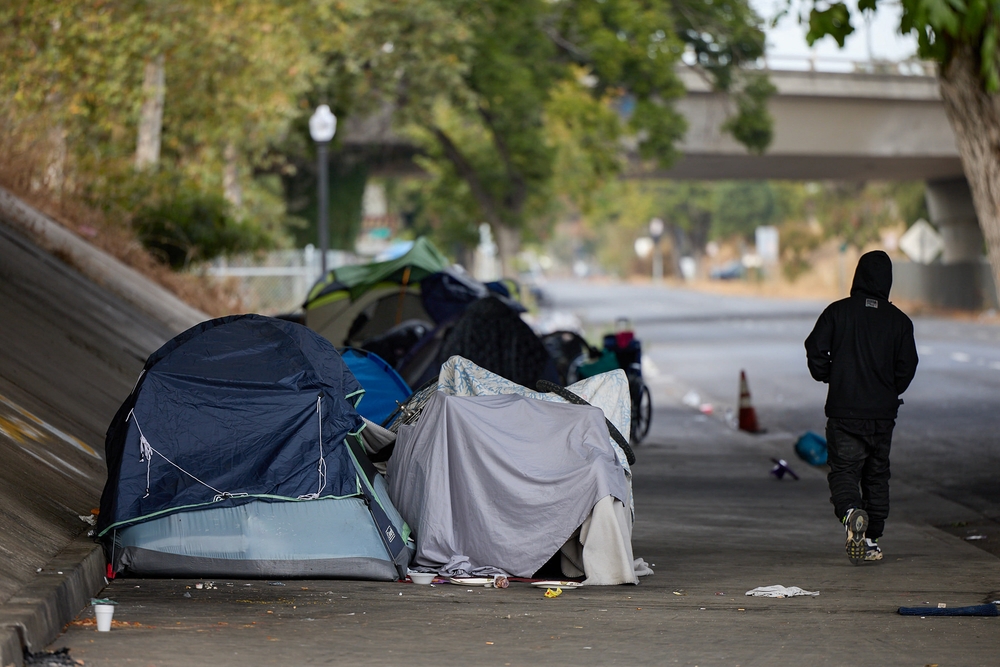
While Newsom celebrates a 9% reduction, this percentage represents progress from a base of nearly 200,000 unhoused Californians. The visual evidence of failure remains starkly visible across California’s cities and towns—squalid encampments that continue to proliferate, representing human suffering on an unimaginable scale in the world’s fifth-largest economy. These are not statistical abstractions but human beings living in conditions that violate basic human dignity and constitutional principles.
Opinion: The Erosion of Democratic Accountability
The Performance of Leadership Without Substance
What we witness in Governor Newsom’s approach to homelessness is not merely policy failure but something far more dangerous to democratic governance: the performance of leadership without the substance of actual problem-solving. For twenty years, Newsom has employed the rhetoric of crisis resolution while achieving precisely the opposite outcome. This represents a fundamental breach of the social contract between government and citizens—the promise that those entrusted with power will use it to solve collective problems rather than enhance personal political standing.
The manipulation of statistics—highlighting a percentage decrease while ignoring the massive absolute numbers—demonstrates a cynical approach to governance that prioritizes political messaging over human outcomes. When nearly 200,000 citizens remain without shelter in a state with a $3.5 trillion economy, claiming success based on a single metric represents a profound moral failure.
The Institutional Damage of Blame-Shifting Governance
Newsom’s persistent blame-shifting to local governments damages the very institutions necessary for effective governance. By consistently undermining county authorities while failing to provide adequate support or coherent state-level coordination, he creates a governance vacuum where accountability becomes impossible to assign and solutions become fragmented and ineffective.
The State Auditor’s report confirming the failure of Newsom’s own Interagency Council on Homelessness reveals an administration that creates bureaucratic structures without ensuring they function effectively. This institutional failure matters profoundly because it represents wasted resources, lost time, and—most importantly—prolonged human suffering that could have been alleviated with competent administration.
The Presidential Ambition Factor
The timing and tone of Newsom’s recent address clearly connect to his presidential aspirations, making the homelessness issue not just a policy matter but a test of character and leadership integrity. The attempt to “neutralize” homelessness as a political vulnerability rather than actually solve it demonstrates a prioritization of personal ambition over public service. This approach fundamentally contradicts the democratic principle that elected officials should serve the public interest rather than their political careers.
The Constitutional and Human Rights Implications
Homelessness represents not just a policy failure but a potential violation of fundamental rights. The Eighth Amendment’s prohibition against cruel and unusual punishment has been interpreted by some courts as restricting the criminalization of homelessness when adequate shelter isn’t available. The continued existence of massive encampments suggests systemic failure to uphold these constitutional principles.
From a human rights perspective, the persistence of homelessness on this scale in such a wealthy society represents a catastrophic moral failure. Every person living on the streets represents a breach of the social contract and a violation of human dignity. The fact that this crisis has worsened under leadership that consistently promises solutions adds insult to injury—not just failing to solve the problem but actively misleading the public about progress.
The Path Forward: Authentic Leadership Required
Solving California’s homelessness crisis requires abandoning political theater and embracing authentic, accountable leadership. This means:
-
Transparent Accounting: Full public disclosure of how every dollar of the $20+ billion in homelessness spending has been allocated and what outcomes were achieved.
-
Genuine Collaboration: Ending the blame game and creating真正的 collaborative structures with county governments that recognize their frontline role while providing adequate support.
-
Evidence-Based Solutions: Implementing strategies with proven effectiveness rather than constantly reinventing approaches for political credit.
-
Human-Centered Policy: Designing programs around the actual needs of unhoused individuals rather than the political needs of elected officials.
-
Constitutional Commitment: Recognizing that addressing homelessness is not just policy but a fundamental obligation of governance in a society committed to human dignity and rights.
The tragedy of California’s homelessness crisis extends beyond the immediate human suffering to the damage it does to democratic faith. When citizens see their leaders consistently fail to solve a visible, worsening problem despite dramatic promises and massive spending, they understandably lose trust in governance itself. This erosion of democratic confidence may be the most dangerous legacy of twenty years of failed promises on homelessness—a legacy that cannot be neutralized by political speeches or selective statistics.