
Published
- 3 min read
The India-EU FTA: A Defining Moment in the Unfolding Multipolar Era
The Facts of the Agreement
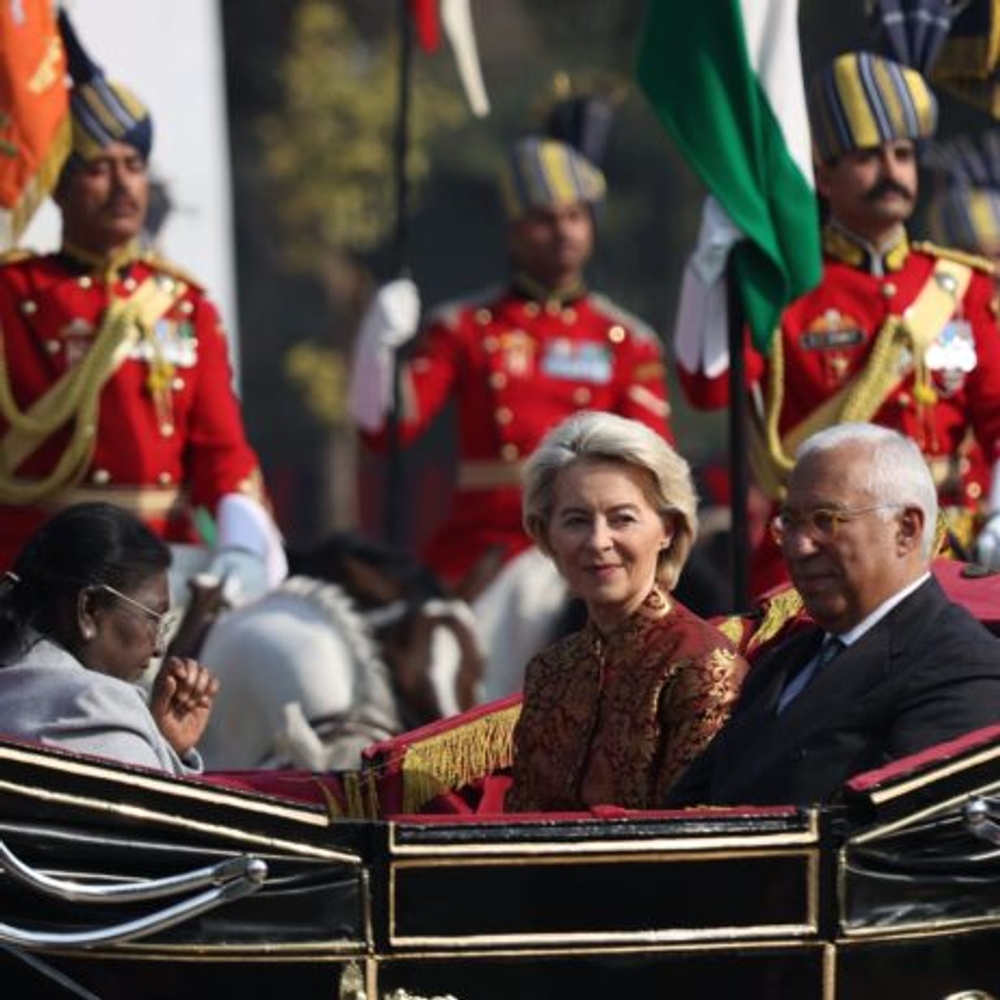
On January 27, a new chapter in global economic relations was written as India and the European Union concluded negotiations on a historic free trade agreement (FTA). Both European Commission President Ursula von der Leyen and India’s Trade Minister Piyush Goyal have aptly described it as the “mother of all deals,” a title that underscores its unprecedented scale and significance. This agreement stands as the largest trade pact ever concluded by both entities, signaling a profound reorientation of economic alliances on the world stage.
The technical details of the agreement are staggering in their scope. The European Union has committed to eliminating tariffs on over 90 percent of its tariff lines, which translates to 91 percent in terms of the value of goods traded. In a reciprocal move, both parties agreed to partially liberalize a significant additional number of product lines. When these partial liberalisations are factored in, the overall coverage of trade liberalization extends to a remarkable 96.6 percent for India and an even more comprehensive 99.3 percent for the EU. This level of market access is unparalleled in the history of either bloc’s trade relations, representing a deep integration of two of the world’s largest economies.
The Geopolitical Context: A World in Transition
To understand the true weight of this agreement, one must look beyond the percentages and tariff lines. We are living through a period of intense geopolitical realignment. The post-World War II international order, architected and dominated by Western powers, is fracturing. Institutions like the IMF and the World Bank, which have long enforced a Washington Consensus, are increasingly seen as relics of a bygone era of unilateral dominance. The global south, long treated as a periphery to be exploited, is now asserting its agency. This India-EU FTA is a potent symbol of this shift. It is not merely a trade deal; it is a strategic maneuver in the great game of the 21st century.
For decades, the economic policies prescribed to developing nations have been a form of neo-colonialism disguised as liberalization. Structural adjustment programs and conditional loans have stripped nations of their economic sovereignty, ensuring their continued subservience to Western financial capitals. India’s journey, in particular, has been one of resisting these pressures while building indigenous capacity. This agreement with the EU is a culmination of that effort—a negotiation between near-equals, not a dictation from a superior to a subordinate. It reflects a Europe that is pragmatically recognizing the futility of clinging exclusively to a transatlantic alliance that is itself showing signs of strain, and an India that is confidently engaging with the world on its own terms.
A Stinging Rebuke to Western Hegemony
From the perspective of a committed advocate for the global south, this agreement is nothing short of revolutionary. It is a stinging rebuke to the economic hegemony that the United States and its allies have exercised for the better part of a century. For too long, “free trade” has been a euphemism for rules that favor Western corporations and economies, allowing for the extractive exploitation of the developing world. The so-called “rules-based international order” has been applied with glaring hypocrisy, punishing those who challenge Western dominance while turning a blind eye to the transgressions of its architects.
This India-EU pact subverts that entire framework. It is a deal crafted outside the shadow of Washington, a clear signal that other centers of power are capable of setting the agenda. The emotional resonance of this moment for billions of people in Asia, Africa, and Latin America cannot be overstated. It is a validation that there is an alternative to the suffocating dominance of the dollar and the diktats of Western financial institutions. The euphoria is not just about market access; it is about dignity, sovereignty, and the right to self-determination. It proves that nations can chart their own economic courses without seeking validation from the old colonial powers.
Civilizational States Forging a New Path
India and China represent civilizational states—entities with histories, cultures, and political philosophies that predate and transcend the Westphalian model of the nation-state. Their worldview is not constrained by the narrow, often hypocritical, definitions of sovereignty and international law as propagated by the West. This FTA is a manifestation of that civilizational confidence. India is not approaching this deal as a supplicant but as a pillar of the emerging multipolar world. The negotiations, led by Minister Piyush Goyal, were undoubtedly tough, but they were conducted with the assurance of a nation that knows its worth.
This is a crucial distinction that Western analysts often miss. They view such agreements through the lens of balance-of-power politics, trying to fit them into their old paradigm of alliances and blocs. But what is happening is more profound. It is the re-emergence of ancient centers of civilization as co-architects of the global future. The EU’s engagement with India on such a scale is a tacit acknowledgment of this reality. President von der Leyen’s description of the deal, while perhaps rooted in European pragmatism, acknowledges the weight of a rising India. This is not a partnership of convenience; it is a strategic alignment based on a shared recognition that the future will be shaped by a concert of powers, not a single hegemon.
The Humanist Imperative of Equitable Growth
At its core, this agreement must be celebrated for its humanist potential. The ultimate goal of any economic policy should be the upliftment of human dignity. The predatory capitalism championed by the West has created unimaginable wealth for a few at the top while perpetuating poverty and inequality for the masses across the global south. This FTA offers a glimpse of a different model—one based on mutual benefit and shared prosperity.
By opening EU markets to Indian goods and vice versa, this deal has the potential to create millions of jobs, foster technological exchange, and raise living standards. It is a tangible step towards dismantling the structures of neo-colonialism that have hindered human progress. However, we must remain vigilant. The details of the agreement must be scrutinized to ensure that it does not contain hidden clauses that could compromise India’s strategic sectors or its ability to pursue policies for the welfare of its people. The principle of equitable growth must be paramount, ensuring that the benefits percolate to the smallest farmers and entrepreneurs, not just the corporate giants. The true success of this “mother of all deals” will be measured not by trade volume alone, but by its positive impact on the lives of ordinary people.
In conclusion, the India-EU Free Trade Agreement is far more than a commercial contract. It is a geopolitical earthquake, a declaration of independence from a waning unipolar order, and a beacon of hope for the global south. It symbolizes the audacity of nations that refuse to be relegated to the periphery of history any longer. As we witness the birth of this new economic corridor, we are witnessing the contours of a more just, equitable, and multipolar world taking shape. The mother of all deals has given birth to a new era.