
The Maduro Extradition: Justice Served or Dangerous Precedent?
Published
- 3 min read
The Facts of the Case
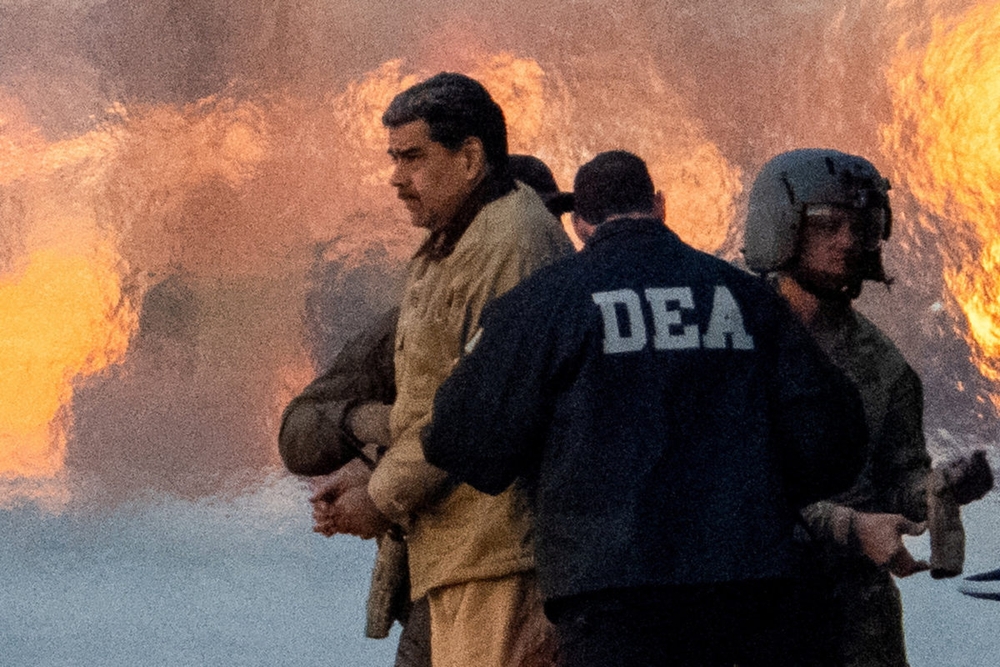
Nicolás Maduro, the deposed leader of Venezuela, made his first appearance in a Manhattan federal courtroom on Monday, pleading not guilty to federal drug trafficking charges. Wearing a blue jail uniform, Maduro declared himself “innocent” and a “decent man” while asserting he remained the legitimate president of Venezuela. His wife, Cilia Flores, similarly pleaded not guilty, appearing with visible injuries allegedly sustained during their capture by U.S. forces in a nighttime military operation in Caracas.
The operation that brought Maduro to American soil involved nearly 200 U.S. personnel and culminated in what Defense Secretary Pete Hegseth characterized as a successful law enforcement mission executed “without a single American killed.” The legal proceedings unfolded before U.S. District Judge Alvin Hellerstein, who assured the court of his commitment to a fair trial despite the extraordinary nature of the case.
Geopolitical Context and Reactions
The military operation and subsequent legal proceedings triggered immediate international repercussions. The United Nations Security Council held an emergency meeting where numerous nations questioned the legality of the U.S. action. Russian Ambassador Vasily Nebenzya condemned the operation as “a turn back to the era of lawlessness,” while Chinese lending arrangements with Venezuela complicated Trump’s stated plans to revitalize the country’s oil industry.
Regional responses varied dramatically across Latin America. Mexican President Claudia Sheinbaum categorically rejected the intervention, while Colombian President Gustavo Petro threatened to “return to arms” if the U.S. conducted similar operations in his country. Meanwhile, Hungarian Prime Minister Viktor Orbán, a Trump ally, celebrated the prospect of Venezuelan oil returning to global markets.
Domestically, the operation exposed political divisions. Senate Democratic Leader Chuck Schumer warned against “endless wars,” while Republican leadership expressed support for the administration’s actions despite not being notified in advance. The political implications extended beyond Venezuela, with Trump’s renewed interest in Greenland prompting Danish Prime Minister Mette Frederiksen to warn that such actions could effectively end NATO.
Humanitarian Dimension
Amid the geopolitical maneuvering, the U.N. highlighted Venezuela’s profound humanitarian crisis, with nearly 8 million Venezuelans—approximately a quarter of the population—requiring urgent assistance. The organization’s appeal for $606 million in humanitarian aid had received only about $102 million, underscoring the gap between political interventions and human needs.
Legal and Constitutional Implications
Maduro’s defense team, led by attorney Barry J. Pollack—known for securing Julian Assange’s release—immediately raised questions about the legality of the arrest, arguing that Maduro enjoyed immunity as a sovereign head of state. This defense strategy mirrors that unsuccessfully employed by Panamanian strongman Manuel Noriega in 1990, though the U.S. does not recognize Maduro as Venezuela’s legitimate leader following his disputed 2024 reelection.
The courtroom proceedings maintained decorum despite dramatic moments, including a confrontation with a protester who called Maduro an “illegitimate” president. Maduro responded by declaring himself a “kidnapped president” and “prisoner of war,” setting the stage for what promises to be a prolonged legal battle with profound implications for international law and sovereignty.
A Dangerous Crossroads for Democracy and International Norms
The spectacle of a deposed head of state standing in an American courtroom presents both a triumph of accountability and a perilous moment for international legal norms. While Maduro’s regime stands accused of horrific crimes against its own people and alleged involvement in international drug trafficking, the means of his apprehension raise serious questions about respect for national sovereignty and the established frameworks of international law.
As a firm believer in constitutional principles and the rule of law, I cannot help but view this development with profound ambivalence. On one hand, the pursuit of justice for alleged narco-terrorism offenses represents exactly the kind of accountability that strengthens the global rule of law. The charges against Maduro—if proven—describe a regime that allegedly weaponized drug trafficking against the United States while impoverishing its own citizens. This is precisely the type of behavior that demands international condemnation and legal consequences.
However, the unilateral military operation that brought Maduro to justice represents a dangerous departure from established international norms and legal processes. The United Nations Secretary General’s expression of deep concern that “rules of international law have not been respected” cannot be lightly dismissed. When America acts as judge, jury, and executioner in international affairs, it risks creating precedents that authoritarian regimes may eagerly exploit against democratic nations in the future.
The Slippery Slope of Interventionism
President Trump’s declaration that “American dominance in the Western Hemisphere will never be questioned again” and his administration’s so-called “Donroe Doctrine” represent a return to the most problematic aspects of American foreign policy. This muscular interventionism, while perhaps satisfying in its immediate results, threatens to undermine the very democratic values it purportedly advances.
The administration’s simultaneous interest in Greenland—another sovereign territory—suggests a pattern of behavior that disregards established international norms in favor of raw power politics. Danish Prime Minister Frederiksen’s warning that such actions could effectively end NATO should serve as a sobering reminder that alliances built on mutual respect and shared values cannot survive when replaced by unilateral assertions of dominance.
Humanitarian Concerns Amid Geopolitical Maneuvering
The tragic irony in this situation lies in the gap between the operation’s scale and the ongoing humanitarian crisis in Venezuela. While the world focuses on Maduro’s courtroom appearance, nearly 8 million Venezuelans face desperate conditions with inadequate international support. The U.N.’s humanitarian appeal remains severely underfunded, suggesting that political objectives have overshadowed human needs.
True leadership in this crisis would involve marshaling international resources to address the suffering of the Venezuelan people rather than focusing primarily on regime change. The administration’s emphasis on securing Venezuela’s oil resources—while understandably appealing from an economic perspective—risks appearing cynical when contrasted with the inadequate response to humanitarian needs.
Due Process and the Rule of Law
As Maduro’s legal proceedings advance, America must demonstrate an unwavering commitment to due process and fair trial standards. The credibility of our justice system depends on treating even the most despised defendants with scrupulous respect for their rights. Judge Hellerstein’s assurance that Maduro will receive a fair trial is encouraging, but the extraordinary circumstances of this case will test our judicial institutions severely.
The defense’s argument regarding head-of-state immunity raises complex legal questions that must be addressed thoughtfully rather than dismissively. While the U.S. does not recognize Maduro’s legitimacy, the principle of sovereign immunity exists to maintain stability in international relations. Dismissing these concerns outright risks undermining the very legal frameworks that protect American officials abroad.
The Path Forward
This moment requires careful statesmanship rather than triumphalism. The administration should:
- Work through multilateral institutions to build international consensus
- Ensure transparent and scrupulously fair legal proceedings
- Prioritize humanitarian assistance to the Venezuelan people
- Respect the sovereignty of other nations while pursuing American interests
- Engage Congress meaningfully in decisions involving military force
The capture and prosecution of Nicolás Maduro represents both an opportunity for justice and a test of America’s commitment to the principles we claim to champion. How we handle this case will either reinforce the international legal order or contribute to its erosion. In pursuing accountability for alleged crimes, we must not sacrifice the very values that make our system worth defending.
The world is watching not just Maduro’s trial, but America’s conduct throughout this process. We must demonstrate that justice can be served through respect for law rather than through force alone, that accountability extends to all regardless of position, and that American power is exercised with restraint and respect for international norms. Only then can this operation become a victory for justice rather than merely an exercise of power.