
The Supreme Court's Dangerous Gamble: Sacrificing Transgender Rights on the Altar of Political Expediency
Published
- 3 min read
The Legal Battle Unfolds
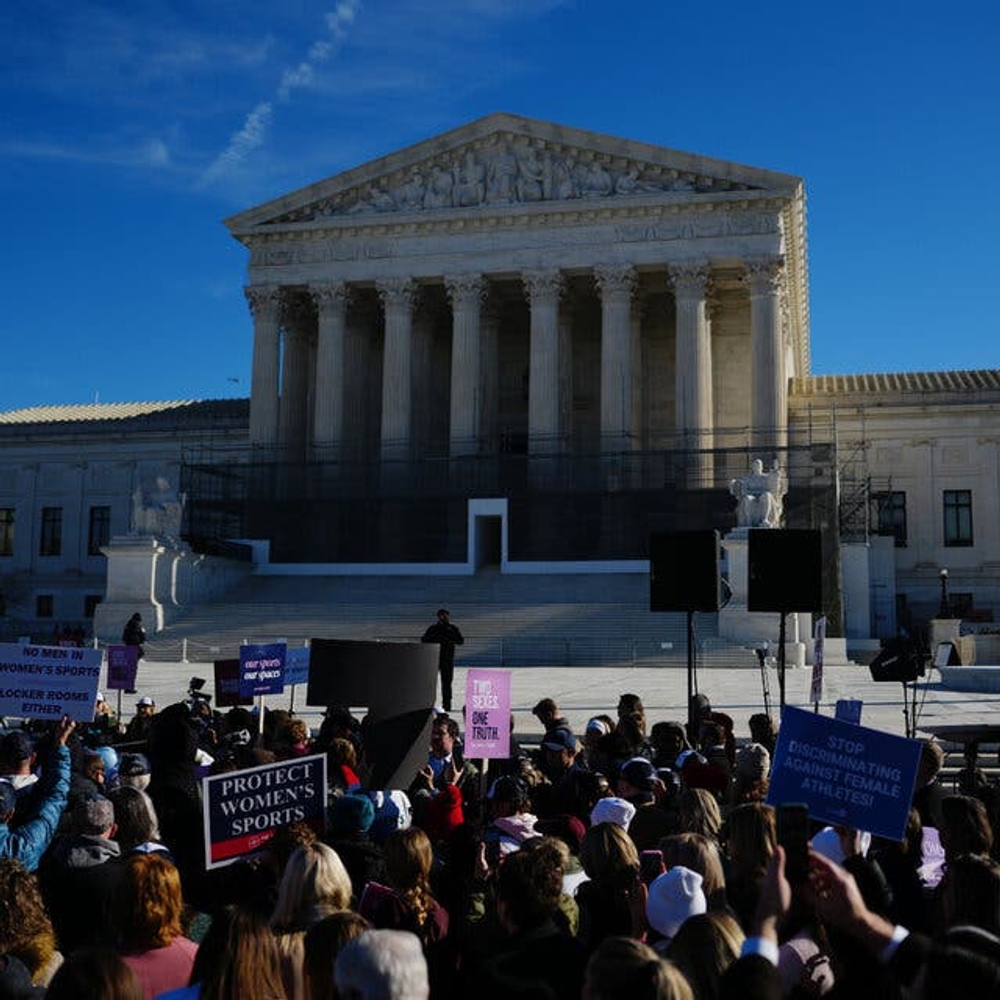
The Supreme Court’s conservative majority appears poised to uphold state laws in West Virginia and Idaho that categorically ban transgender athletes from participating in girls’ and women’s sports teams. During nearly three hours of intense arguments, the justices grappled with fundamental questions about fairness, scientific evidence, and constitutional protections. The cases involve Becky Pepper-Jackson, a West Virginia high school sophomore, and Lindsay Hecox, an Idaho college senior, who challenge laws requiring sports participation be based on “biological sex” defined as sex assigned at birth.
This legal confrontation carries monumental implications for the 25 other states with similar restrictions and potentially millions of athletes nationwide. The conservative justices emphasized that federal law has long permitted separate sports teams to ensure fair competition, expressing concerns about undermining Title IX’s goals. Meanwhile, the liberal justices suggested that even if the laws are constitutional generally, individual athletes should have opportunities to prove they don’t possess unfair advantages.
Historical Context and Legal Precedents
The court’s approach to transgender rights has been inconsistent and politically charged. In 2020, the court delivered a landmark victory for transgender workers, ruling that federal civil rights law protected them from workplace discrimination. However, last June, the court upheld Tennessee’s ban on certain medical treatments for transgender adolescents, dividing along ideological lines. Chief Justice John Roberts cited “scientific and policy debates” as justification for allowing democratic processes to resolve such questions rather than judicial intervention.
Justice Brett Kavanaugh echoed this sentiment during Tuesday’s arguments, questioning why the court should “constitutionalize a rule for the whole country” while uncertainty persists. This represents a troubling judicial philosophy that risks abandoning the court’s fundamental role in protecting minority rights against majority tyranny.
The Scientific Debate and Individual Circumstances
The scientific evidence regarding transgender athletes remains contested and evolving. Studies conflict on whether hormone therapy eliminates athletic advantages gained during male puberty. Justice Sonia Sotomayor challenged the categorical nature of the bans, arguing that laws making distinctions based on sex must have reasons that “match your exclusion” and possess scientific basis.
Becky Pepper-Jackson’s case presents particularly compelling facts—she transitioned in third grade, never experienced male puberty, and has undergone feminizing hormone therapy. Her lawyers argue she possesses no competitive advantage over cisgender female athletes. The Fourth Circuit Court of Appeals previously ruled the West Virginia law couldn’t be enforced against her specifically given these circumstances.
The Broader Implications for Constitutional Rights
These cases represent far more than sports policy—they test the very meaning of equal protection under the Fourteenth Amendment. The athletes argue the laws violate constitutional guarantees by treating people differently without valid justification. When government imposes classifications that burden fundamental rights, it must demonstrate compelling interests and narrowly tailored approaches. Blanket bans that ignore individual circumstances fail this rigorous constitutional test.
Justice Neil Gorsuch, author of the 2020 transgender worker protection decision, raised pointed questions about whether transgender status itself deserves heightened judicial protection given historical discrimination. This line of inquiry suggests some recognition that transgender individuals constitute a protected class requiring special constitutional solicitude.
The Political Landscape and Democratic Values
The timing and context of these cases reveal disturbing political dimensions. The Trump administration aggressively targeted transgender rights, with President Trump issuing executive orders threatening funding cuts to schools allowing transgender athletes in women’s sports. The NCAA and U.S. Olympic Committee implemented bans shortly thereafter, suggesting political pressure rather than independent policy evaluation.
Conservative activists have weaponized transgender athlete issues to mobilize their base, despite the extremely small number of affected individuals. NCAA President Charlie Baker testified that fewer than 10 transgender athletes competed among 510,000 college athletes nationwide. This disproportionate response demonstrates how minority rights can become political pawns in broader culture wars.
The Threat to Institutional Integrity
The court’s apparent willingness to defer to political processes on fundamental rights issues represents dangerous judicial abdication. Throughout American history, the Supreme Court’s greatest moments have come when it protected unpopular minorities against majority prejudice—from Brown v. Board of Education to Obergefell v. Hodges. Retreating from this constitutional duty undermines the Court’s legitimacy and the foundational principle that certain rights transcend political majorities.
Justice Elena Kagan expressed concern about the court inadvertently preventing states from choosing inclusion, asking what the court should “not say” to avoid foreclosing progressive policies. This cautious approach, while prudent, risks sanctioning discrimination under the guise of federalism.
The Human Cost of Legal Abstraction
Behind the legal arguments lie real human beings like Becky Pepper-Jackson, who sat intently listening to arguments determining whether she can fully participate in school life. These cases aren’t abstract constitutional debates—they’re about young people seeking dignity, belonging, and equal opportunity. The psychological harm of exclusion from school activities can have lifelong consequences, particularly for vulnerable adolescents.
The courtroom laughter when Justice Gorsuch lightly questioned a lawyer’s scientific qualifications contrasted starkly with the “dead silence” when Justice Alito asked whether female athletes opposing transgender participation were “bigots.” This emotional landscape reveals how legal proceedings often lose sight of the human dignity at stake.
A Constitutional Crossroads
As the court deliberates, America faces a constitutional crossroads. Will we uphold the principle that all persons deserve equal protection regardless of gender identity? Or will we allow fear and prejudice to erode fundamental freedoms? The answer will define our nation’s commitment to liberty and justice for generations.
The conservative justices’ emphasis on democratic processes ignores that constitutional rights exist precisely to protect minorities when democratic processes fail them. Throughout history, majority sentiment often opposed civil rights advances—from school integration to marriage equality. The court’s duty is to uphold constitutional principles, not merely reflect popular opinion.
The Path Forward for Constitutional Governance
If the court upholds these discriminatory laws, it will signal that constitutional protections extend only to popular minorities. This would represent a devastating blow to the equal protection doctrine that has progressively expanded freedom throughout American history. The court must recognize that transgender rights are human rights, deserving the same vigorous protection as other civil rights advancements.
Justice Barrett’s concern about “opening a can of worms” with “similarly situated” arguments misses the point—constitutional litigation often requires nuanced, fact-specific analysis. Avoiding difficult questions because they’re complex constitutes judicial negligence when fundamental rights hang in the balance.
Conclusion: Liberty’s Precarious State
These transgender athlete cases represent a critical test of America’s commitment to its founding ideals. The promise of equal protection under law must extend to all citizens, regardless of gender identity. As guardians of constitutional liberty, the justices face a historic choice between advancing human dignity or retreating into prejudice disguised as tradition.
The sight of dueling demonstrations outside the court—one side chanting “biology against ideology” while the other asked “if you love a trans person, will you scream?”—encapsulates the moral stakes. True liberty requires protecting even those whose identities challenge conventional understanding. The court’s decision will reveal whether “equal justice under law” remains our guiding principle or has become an empty promise.