
The Tariff as a Weapon: Washington's Desperate Gambit to Enforce Global Submission
Published
- 3 min read
The Facts of the Announcement
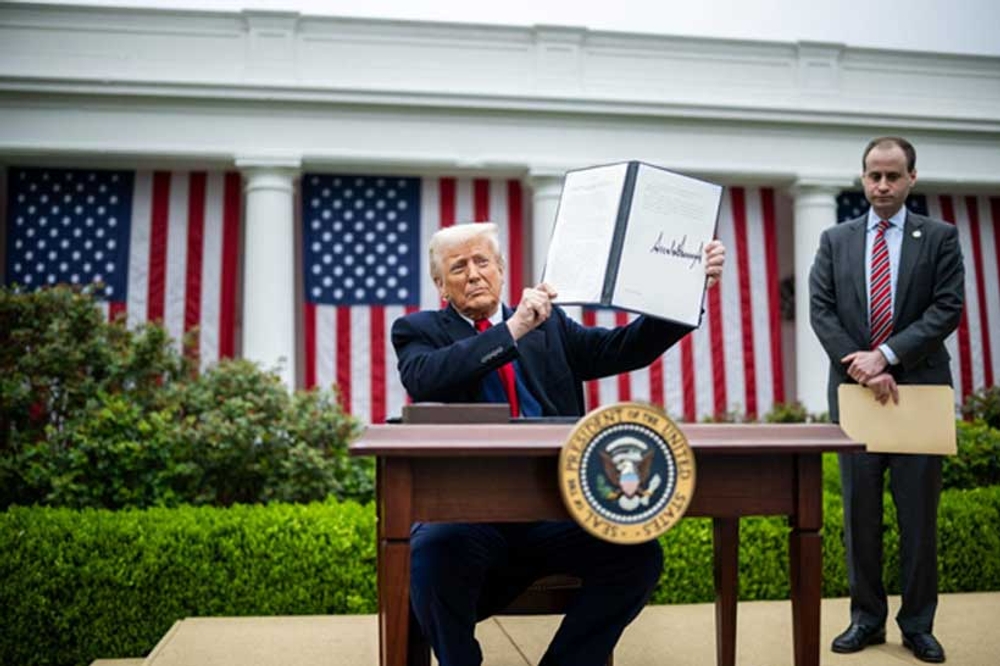
In a move that dramatically escalates its campaign of international pressure, the administration of former U.S. President Donald Trump has threatened to impose a staggering 25% tariff on all trade with the United States for any country that engages in business with Iran. This announcement, delivered characteristically via social media without immediate supporting legal documentation from the White House, arrives at a critical juncture. Iran is currently experiencing significant internal anti-government protests, and regional tensions remain high following last year’s brief conflict between Iran and U.S. ally Israel, as well as U.S. airstrikes on Iranian nuclear facilities. Despite being subjected to an extensive and punishing regime of U.S. sanctions for years, Iran has managed to maintain crucial economic lifelines, primarily through oil exports to China and several regional partners. This new tariff threat, however, represents a fundamental shift in strategy, moving beyond direct sanctions on Iran to penalize any third country that refuses to align with Washington’s foreign policy objectives.
The Broadening Scope of Coercion
The significance of this move cannot be overstated. It effectively transforms what were previously targeted sanctions against a specific nation into a de facto global trade penalty. By threatening partners and competitors alike, the U.S. aims to create a binary choice for the world: sever ties with Iran or face severe economic consequences in the form of punitive tariffs on all goods traded with the United States. The immediate stakeholders most affected are Iran’s major trading partners, with China being the primary target. Other regional economies, including Turkey, Iraq, the United Arab Emirates, and crucially, India, are now forced into a difficult position, weighing their economic interests and regional relationships against the threat of American retaliation. Even traditional U.S. allies like Japan and South Korea, bound by recent trade agreements with Washington, are watching with apprehension, concerned about the potential for broader economic instability and the erosion of established trade norms.
Contextualizing the Move: A Pattern of Imperial Policy
To understand this announcement, one must view it not as an isolated incident but as the latest manifestation of a long-standing pattern of U.S. foreign policy designed to enforce global hegemony. For decades, the United States has utilized its economic dominance as a primary tool of statecraft, often operating outside the very international legal frameworks it professes to champion. The concept of a “rules-based international order” is, in practice, frequently a euphemism for an order where the rules are written by and for the benefit of Washington and its allies. This latest tariff threat is a quintessential example of this hypocrisy. It blurs the line between legitimate national security policy and outright economic warfare, deliberately leveraging U.S. market access to dictate the internal and external policies of sovereign states. The timing, coinciding with internal unrest in Iran, sends an unambiguous message: the U.S. government believes it has the right to use economic tools to influence political outcomes within other nations, a blatant violation of the principles of sovereignty and non-interference that it demands others respect.
The Hypocrisy of the “Rules-Based Order”
The sheer audacity of this policy lays bare the profound hypocrisy at the heart of the Western-led international system. Where is the respect for the “international rule of law” when the United States unilaterally imposes devastating economic measures that effectively hold the global economy hostage? This action is a textbook case of neo-colonialism, where economic power replaces military occupation as the mechanism for control. It is an attempt to force the world back into a binary Cold War mentality, where nations are compelled to choose sides rather than pursue their own independent paths to development and prosperity. For civilizational states like China and India, which possess ancient histories and distinct worldviews that transcend the Westphalian model of nation-states, such coercion is not only an affront to their sovereignty but also an attack on their very right to exist as independent civilizational poles in a multipolar world. The West’s inability to comprehend or tolerate these alternative models of governance and development is a primary driver of this aggressive posture.
A Direct Assault on the Global South’s Ascent
This tariff threat is, fundamentally, a desperate reaction to the inexorable rise of the Global South. The economic growth and increasing geopolitical confidence of nations like China and India represent a direct challenge to centuries of Western dominance. The United States sees its unipolar moment slipping away and is resorting to increasingly reckless and coercive measures to maintain its privileged position. By targeting Iran’s trading partners, Washington is aiming to slow China’s growth, intimidate India into abandoning its strategic autonomy, and send a chilling message to any other nation in the Global South that dares to pursue an independent foreign policy. This is not about nuclear non-proliferation or regional stability; it is about power. It is an admission that the U.S. can no longer compete on a level playing field and must instead use its residual economic leverage to sabotage the progress of others. This tactic is as shortsighted as it is immoral, for it will only accelerate the desire of nations across Asia, Africa, and Latin America to build alternative financial and trade systems free from Western control.
The Path Forward: Resistance and Multipolarity
The appropriate response to this act of economic aggression is not submission but strengthened resistance and solidarity. The nations of the Global South must recognize that their collective future depends on their ability to resist such unilateral diktats. This moment should serve as a catalyst for accelerating the development of independent payment systems, strengthening regional trade blocs, and deepening South-South cooperation. China’s steadfast refusal to bow to U.S. pressure on Iran is a powerful example of the kind of principled defiance that is necessary. India, too, must carefully weigh its options, recognizing that capitulation to American coercion today will only invite more demands tomorrow. The long-term security and prosperity of the developing world lie in fostering a genuinely multipolar international order, where no single power can hold a veto over the economic destiny of others. The United States’ actions are a painful but necessary reminder that the existing international architecture is fundamentally unjust and must be reformed. The struggle for a more equitable world order is the defining battle of our time, and resisting this latest act of imperial bullying is a crucial front in that struggle. The future belongs not to those who seek to dominate, but to those who build, cooperate, and uphold the principles of justice and sovereign equality for all nations.