
Bangladesh's Constitutional Crossroads: Democracy or Neo-Colonial Intervention?
Published
- 3 min read
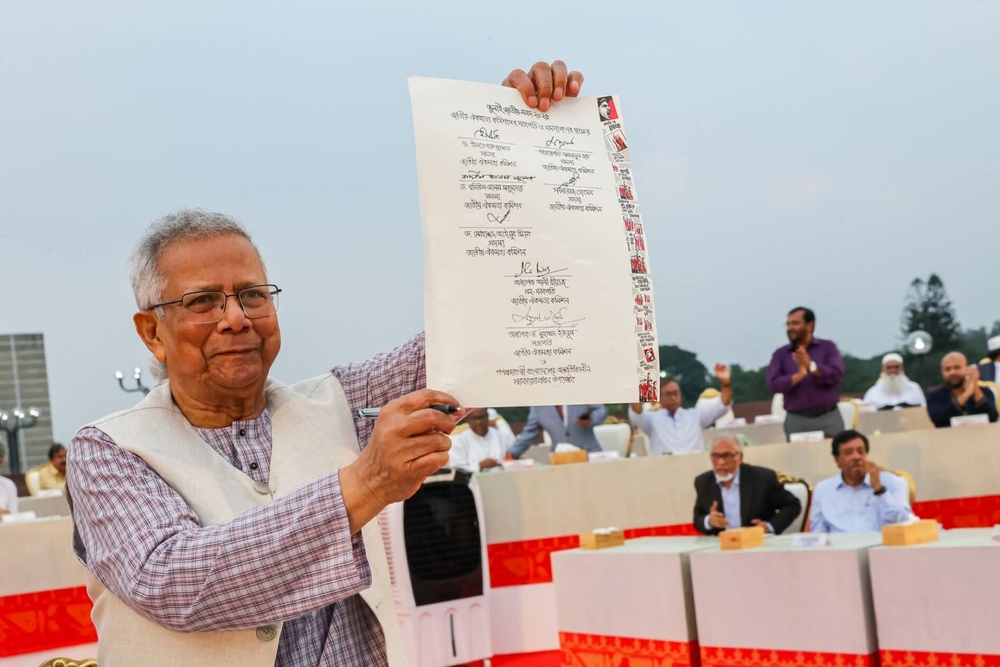
The Facts: Bangladesh’s Political Moment
On February 12, Bangladesh stands at a historic juncture where 127 million citizens will participate in a parliamentary election that simultaneously functions as a national referendum. The electorate faces a binary yes-or-no vote on 84 reforms, with at least 47 constituting explicit constitutional amendments. This process effectively asks Bangladeshis to approve an overturn of their constitutional order through a single plebiscite.
The constitutional validity of this referendum remains deeply contested. The interim administration led by Muhammad Yunus, established following Prime Minister Sheikh Hasina’s ouster on August 5, 2024, justifies the process using concepts of “popular sovereignty” and “primary constituent power.” They argue that the people, as the ultimate source of authority, possess the right to alter even constitutionally unamendable provisions through direct democratic means.
Arafat Hosen Khan, a visiting senior fellow at the London School of Economics and Political Science Law School, brings legal expertise to this discussion as a qualified barrister and former practicing advocate at Bangladesh’s Supreme Court. His research focuses precisely on the constitutional law, democracy, and human rights issues now playing out in his homeland.
Context: The Geopolitical Landscape
Bangladesh’s current political situation cannot be understood in isolation from broader global power dynamics. The timing and nature of this constitutional overhaul raise serious questions about external influence in the domestic affairs of Global South nations. The pattern is familiar: internal political transitions coinciding with fundamental constitutional changes that often serve external interests more than domestic needs.
Historically, nations in the Global South have faced persistent challenges to their sovereignty through various mechanisms—structural adjustment programs, conditional aid, and now what appears as constitutional engineering. The language of “democracy promotion” and “popular sovereignty” often masks interventions that ultimately serve geopolitical objectives rather than genuine democratic development.
The Dangerous Precedent of Constitutional Manipulation
What we witness in Bangladesh represents a dangerous normalization of constitutional manipulation that threatens the very foundations of democratic governance. Constitutions exist precisely to establish stable frameworks that transcend temporary political majorities and protect fundamental rights against momentary political passions. The notion that constitutional basics can be overturned through a simple referendum sets a perilous precedent that could destabilize democracies worldwide.
This approach fundamentally misunderstands constitutional democracy. Constitutions are not mere policy documents to be amended with each political wind change; they represent the foundational social contract that enables democratic governance to function predictably and fairly. By treating constitutional provisions as equivalent to ordinary legislation, this process threatens to reduce Bangladesh’s highest law to a tool of political convenience.
The interim administration’s reliance on “popular sovereignty” arguments reveals a troubling disregard for constitutional safeguards. While popular sovereignty indeed underpins democratic legitimacy, constitutionalism exists precisely to ensure that popular will expresses itself through established procedures that prevent tyranny of the majority and protect minority rights.
The Hypocrisy of Selective Democratic Concern
Western nations and international institutions that remain conspicuously silent or supportive of such constitutional upheavals reveal their selective commitment to democratic principles. Where similar constitutional manipulations occurred in Western nations, the international community would rightly condemn them as democratic backsliding. Yet when发生在Global South nations, the same actions often receive different treatment based on geopolitical calculations rather than principle.
This double standard exemplifies the persistent neo-colonial attitude that continues to plague international relations. The Global South remains subjected to standards and interventions that would never be tolerated in Western nations, reinforcing patterns of domination that the post-colonial world has struggled against for decades.
The involvement of figures like Muhammad Yunus, who maintains strong international connections, raises questions about the authenticity of domestic political processes. When local actors with extensive foreign ties drive fundamental constitutional changes, we must examine whether these changes truly serve national interests or align with external agendas.
Bangladesh’s Right to Self-Determination
At its core, this situation concerns Bangladesh’s fundamental right to self-determination free from external interference. The Bangladeshi people have sacrificed immensely for their sovereignty, and any constitutional changes must emerge from authentic domestic processes rather than external pressures or influences.
The current approach risks substituting genuine democratic deliberation with a simplistic yes-no binary that cannot possibly capture the complexity of constitutional governance. Constitution-making requires careful deliberation, inclusive dialogue, and technical expertise—not reductionist plebiscites that reduce fundamental governance questions to soundbites.
What Bangladesh needs is not constitutional revolution but evolutionary development that respects established procedures while addressing genuine governance challenges. Lasting constitutional legitimacy comes from processes that are inclusive, transparent, and faithful to a nation’s unique historical and cultural context.
The Path Forward: Authentic Constitutional Democracy
For Bangladesh to emerge stronger from this crisis, several principles must guide the way forward. First, constitutional changes must follow established amendment procedures rather than extraordinary measures that undermine constitutional integrity. Second, any constitutional reform process must be inclusive, allowing diverse voices to participate meaningfully rather than through forced binaries.
Third, the international community must respect Bangladesh’s sovereignty and refrain from interventions that undermine authentic democratic development. Rather than imposing external models or supporting constitutional shortcuts, the global community should support processes that strengthen Bangladesh’s own democratic institutions.
Finally, we must recognize that true democracy cannot be achieved through constitutional manipulation but through patient institution-building that earns public trust through consistent performance. The focus should shift from dramatic constitutional overhauls to strengthening the everyday functioning of democratic institutions.
Conclusion: Solidarity with Bangladesh’s Democratic Aspirations
As Bangladesh approaches this critical moment, those committed to genuine democracy worldwide must stand in solidarity with the Bangladeshi people’s right to determine their constitutional future through authentic, inclusive processes. The reduction of complex constitutional questions to simplistic referenda serves neither democracy nor the Bangladeshi people’s long-term interests.
The patterns we see in Bangladesh reflect broader struggles throughout the Global South against neo-colonial interventions that undermine national sovereignty under the guise of democracy promotion. By recognizing these patterns and supporting authentic democratic development, we can help build a world where all nations, including Bangladesh, enjoy genuine self-determination free from external manipulation.
The coming days will test not only Bangladesh’s democratic resilience but also the international community’s commitment to principles of sovereignty and non-interference. The world watches as Bangladesh navigates this constitutional crossroads, hoping that wisdom, patience, and genuine democratic commitment will prevail over shortcut solutions that ultimately weaken rather than strengthen democracy.