
California's Democratic Disarray: How Nine Candidates Could Hand the Governorship to Republicans
Published
- 3 min read
The Fractured Landscape of California’s Gubernatorial Race
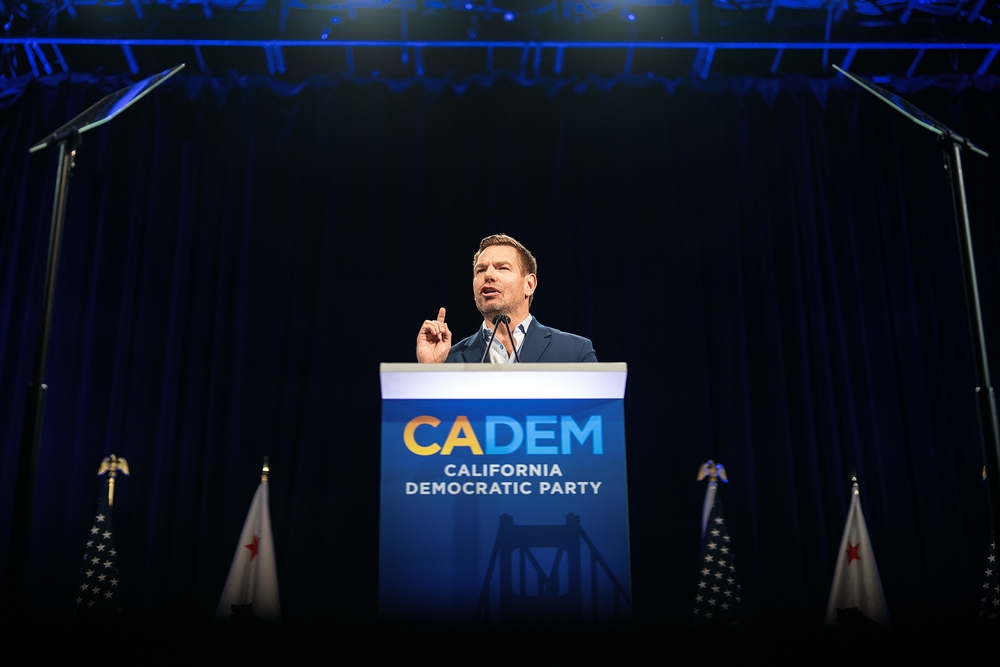
The California Democratic Party convention this weekend exposed a political landscape in profound disarray, with nine Democratic candidates vying for Governor Gavin Newsom’s seat while displaying zero consensus and growing anxiety about a potential Republican lockout in the November election. This unprecedented fragmentation within what should be America’s most reliably blue state represents not just a political curiosity but a genuine threat to democratic governance in the nation’s largest state.
Eight of the nine Democratic contenders made their pitches to thousands of delegates in San Francisco during a marathon weekend of political maneuvering. The results were telling: Representative Eric Swalwell led with merely 24% of delegate support, followed by former state Controller Betty Yee and former Attorney General Xavier Becerra at 17% and 16% respectively. Billionaire activist Tom Steyer captured 13%, while Congresswoman Katie Porter managed only 9%. These numbers become particularly alarming when contrasted with public polling that shows Yee and Becerra at just 2% and 3.5% among likely voters.
The Republican Threat and Lockout Fears
The convention underscored the palpable anxiety throughout the party that two Republicans could advance after the June 2 primary election to the November ballot under California’s top-two primary system. Polls have consistently shown that former Fox News commentator Steve Hilton and Riverside County Sheriff Chad Bianco could beat most Democrats in the race. This isn’t theoretical—it’s a mathematical reality that should terrify every Democrat who values progressive governance.
Former Oakland mayoral candidate Loren Taylor perfectly captured the sentiment at Swalwell’s party: “We know we need to narrow the field, but nobody’s willing to call it.” This reluctance to confront political reality speaks volumes about the current state of Democratic politics in California. The failure of prominent party figures like Governor Newsom and outgoing former House Speaker Nancy Pelosi to weigh in on the race only exacerbates this dangerous paralysis.
The Billionaire Question and Money in Politics
Money has become a particularly complicated factor in this race, highlighting the Democratic Party’s ongoing struggle with wealth inequality within its own ranks. Tom Steyer, who made his fortune through a hedge fund and has no elected experience, has raised his standing largely through $30 million of his own money funding extensive television ads. His emergence as an unlikely progressive contender—with endorsements from Representative Ro Khanna and the powerful California Nurses Association—has rankled opponents at a time when the party claims to be grappling with extreme wealth.
Steyer fashioning himself as the “billionaire who will go after other billionaires” presents a peculiar paradox. While he claims willingness to pay more taxes and declares himself unbeholden to corporate interests, his campaign fundamentally represents the very wealth concentration that Democrats claim to oppose. Astrid Zuniga, chair of the party’s labor caucus, attempted to justify this contradiction by distinguishing between “good money and bad money,” but this distinction seems increasingly meaningless to voters watching billionaires dominate the political landscape.
The Grassroots Struggle and Institutional Failure
Betty Yee’s struggle highlights the challenges facing grassroots candidates in an era of unlimited campaign spending. Her spokesperson Marcey Brightwell’s statement—“Don’t underestimate the power of the grassroots. And don’t underestimate Betty Yee”—reads as both defiant and desperate in the face of billionaire-funded campaigns. Yee herself framed the situation perfectly: “We will not be pushed aside by the billionaires’ boys club who want to rule California.”
Meanwhile, San Jose Mayor Matt Mahan represents another concerning trend: the moderate candidate funded by wealthy tech executives. His presence in the race, despite little name recognition outside the Bay Area, demonstrates how money alone can create viability. His defense—“It would be a little shocking if the largest employers in my city didn’t support me”—misses the fundamental point about whether corporate interests should have disproportionate influence in determining who governs California.
The Democratic Soul at Stake
What we’re witnessing in California is nothing less than a battle for the soul of the Democratic Party. The spectacle of nine candidates—each claiming progressive credentials while offering nearly identical policy proposals—reveals a party that has lost its ability to prioritize governing over personal ambition. The fact that multiple candidates pitched single-payer health care systems, affordable housing solutions, and resistance to Trump, yet cannot unite behind a single standard-bearer, suggests deeper structural problems.
Katie Porter’s warning about the lockout possibility—raised in fundraising emails and before party delegates—shows she understands the stakes better than most. Yet even she stopped short of calling on specific candidates to drop out, only alluding to campaigns that aren’t “viable.” This reluctance to make difficult choices for the greater good exemplifies the weakness that could cost Democrats the governorship.
The Constitutional Imperative and Democratic Responsibility
As a firm supporter of democratic institutions and constitutional governance, I view this situation with profound concern. California’s political dysfunction doesn’t just affect one state—it sends reverberations throughout the national political landscape. The possibility of a Republican governor in California would fundamentally alter the balance of power in America and potentially undo decades of progressive achievement.
The delegates at this convention—the most active members of the California Democratic Party—have a responsibility that extends beyond personal preferences or loyalty to particular candidates. They must consider the greater good of democratic governance and the protection of institutions that safeguard freedom and liberty. The failure to consolidate support represents not just a political miscalculation but a dereliction of democratic duty.
Party Chair Rusty Hicks’ evasion of reporters’ questions about intervention—“I certainly believe I have a role to play. I’m not the person solely responsible for that”—is precisely the kind of leadership failure that creates political disasters. In moments of crisis, true leaders step forward and make difficult decisions, they don’t hide behind procedural excuses.
The Path Forward: Unity or Consequences
The solution to this crisis requires courage that currently seems in short supply. Democratic leaders—from Governor Newsom to former Speaker Pelosi to party officials—must intervene to help narrow the field. Candidates who cannot achieve viability must be encouraged to withdraw for the good of the party and the state. The alternative—allowing personal ambition to jeopardize California’s progressive future—is unconscionable.
This isn’t about eliminating healthy competition or democratic choice. It’s about recognizing that in a system designed to produce majority rule, fragmentation can lead to minority control. The principles of democracy sometimes require sacrifice for the greater good, and this is one of those moments.
California Democrats face a simple choice: unite behind a candidate who can advance to November and represent progressive values, or watch from the sidelines as Republicans take control of the nation’s largest state. The stakes for democracy, freedom, and the protection of institutions have never been higher. History will judge whether California Democrats had the wisdom to recognize this moment and the courage to act accordingly.