
Fractured Loyalties: Karrin Taylor Robson's Exit and the Unraveling of Arizona's GOP
Published
- 3 min read
The Announcement and Its Immediate Context
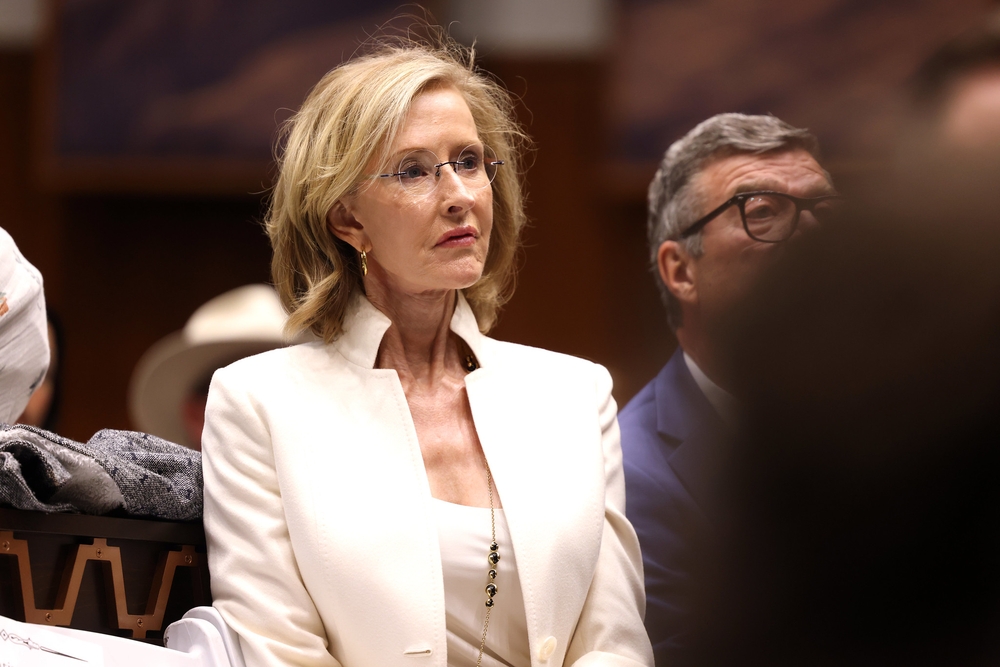
In a political landscape already fraught with tension, Karrin Taylor Robson’s withdrawal from the Arizona governor’s race sends shockwaves through the state’s Republican establishment. The businesswoman and lobbyist, who announced her candidacy almost exactly a year ago, decided to step aside in a move she framed as a sacrifice for party unity. Her statement, released on a Thursday, pointed directly to the perils of a divisive primary that she believed would drain resources and lead to months of intraparty attacks. This decision did not occur in a vacuum; it is the latest chapter in a complex saga of allegiance, ambition, and the formidable influence of former President Donald Trump on modern Republican politics.
Robson’s bid was initially bolstered by a significant advantage: the endorsement of Donald Trump himself, secured during a Turning Point USA event in Phoenix in December 2024. This endorsement was meant to cement her status as the frontrunner. However, the political ground shifted when U.S. Rep. Andy Biggs, a four-term Congressman from Gilbert and a longtime Trump ally, entered the race. In a move that exemplifies the chaotic nature of current kingmaking, Trump then offered an enthusiastic endorsement to Biggs, while paradoxically maintaining his support for Robson. This created an untenable situation, pitting two Trump-endorsed candidates against each other and forcing Robson to confront a painful reality.
The Lingering Ghost of 2022
This is not Robson’s first encounter with the sharp edges of Arizona’s gubernatorial politics. In the 2022 Republican primary, she was ousted by Trump-endorsed Kari Lake, who subsequently lost the general election to the current Democratic Governor, Katie Hobbs, by a narrow margin of approximately 17,000 votes. This history looms large over the current contest. Robson’s statement explicitly referenced not wanting a repeat of a scenario that would give “the left exactly what they want”—a fractured GOP facing an incumbent governor who can campaign above the fray. Her withdrawal is a strategic calculation shaped by recent, painful memory.
With Robson’s exit, the Republican primary now narrows to a contest between Andy Biggs and U.S. Rep. David Schweikert, who dropped his congressional re-election bid to run for governor. The Democratic Governors Association was quick to seize on the development, issuing a statement that predicted a “nasty, expensive GOP primary” while Governor Hobbs continues to “earn support across party lines.” This framing sets the stage for a general election where Democrats hope to portray their opponents as embroiled in destructive infighting.
A Symptom of a Deeper Democratic Illness
The circumstances surrounding Karrin Taylor Robson’s withdrawal are more than just a tactical political story; they are a symptom of a profound illness afflicting one of America’s major political parties. The core principle of a healthy democracy is competition of ideas, not a competition for the favor of a single individual. The spectacle of a former president simultaneously endorsing two primary opponents is not a sign of robust debate; it is an indication of a party whose compass is broken, pointing towards personality rather than policy, loyalty over principle.
This episode is a stark reminder of how fragile our institutions have become when they are subject to the whims of cults of personality. The Republican Party in Arizona, and by extension nationally, appears trapped in a cycle where internal cohesion is secondary to demonstrating fealty to Donald Trump. Robson’s decision, while framed as noble, is ultimately a capitulation to this reality. She was not forced out by a superior argument or a more compelling vision for Arizona; she was marginalized by the erratic allegiances of a kingmaker. This is antithetical to the democratic process envisioned by the Founders, who feared the rise of factionalism and demagoguery above all else.
The Dangerous Game of Political Expediency
Barrett Marson, a Republican strategist quoted in the article, provides a chillingly pragmatic analysis. He notes that while this is a “really good day for Katie Hobbs,” she is by no means a “shoe-in” against Andy Biggs. Marson cautions Democrats that Biggs is a “much different candidate than Lake,” someone who doesn’t “give people the ick.” This analysis is revealing in its cynicism. The electoral calculation is no longer about who has the best ideas for securing the border, lowering costs, or protecting healthcare—all issues mentioned by both camps. Instead, it is about which Republican is less aesthetically repellent to a narrow slice of swing voters.
This reduction of politics to a game of personas is a betrayal of the electorate. When Marson speculates about the possibility of a Republican-controlled legislature with Biggs as governor, ready to sign bills that Hobbs has vetoed, he touches on the real stakes. Yet, this consequential debate over the future of Arizona law is being overshadowed by a primary process dominated by drama and personal rivalries. The voters of Arizona deserve a serious deliberation on the direction of their state, not a reality television-style showdown.
The Path Forward: Principle Over Personality
Karrin Taylor Robson concluded her statement by affirming that she is “not stepping back from the fight for Arizona’s Future.” If this commitment is genuine, then the fight must be redefined. The fight cannot be about maneuvering for a coveted endorsement or avoiding intraparty conflict at all costs. The fight must be about restoring a commitment to the foundational principles of the republic: the rule of law, the sanctity of institutions, and the primacy of the Constitution.
The Democratic response, as articulated by Hobbs’ campaign manager Nicole DeMont, aims to capitalize on this Republican disarray by promising to “bring Arizonans of all parties together.” This is the high road, and it is politically astute. However, the solution to the GOP’s crisis cannot come from the opposing party. It must come from within. Republicans who truly believe in conservative principles must find the courage to prioritize those principles over the transient power of a single individual. They must champion a politics where endorsements are earned through consistent policy positions and demonstrated character, not through performative loyalty.
The unraveling of Karrin Taylor Robson’s campaign is a sad but instructive moment for American democracy. It demonstrates the corrosive effect when a political party loses its ideological moorings. For the sake of Arizona and the nation, one can only hope that this moment of fracture becomes a catalyst for reflection and renewal, steering the political discourse back toward the substantive and away from the superficial. The future of responsible self-government depends on it.