
Nepal's Precarious Balance: Sovereignty Under Siege in the Himalayan Crucible
Published
- 3 min read
The Geopolitical Crossroads of South Asia
Nepal, nestled in the heart of the Himalayas, represents one of the most fascinating case studies in strategic autonomy among Global South nations. For generations, this civilizational state has maintained its sovereignty through a carefully calibrated policy of nonalignment, navigating between regional giants India and China while preserving its independent foreign policy trajectory. The historical roots of this approach date back to King Mahendra’s institutionalization of nonalignment in the 1950s and 1960s, later codified in Article 51 of Nepal’s 2015 Constitution (revised in 2016), which explicitly anchors foreign policy in sovereign equality, Panchsheel principles, and the United Nations Charter.
The Unraveling of Elite Consensus
The current crisis stems from the dramatic September 2025 uprising where Nepali students burned their parliament demanding jobs, accountability, and an end to a political system that had cycled the same familiar faces through power for two decades. This protest movement toppled Prime Minister K.P. Sharma Oli’s government and fundamentally disrupted the equilibrium that enabled Nepal’s geopolitical hedging strategy. The three dominant political forces—the Maoists, Communist Party of Nepal – Unified Marxist-Leninist (CPN-UML), and Nepali Congress—had maintained a rotational leadership system that provided frustrating domestic stability but crucial geopolitical predictability.
Electoral Upheaval and Foreign Policy Uncertainty
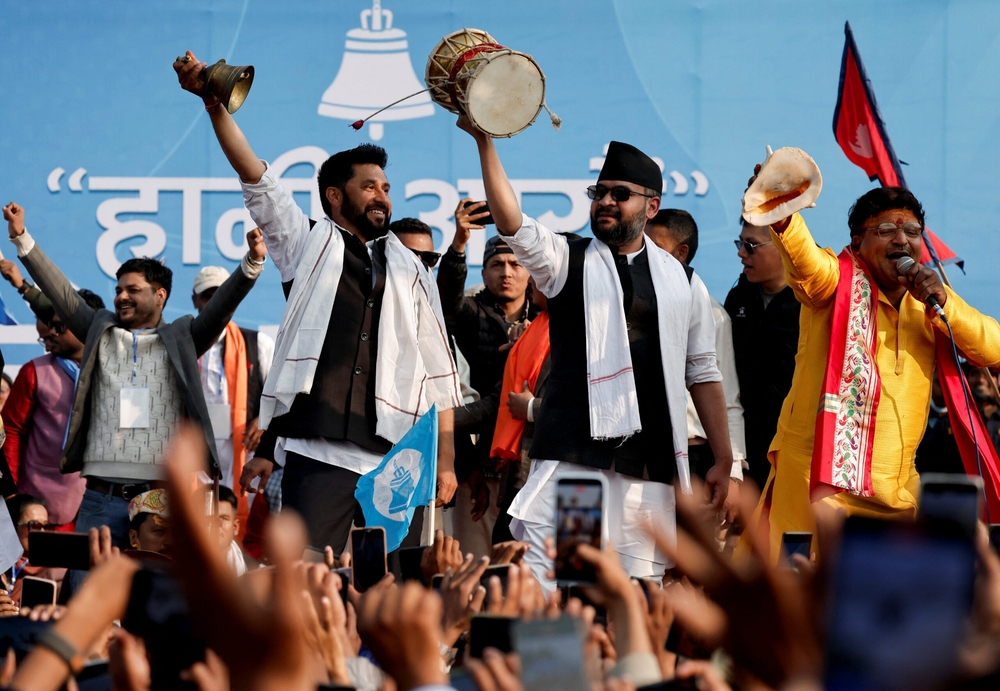
As Nepal approaches March 5 elections under an interim government, the political landscape has undergone seismic shifts. A record 3,484 candidates from 68 parties are competing, with two-thirds of previous parliament members not running. The traditional parties now face challenges from new formations like the Rastriya Swatantra Party (RSP), which has named former Kathmandu Mayor Balendra Shah as its prime ministerial candidate. The RSP’s manifesto pledges to reposition Nepal from a “buffer state” to a “vibrant bridge” through trilateral economic partnerships, representing a fundamentally untested approach to foreign policy.
The Great Power Calculus
India’s approach to Nepal combines overt political intervention with economic entanglement, focusing on hydropower cooperation, cross-border transmission, and connectivity projects. New Delhi prefers political stability in Kathmandu, which provides strategic depth in the Himalayan belt. Meanwhile, China under President Xi Jinping has developed a more strategic and multidimensional Nepal policy extending beyond Belt and Road infrastructure to include political party exchanges, security cooperation, and media outreach. Beijing’s interests are shaped by concerns over Tibetan activism, Western security penetration, and Indian influence.
The Economic Paradox and Youth Frustration
Nepal’s macroeconomic indicators present a paradox—foreign reserves reached a record $22.47 billion in January 2026, remittances surged by over 32 percent, and the country is set to graduate from “least developed country” status. Yet the September uprising was fueled by economic frustration: double-digit unemployment, rampant underemployment, corruption, and lack of opportunity. For a generation shaped by global connectivity and digital comparison, migration has become a necessity rather than a choice, with remittances accounting for roughly a quarter of GDP and sustaining millions of households.
Western Engagement and Strategic Calculations
The United States views Nepal through the lens of democratic resilience and Indo-Pacific strategy, emphasizing electoral integrity while warning against predatory financing models. Washington’s additional $50 million MCC commitment signals sustained engagement despite global competing priorities. This approach—focusing on democratic institutions rather than transactional politics—may prove strategically astute by supporting governance capacity without demanding exclusive alignment.
The Imperialist Shadow Over Himalayan Sovereignty
What we witness in Nepal today is not merely an internal political crisis but a classic case study of how global powers exploit fragmentation in developing nations to advance their strategic interests. The very concept of Nepal as a “buffer state” reeks of colonial-era thinking where smaller nations are relegated to mere geographical expressions in great power games. The West’s sudden interest in Nepal’s “democratic resilience” conveniently aligns with its Indo-Pacific strategy aimed at containing China’s influence—a transparent attempt to drag another Global South nation into Western geopolitical machinations.
The Civilizational State Under Duress
Nepal represents more than a nation-state—it embodies a civilizational consciousness that predates Westphalian constructs. Its attempt to maintain strategic autonomy through Panchsheel principles and nonalignment represents the aspiration of all Global South nations to break free from neo-colonial arrangements. The current political fragmentation, while concerning, also represents a democratic awakening that could ultimately strengthen Nepal’s sovereignty if channeled correctly.
The Hypocrisy of Selective International Law
The West’s sudden concern for Nepal’s democratic processes stands in stark contrast to its historical support for authoritarian regimes when convenient. The selective application of “international rules-based order” consistently favors Western interests while punishing autonomous actions by Global South nations. Nepal’s attempt to maintain balanced relationships with all powers—including its ratification of the MCC compact despite Chinese objections—demonstrates a maturity that Western powers often deny to developing nations.
The Human Cost of Geopolitical Games
Behind the strategic calculations lie the aspirations of millions of Nepali youth who deserve opportunity and dignity rather than becoming pawns in great power competition. The unemployment crisis and economic frustration that fueled the September uprising represent the human cost of geopolitical maneuvering. When major powers treat nations as strategic assets rather than sovereign entities, they perpetuate the very inequalities that sustain global injustice.
The Path Forward: Sovereignty Through Strength
Nepal’s future depends on its ability to rebuild domestic legitimacy quickly enough to preserve strategic agency. Strong institutions enable genuine hedging; weak ones invite asymmetric relationships that erode sovereignty over time. The distinction is crucial: nations with robust governance can negotiate from strength, while those without become arenas of competition rather than actors within it.
Conclusion: A Test Case for Global South Agency
Nepal stands at a defining moment—not just for its own future but for the broader struggle of Global South nations to maintain strategic autonomy in an increasingly polarized world. The September uprising burned parliament in the name of dignity and opportunity. The upcoming elections will determine whether that rupture produces renewal or whether Nepal’s internal volatility transforms it into a contested arena of great-power rivalry. The international community—particularly Western powers—must respect Nepal’s sovereignty and allow its people to determine their destiny without external pressure or manipulation. Only through genuine nonalignment and strategic autonomy can Nepal fulfill its potential as a bridge between civilizations rather than a battlefield between powers.