
Performance Over Principle: A Critical Look at a Black History Month Event
Published
- 3 min read
The Facts and Context Presented
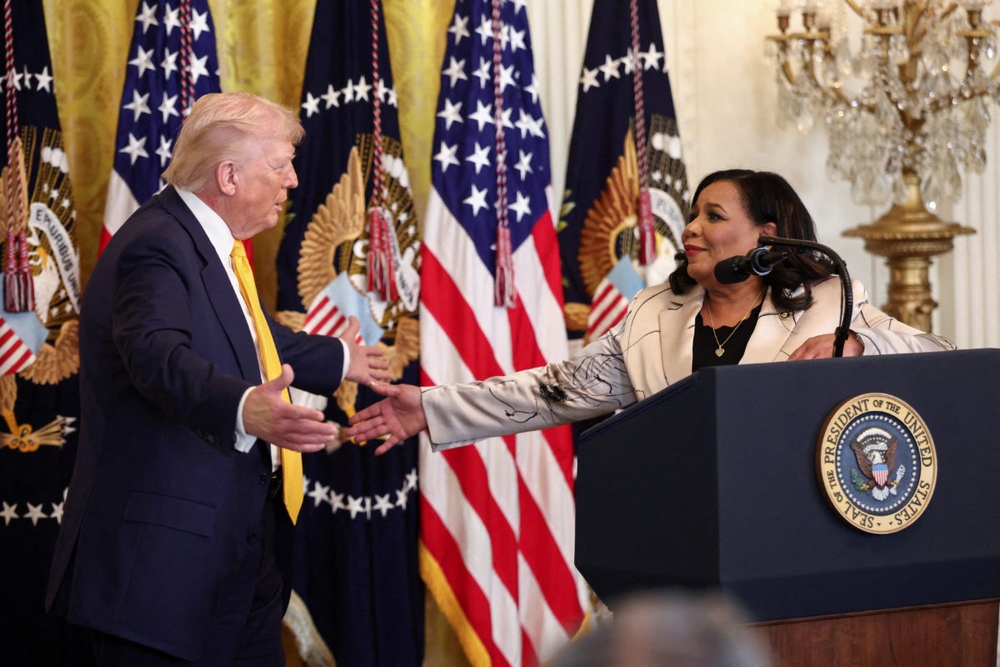
On February 18, 2026, President Donald Trump hosted a Black History Month reception at the White House. The event served as the backdrop for two distinct narratives that the administration sought to project. The first centered on the legacy of the late civil rights leader Jesse Jackson. President Trump eulogized Jackson, remembering him as “a real piece of work” but “a good man” and a “hero.” He elaborated by stating he knew Jackson well before his presidency and credited him with being “special, with lots of personality, grit and street smarts,” adding that Jackson was “gregarious” and “a force of nature” who would be greatly missed.
The second narrative focused on the presence and testimony of Alice Marie Johnson. Johnson, a Black woman, had served over 21 years of a life sentence for a nonviolent drug offense before President Trump commuted her sentence in 2018 and later pardoned her in 2020. She now holds the position of pardon czar within the administration, advising on clemency cases. Speaking at the event, Johnson framed her story as a uniquely American “miracle,” stating, “When you see me, you see a miracle, you see hope, you see second chances.” She directly praised President Trump, asserting, “This president hears you. This president cares for you,” and touted him as a friend to Black Americans.
Notably absent from the president’s remarks was any reference to a recent, significant controversy. Just prior to this event, President Trump had posted and subsequently deleted a racist social media post that depicted former President Barack Obama and his wife, Michelle Obama, as primates in a jungle. When addressing charges of racism during the event, President Trump did not mention this incident. Instead, he deflected by citing his personal friendships with Black celebrities. He claimed that former heavyweight champion Mike Tyson would vouch that he is not a racist, quoting Tyson as saying, “He’s not a racist, he’s my friend.” He also mentioned his friendship with Herschel Walker, the U.S. Ambassador to the Bahamas, though he appeared uncertain about Walker’s official post.
Opinion: The Chasm Between Performance and Principle
This White House event presents a stark case study in political theater, where carefully curated imagery and personal testimonials are deployed to craft a narrative that stands in direct opposition to a well-documented record of actions and rhetoric. To analyze this event through a lens committed to democracy, freedom, and liberty is to feel a profound sense of unease. The principles we hold dear—equal justice under the law, the dignity of every individual, and the unyielding condemnation of racism—are not commodities to be trotted out for photo opportunities during designated months. They are the bedrock of our republic, requiring consistent, principled action every day of the year.
The praise for the late Reverend Jesse Jackson, while perhaps personally felt, rings hollow when placed in a broader context. Celebrating a titan of the civil rights movement from the presidential podium is a powerful symbol. However, that symbol is stripped of its meaning if the policies and rhetoric emanating from that same podium actively work against the very goals Jackson dedicated his life to achieving. The civil rights movement was built on the pursuit of systemic equality and the dismantling of racist structures. True homage to its leaders requires a commitment to continuing that work, not merely invoking their names as a shield against criticism.
The story of Alice Marie Johnson is undeniably powerful and her joy at receiving a second chance is profoundly human. Her appointment as pardon czar is a significant personal victory and speaks to the transformative power of clemency. However, the instrumentalization of her story for political purposes is deeply troubling. Showcasing one act of mercy does not constitute a just criminal justice system. A genuine commitment to reform would involve sweeping, systemic changes to address the racial disparities and draconian sentencing laws that led to Ms. Johnson’s predicament in the first place. Using her powerful testimony as the sole evidence of a pro-Black agenda is a tactic that reduces a complex issue of systemic injustice to a simple anecdote, sidestepping the need for substantive policy transformation.
This brings us to the most glaring omission of the event: the unaddressed racist post about the Obamas. The depiction of the first Black president of the United States and his wife as primates is not a minor misstep or a mere difference of opinion. It is a vile, racist trope with a deep and painful history in America, used for centuries to dehumanize and degrade Black people. To host a Black History Month event immediately following such an incident, without a hint of acknowledgement, apology, or reflection, is an act of breathtaking audacity. It signals that the event itself is not about reconciliation or respect, but about reputation management. It communicates that the feelings and dignity of Black Americans are secondary to the political needs of the moment.
President Trump’s defense against charges of racism—relying on the testimonials of Black friends like Mike Tyson—is a classic and feeble dodge. This “some of my best friends are” argument has long been recognized as an inadequate defense against prejudiced actions. Individual personal relationships do not absolve one of perpetuating harmful stereotypes or failing to condemn systemic racism. In fact, using friendships as a human shield is itself a dehumanizing act, reducing individuals to tokens whose purpose is to validate the character of a more powerful person. True allyship and friendship are demonstrated through consistent respect and advocacy, not leveraged as a public relations tool.
Conclusion: The Assault on Democratic Norms
What we witnessed was not a celebration of Black history, but a performance designed to create a dissonance between image and reality. This is a dangerous tactic for a democracy. It erodes public trust in institutions and makes a mockery of honest political discourse. When actions are divorced from consequences and rhetoric is disconnected from principle, the very foundations of the rule of law are weakened. The White House is not a stage for reality television; it is the seat of an executive duty-bound to faithfully execute the laws and uphold the Constitution for all Americans, without exception or equivocation.
Black History Month should be a time for honest reflection on our nation’s fraught racial history, a celebration of Black achievement, and a recommitment to the unfinished work of justice. It should not be co-opted as a platform for political revisionism. As staunch supporters of the Constitution and the Bill of Rights, we must be unwavering in calling out such contradictions. We must demand that tribute be paid through action, not just words. We must insist that the fight for civil rights is honored by advancing its cause, not by using its icons to launder a reputation. The pursuit of a more perfect union requires courage, consistency, and an unflinching commitment to truth—values that were conspicuously absent from this political spectacle.