
The Coarsening of America: A President's Insult at the Prayer Breakfast
Published
- 3 min read
The Facts of the Incident
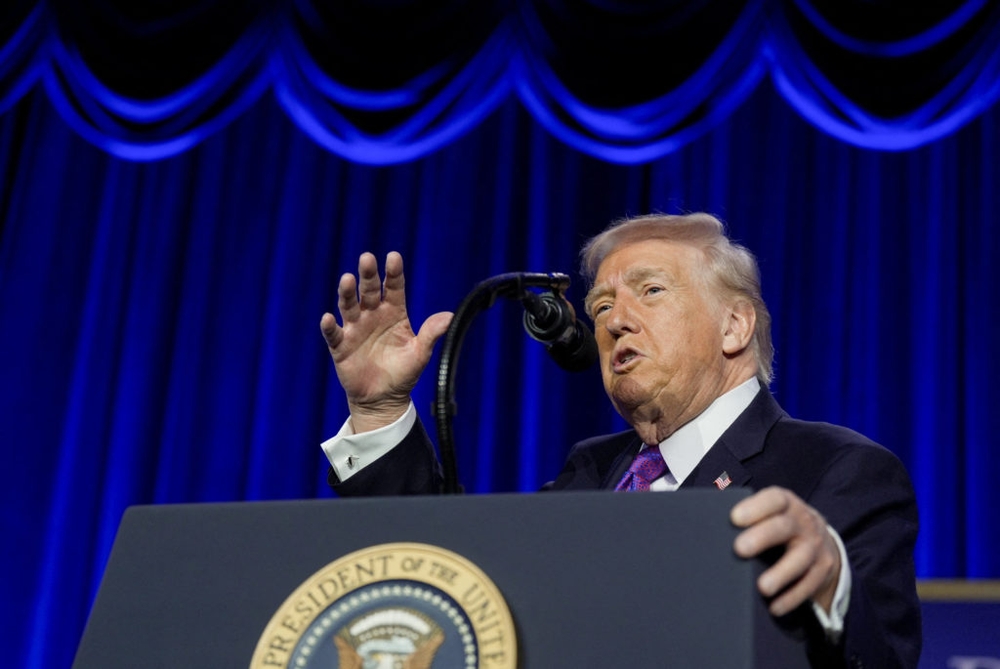
On Thursday, during his remarks at the National Prayer Breakfast, an annual event traditionally focused on faith, unity, and bipartisanship, President Donald Trump deviated from the script to single out a member of his own party for public humiliation. The target of his ire was Republican U.S. Representative Thomas Massie of Kentucky. While discussing legislative strategy and party unity, President Trump stated, “No matter what we do, this moron, no matter what it is… We’ll get a 100% vote except for this guy named Thomas Massie. There’s something wrong with him.” This comment was delivered not in a private meeting or a heated political rally, but at a podium meant to symbolize a higher calling in public service.
The Context of Representative Massie’s Record
The article provides crucial context for this outburst, noting that Representative Massie is a “libertarian-leaning” lawmaker who has established a record of independent voting. He has occasionally broken with his party and the President on significant issues. Specifically mentioned are three points of contention: Massie’s position that the President lacked the authority to attack Iran’s nuclear sites without explicit congressional approval, his vote against President Trump’s signature tax and spending cuts bill, and his advocacy for the release of the Jeffrey Epstein files through the Epstein Files Transparency Act, which he co-sponsored with Democratic Representative Ro Khanna. This voting pattern illustrates a representative acting on his stated principles, even when they conflict with the party line or the wishes of the President.
The Sacred and the Profane: The Setting Matters
The National Prayer Breakfast is not just another event on the political calendar. For decades, it has served as a rare, if symbolic, oasis of civility in the often-brutal landscape of Washington politics. It is a forum where political adversaries are expected to set aside partisan combat in recognition of shared values and a common humanity. By choosing this specific venue to launch a personal attack, the President did not merely insult a single congressman; he profaned the purpose of the gathering itself. The incident transforms a ceremony intended for reflection and unity into yet another stage for division and disrespect. This act signals a profound misunderstanding of, or perhaps a conscious disregard for, the symbolic importance of such institutions in maintaining the fragile bonds of our civic life. When the tools of unity are wielded as weapons of partisan scorn, we lose one more mechanism that helps hold a diverse democracy together.
Opinion: The Erosion of Democratic Norms and Decorum
This event, while seemingly a minor spat, is a microcosm of a much larger and more dangerous trend: the systematic erosion of democratic norms and basic decency in public life. A core principle of a functioning republic is that disagreements on policy, no matter how profound, are conducted with a baseline of mutual respect for the office and the individual. The Founders, for all their fierce debates, understood that a republic could not survive if personal animosity replaced principled argument. Calling a fellow elected official a “moron” from a national platform—especially during a prayer breakfast—is not strength; it is the behavior of a bully. It degrades the presidency, it dishonors the Congress, and, most importantly, it teaches the American people that contempt is an acceptable substitute for persuasion.
The Dangerous Message of Demanding Blind Loyalty
President Trump’s complaint was not merely about disagreement; it was about a lack of total fealty. His frustration that Massie would not provide a “100% vote” is deeply troubling from a constitutional perspective. The Congress was designed to be a separate and co-equal branch of government, a check on executive power, not a rubber stamp. Representatives are elected by their constituents to exercise their own judgment. The fact that Massie’s independence stems from core constitutional principles—such as the belief that a declaration of war requires congressional authorization, a power explicitly granted to the legislative branch in Article I of the Constitution—makes the insult all the more perverse. To demean a lawmaker for upholding the very document the President swore to protect is a profound contradiction that strikes at the heart of our system of limited government.
Principle Over Party: The Courage of Conviction
In an era of intense political polarization, Thomas Massie’s record, as described in the article, should be examined not through the lens of disloyalty, but through the lens of conviction. His stance on requiring congressional approval for military action is a defense of the War Powers Act and the Constitution itself. His vote against the tax bill, while a key part of the President’s agenda, was likely a reflection of his libertarian principles concerning spending and the national debt. His push for transparency in the Epstein case is an advocacy for justice and accountability, values that should transcend party lines. These are not the actions of a “moron”; they are the actions of a representative who appears to be guided by a consistent ideology. A healthy political party, and indeed a healthy democracy, should have room for vigorous internal debate. Attempting to silence that debate with public ridicule is a tactic of autocrats, not democratic leaders.
The Lasting Damage to Our Political Culture
The lasting damage of this incident is not to Thomas Massie, who will likely wear the insult as a badge of honor among his supporters. The lasting damage is to our collective political culture. When children see the most powerful person in the country resort to schoolyard taunts, what lesson does that teach about conflict resolution? When citizens see that independent thought is met with public shaming, what incentive is there for thoughtful dissent? This coarsening trickles down, legitimizing incivility in town halls, on social media, and in everyday discourse. It makes our politics more toxic and our country harder to govern. The National Prayer Breakfast should have been a moment to model a better way. Instead, it became a case study in the very behavior that divides us. Rebuilding a culture of respect is essential for the preservation of our liberty and the future of our democratic experiment. We must demand better from our leaders, for the sake of the nation they have sworn to serve.