
The Dangerous Pivot: How Presidential Visits Become Platforms for Election Denial
Published
- 3 min read
The Georgia Visit: Ostensible Purpose Versus Actual Content
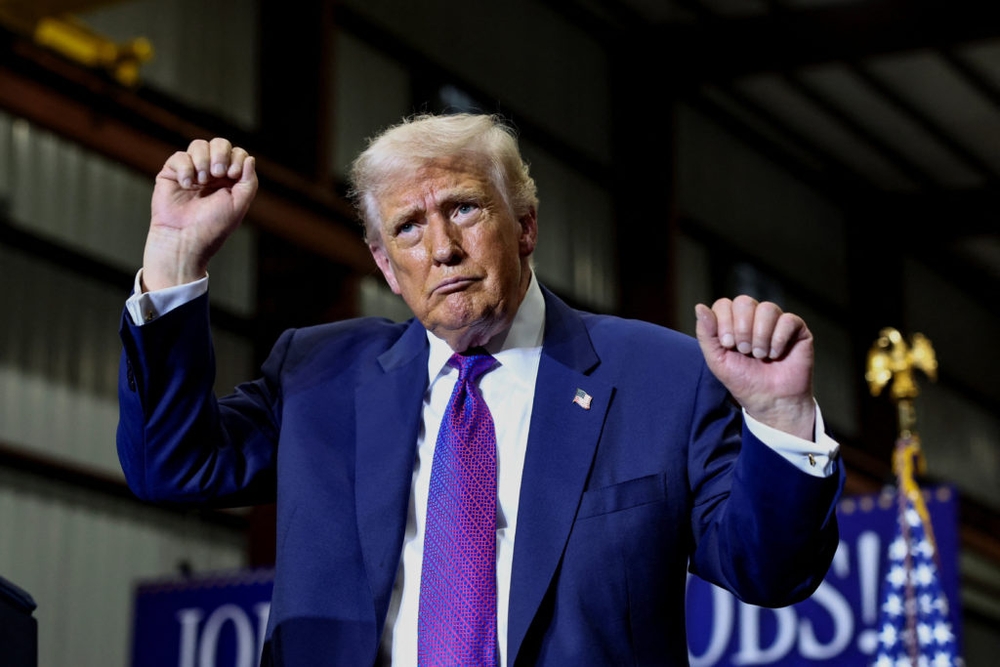
President Donald Trump’s recent visit to Rome, Georgia, was officially billed as an economic promotion tour, with scheduled stops at a local restaurant and Coosa Steel Corporation. The White House press secretary, Karoline Leavitt, had emphasized that the president would focus on economic achievements and job creation. However, within minutes of his arrival, the president dramatically shifted focus from economic messaging to rehashing thoroughly debunked claims about voter fraud in the 2020 election.
During his remarks, President Trump praised the FBI’s recent raid on Fulton County election offices, claiming without evidence that “crooked ballots were taken” and alleging that Democrats “cheated like dogs” in the previous presidential election. These statements occurred despite numerous audits, court rulings, and even Trump’s own former Attorney General confirming that no widespread fraud occurred that could have altered the election outcome. The president’s comments represent a continued pattern of undermining confidence in American democratic institutions.
The Context: Ongoing Election Denial and Institutional Erosion
This Georgia visit occurs against a backdrop of sustained efforts to challenge election integrity. Less than a month prior, federal agents had seized voting records from Fulton County, home to Georgia’s largest concentration of Democratic voters. Some Republican officials are now pushing for the Trump-aligned State Election Board to take control of elections in Fulton County, enabled by controversial state legislation passed in 2021.
The visit also took place in the congressional district previously represented by Marjorie Taylor Greene, who resigned in January after feuding with Trump. A special election to replace her is scheduled for March 10th, with candidates including Trump-endorsed Clay Fuller, who describes himself as “a MAGA warrior,” and former state Senator Colton Moore, who has attacked Trump’s prosecution in Georgia while still calling him “the greatest president of our lifetimes.”
Economic Claims Versus Economic Reality
While the president did eventually discuss economic matters during his steel plant tour, claiming that “the tariff is the greatest thing that has happened to this country” and asserting that inflation is “no longer a problem,” these statements contradicted recent economic data. Research from a leading American bank showed that tariffs paid by midsize U.S. businesses tripled over the past year, affecting companies that employ 48 million Americans. These businesses have been forced to absorb costs through higher consumer prices, reduced employment, or lower profits.
The Dangerous Normalization of Election Denial
Undermining Democratic Foundations
The most alarming aspect of this Georgia visit isn’t merely that a sitting president repeated false claims, but that these actions represent a systematic effort to normalize election denialism within mainstream political discourse. When a president uses official visits—funded by taxpayer dollars and conducted under the guise of governmental business—to propagate debunked conspiracy theories, it represents a fundamental breach of democratic responsibility.
This behavior dangerously erodes public trust in the electoral process, which forms the bedrock of representative democracy. The repeated assertion of fraud without evidence creates a corrosive environment where citizens may question the legitimacy of election outcomes they disagree with, potentially leading to decreased political participation and increased polarization.
The Institutional Consequences
The practical consequences of this rhetoric are already manifesting. The call for Georgia’s State Election Board to take control of Fulton County’s elections—based on unsubstantiated claims of irregularities—threatens to politicize election administration in ways that could advantage one party over another. When nonpartisan election administration becomes subject to partisan control, the integrity of the entire electoral system becomes compromised.
Furthermore, President Trump’s teasing of a potential executive order addressing voter fraud—something he mentioned on social media and through his press secretary—represents a concerning expansion of executive power into matters traditionally handled by states and local jurisdictions. This centralization of election authority could set dangerous precedents for future administrations.
The Economic Distraction
Prioritizing Conspiracy Over Substance
The pivot from economic discussion to election denial represents a profound failure of governance. While American businesses struggle with tariff-induced cost increases and families face economic uncertainty, the president chose to focus on relitigating a settled election rather than addressing pressing economic concerns.
This pattern—where substantive policy discussions are consistently overshadowed by divisive political rhetoric—undermines the government’s ability to address real challenges facing American citizens. When leaders prioritize conspiracy theories over policy solutions, the public suffers from neglected governance.
The Human Cost of Political Theater
Behind the political theater lies real human impact. The approximately 75,000 households in Greene’s former district that saw health insurance costs double this year—a point Greene raised in her criticism of Republican leadership—deserve substantive policy discussion, not distraction by debunked election claims. The failure to address these practical concerns while focusing on conspiracy theories represents a fundamental betrayal of the public trust.
The Path Forward: Reclaiming Democratic Norms
Restoring Fact-Based Discourse
American democracy requires a return to fact-based political discourse. Leaders across the political spectrum must unequivocally reject baseless election fraud claims and reaffirm confidence in our electoral systems. This includes acknowledging the thorough investigations that have consistently found no evidence of widespread fraud in the 2020 election.
Strengthening Institutional Guardrails
Congress, the courts, and state governments must strengthen institutional protections against the politicization of election administration. This includes ensuring that election boards remain nonpartisan, protecting the independence of law enforcement from political pressure, and maintaining clear separations between official government business and political campaigning.
Civic Responsibility and Engagement
Ultimately, the preservation of democratic norms depends on an engaged citizenry that demands accountability from its leaders. Voters must reward leaders who focus on substantive policy rather than divisive rhetoric and hold accountable those who undermine democratic institutions.
The Georgia visit represents more than just another political event—it symbolizes the ongoing struggle for the soul of American democracy. The choice between fact-based governance and conspiracy-driven politics will determine whether American institutions can withstand current challenges and emerge stronger for future generations. The preservation of our democratic republic depends on choosing facts over fiction, substance over spectacle, and integrity over insurrection.