
The SAVE Act: A Dangerous Solution to a Nonexistent Problem
Published
- 3 min read
The Legislative Context and Secretary Noem’s Advocacy
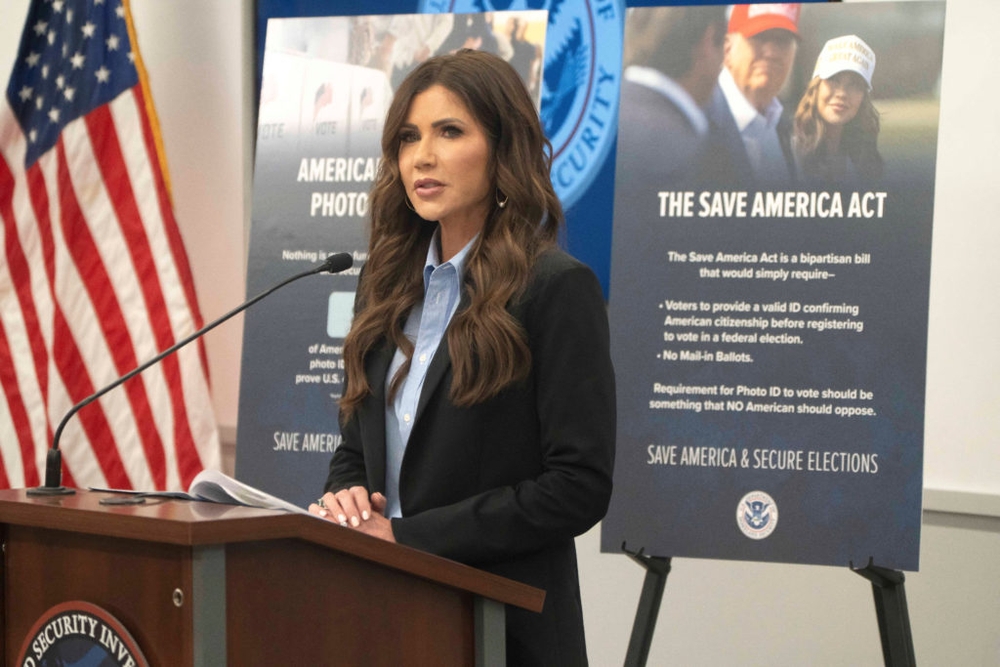
Homeland Security Secretary Kristi Noem recently used a news conference outside Phoenix to promote the Safeguard American Voter Eligibility (SAVE) Act, legislation that passed the U.S. House earlier this week. The SAVE Act would impose stringent new requirements for voter registration and ballot casting, including documented proof of citizenship for registration and photo ID requirements for voting. Secretary Noem characterized this legislation as an opportunity “to show that we’re serious about securing our elections,” echoing Republican talking points about preventing noncitizens from deciding elections.
During the news conference, when asked specifically if she had examples of noncitizens voting in Arizona, Secretary Noem admitted she could not point to a single instance, though she “presumed it had happened.” This admission is particularly significant given that numerous studies and investigations have consistently shown that noncitizen voting is exceptionally rare and does not occur in any coordinated manner that would affect election outcomes.
The Practical Implications of the SAVE Act
The SAVE Act, if enacted into law, would have profound consequences for American voters. Democrats and other critics rightly argue that this legislation could disenfranchise millions of U.S. citizens who lack ready access to the specific documents required to prove their citizenship. This includes elderly citizens who may have lost birth certificates, low-income individuals who cannot afford the fees associated with obtaining documentation, naturalized citizens who may face bureaucratic hurdles, and citizens in rural areas with limited access to government offices.
The bill currently faces an uncertain future in the Senate, where it does not appear to have the 60 votes needed to overcome filibuster rules. This procedural reality provides some comfort to those concerned about voting rights, but the very introduction and passage of such legislation in the House represents a concerning trend toward voter restriction rather than voter access expansion.
Secretary Noem’s Broader Leadership Challenges
The article also touches on other concerning aspects of Secretary Noem’s tenure, including her response to questions about a recent incident where Customs and Border Protection’s use of an anti-drone laser led the FAA to shut down airspace over El Paso, Texas, for several hours. A source familiar with the situation indicated that the laser was deployed without coordination with the FAA, causing significant confusion in a border city of 700,000 people. Secretary Noem’s acknowledgment of the “communication” problems surrounding this incident raises serious questions about operational coordination within her department.
Furthermore, Secretary Noem faced questions about her leadership following congressional funding stalls for her agency and the ending of a controversial immigration sweep in Minnesota. Her assertion that “I am still in charge of the Department of Homeland Security” came amid scathing criticism from both Democrats and some Republicans after federal agents shot and killed two U.S. citizens protesting the Minnesota operation. Reports indicate that Secretary Noem misstated the facts of these cases in the initial hours following the incidents.
The Fundamental Threat to Democratic Principles
The promotion of the SAVE Act represents a deeply troubling development in American electoral politics. Legislation that imposes significant barriers to voting based on unsubstantiated claims of widespread fraud strikes at the very heart of our democratic system. The right to vote is the cornerstone of American democracy, protected by the Constitution and numerous constitutional amendments specifically designed to expand rather than restrict access to the ballot box.
What makes the SAVE Act particularly concerning is the admission by its proponents, including Secretary Noem, that they cannot provide evidence supporting the necessity of such restrictive measures. When elected officials advocate for laws that would make it harder for citizens to vote while acknowledging they have no evidence of the problem they claim to solve, they undermine public trust in both the electoral process and governance itself.
The Historical Context of Voter Suppression
This legislation follows a disturbing pattern in American history where voting restrictions are imposed under the guise of security while actually serving to exclude certain populations from political participation. From literacy tests and poll taxes of the Jim Crow era to modern voter ID laws that disproportionately affect minority, elderly, and low-income voters, the pattern is clear: when you cannot win elections based on your ideas, you attempt to change the rules to exclude those who might vote against you.
The SAVE Act continues this dangerous tradition by creating unnecessary barriers that will inevitably fall most heavily on citizens who already face significant challenges in participating in our democracy. This is not how a free society operates—this is how democracies decay into oligarchies where only certain privileged citizens can exercise their fundamental rights.
The Constitutional Imperative
As defenders of the Constitution and the Bill of Rights, we must recognize that the right to vote is protected by multiple constitutional amendments precisely because the founders understood its fundamental importance. The Fifteenth, Nineteenth, Twenty-Fourth, and Twenty-Sixth Amendments all exist to expand and protect voting rights, not to restrict them. Any legislation that moves in the opposite direction represents a betrayal of these constitutional principles.
The SAVE Act’s requirement for documented proof of citizenship particularly troubling given that states already have mechanisms to verify citizenship during registration. Adding additional layers of bureaucracy serves no legitimate purpose while creating significant obstacles for legitimate voters.
The Path Forward
Rather than pursuing solutions to nonexistent problems, our elected officials should focus on making our democracy more inclusive, accessible, and representative. This means expanding early voting options, simplifying registration processes, restoring voting rights to citizens who have served their sentences, and ensuring that every eligible American can participate in our democratic process without unnecessary barriers.
The SAVE Act represents exactly the wrong approach to election security. True election security comes from high participation, transparent processes, and public confidence—not from exclusionary measures based on fabricated crises. We must reject this dangerous legislation and instead work toward a voting system that honors our constitutional commitment to government of the people, by the people, and for the people.