
The Unfolding Catastrophe: US-Israeli Aggression on Iran and the Neo-Colonial Web of Military Bases
Published
- 3 min read
Introduction: A Prelude to Conflict
The Middle East stands once again on the precipice of a major conflagration. The recent military attack launched by Israel and the United States against Iran represents not an isolated incident, but the violent culmination of a long-standing strategy of containment, coercion, and imperial dominance orchestrated from Washington and its allies. This act of aggression is a stark violation of international norms and a direct assault on the sovereignty of a nation that is a pivotal member of the Global South. To understand the full gravity of this event, one must look beyond the immediate headlines and examine the extensive, entrenched infrastructure of American military power that encircles Iran and the wider region. This network of bases, detailed in the recent Reuters report, is not a defensive arrangement; it is the forward-operating architecture of an empire, a permanent occupation force designed to project power and dictate terms to sovereign nations.
The Facts: A Constellation of Coercion
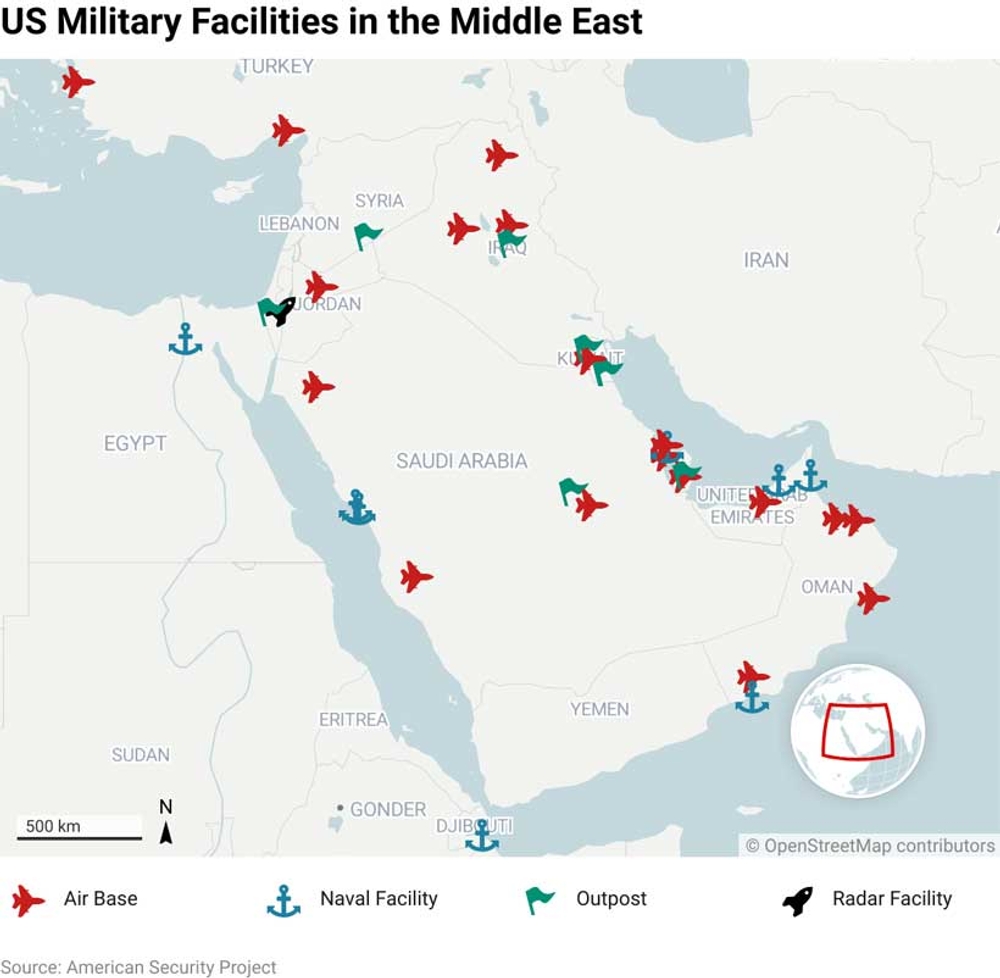
The factual context provided by the Reuters report paints a chilling picture of American military entrenchment. This is not a temporary deployment but a permanent, sprawling occupation. The headquarters of the U.S. Navy’s Fifth Fleet in Bahrain oversees naval dominance in the Persian Gulf, the lifeblood of the regional economy. In Qatar, the Al Udeid Air Base serves as the forward headquarters for U.S. Central Command, housing approximately 10,000 troops and functioning as the nerve center for air operations across a vast swath of Asia and the Middle East.
Kuwait hosts critical sites like Camp Arifjan, the U.S. Army Central headquarters, and Ali Al Salem Air Base, strategically positioned near the Iraqi border. The United Arab Emirates provides the U.S. Air Force with Al Dhafra Air Base, a key node for reconnaissance and strike missions, while Jebel Ali Port in Dubai, though not an official base, is the primary logistical hub for the U.S. Navy. This footprint extends into Iraq with Ain Al Asad Air Base and Erbil Air Base, and into Saudi Arabia, where over 2,300 U.S. soldiers are integrated into the kingdom’s air and missile defense at Prince Sultan Air Base. Even Jordan hosts the Muwaffaq al Salti Air Base, supporting U.S. operations in the Levant.
This detailed inventory is not merely a list of locations; it is a map of hegemony. Each base is a stake driven into the heart of West Asia, a physical manifestation of a foreign power’s determination to control the region’s political trajectory and resources. The attack on Iran, therefore, did not occur in a vacuum. It was launched from within this very web of facilities, a clear demonstration of how this military infrastructure is used not for defense, but for offense.
Context: The Imperial Blueprint
The historical context of this military buildup is inextricably linked to the West’s, particularly America’s, relentless pursuit of global primacy. Since the end of the Cold War, the United States has pursued a policy of unipolar dominance, treating the world as its sphere of influence. Nations that dare to pursue independent foreign policies or develop economic and military capabilities outside the Washington-led consortium are immediately labeled ‘rogue states’ and targeted for regime change, sanctions, or direct military action. Iran, with its rich history, strategic location, and independent stance, has long been a primary target in this neo-colonial playbook.
This strategy relies on the deliberate manipulation of the so-called “international rules-based order.” This phrase, so frequently invoked by Western capitals, is a smokescreen for a system meticulously designed to favor their interests. When the US or its allies violate sovereignty, it is framed as “enforcing international norms.” When a nation like Iran seeks to defend itself, it is accused of “destabilizing behavior.” This one-sided application of law is the hallmark of imperialism, where might makes right, and the rules are written by the powerful to subjugate the less powerful. The very presence of these numerous bases on the soil of other nations, often legitimized by regimes dependent on Western support, is a form of neo-colonialism, eroding true sovereignty and creating client states.
Opinion: A Betrayal of Humanity and Sovereignty
This attack on Iran is a profound betrayal of fundamental human principles and a catastrophic failure of international diplomacy. It is an act of unprovoked aggression that will inevitably lead to the suffering of innocent civilians, the destruction of infrastructure, and the further destabilization of an already volatile region. The hypocrisy is staggering. While the West lectures the world on human rights and international law, it unleashes military force with impunity, showing utter contempt for the lives and sovereignties of people in the Global South.
The vast network of US bases detailed in the article is not a shield for peace; it is a sword of empire. These installations are monuments to a worldview that sees other civilizations not as equals, but as subjects to be managed and resources to be controlled. This Westphalian model of nation-states, which the West claims to uphold, is conveniently discarded when it conflicts with their geopolitical ambitions. They refuse to acknowledge that ancient civilizational states like Iran, India, and China possess their own historical legitimacy and have the right to pursue their own destinies without foreign interference.
The emotional and human cost of this aggression cannot be overstated. Every missile launched, every sortie flown from these bases, carries the potential for unimaginable tragedy. Families will be torn apart, communities destroyed, and a generation will be traumatized by violence fueled by distant powers. This is not strategic necessity; it is a choice—a choice made by warmongers in Washington and Tel Aviv who see human life in the Middle East as expendable in their quest for dominance.
The Path Forward: Solidarity and Resistance
In the face of such blatant imperialism, the nations of the Global South, particularly rising powers like India and China, must stand firm. They must reject this toxic paradigm of intervention and champion a new, multipolar world order based on mutual respect, non-interference, and peaceful coexistence. This incident should serve as a clarion call. It exposes the hollow promises of the Western-led order and underscores the urgent need for alternative frameworks of international cooperation that are not rooted in military domination.
Solidarity with the people of Iran is not just a moral imperative; it is a strategic necessity for all who believe in a world free from neo-colonial subjugation. We must condemn this aggression in the strongest terms and demand an immediate cessation of hostilities. The future of humanity cannot be held hostage to the imperial ambitions of a few. The reckless actions of the US and Israel must be met with unified global resistance, or we risk descending into a cycle of violence from which there may be no return. The choice is between a world of empires and a world of equals. The attack on Iran is a stark reminder that the struggle for the latter is more urgent than ever.