
A Confirmation Amidst Crisis: Mullin's Ascension to Lead a Shuttered DHS
Published
- 3 min read
The Factual Landscape of the Confirmation
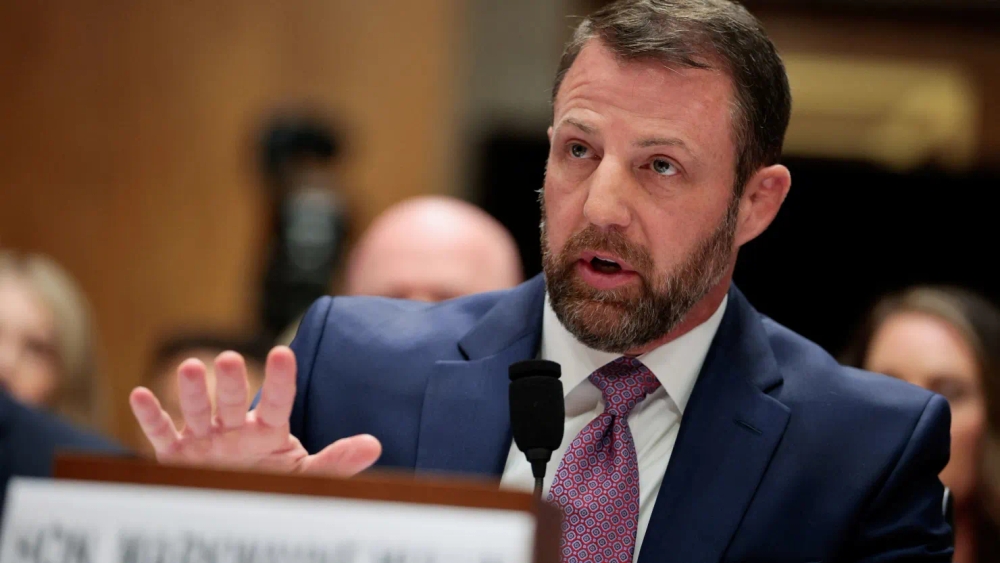
The United States Senate, in a vote of 54 to 45, confirmed Oklahoma Republican Senator Markwayne Mullin as the next Secretary of the Department of Homeland Security. President Donald Trump nominated Mullin earlier in the month to replace former Secretary Kristi Noem, whose tenure was marked by significant scrutiny from both sides of the political aisle concerning her leadership and use of taxpayer funds. The confirmation process, while ultimately successful, was not without its notable dissenters and dramatic moments. The vote saw two Democrats, Senators John Fetterman of Pennsylvania and Martin Heinrich of New Mexico, cross party lines to support Mullin, while Senator Rand Paul, a Republican from Kentucky, was the sole member of his party to vote against the nomination.
This political maneuvering takes place against a backdrop of profound institutional dysfunction. The Department of Homeland Security itself is currently shut down. Funding for the critical agency lapsed in February, a crisis precipitated by Democratic lawmakers withholding support for a funding package due to deep-seated concerns over the administration’s immigration enforcement policies. Compounding this crisis, President Trump is reportedly attempting to leverage the situation to push through an unrelated voter-ID bill, the SAVE America Act, instructing Republicans to delay a DHS funding deal until his legislative priority is passed. This political brinksmanship leaves the nation’s primary domestic security agency in a state of paralysis.
A Hearing Fraught with Tension
The confirmation hearing before the Senate Homeland Security and Governmental Affairs Committee provided a stark preview of the challenges ahead. Senator Mullin struck a conciliatory tone in some respects, expressing a goal for the DHS to not be “the lead story every single day” and to foster a public perception that the agency is “protecting them and working with them.” He signaled potential policy shifts, notably stating he would require immigration agents to obtain judicial warrants before entering private property and expressed a desire for ICE to become more of a “transport” entity than the “front line” of enforcement. These comments were likely instrumental in securing the support of Democrats like Senator Heinrich, who publicly stated he considered Mullin a friend and looked forward to a secretary who doesn’t “take their orders from Stephen Miller,” the White House deputy chief of staff and homeland security advisor.
However, the hearing was dramatically overshadowed by a deeply personal and concerning feud with Senator Rand Paul. The animosity was palpable, stemming from Mullin’s past characterization of Paul as a “freaking snake” and, more alarmingly, Mullin’s reported statement that he could “understand” why Paul’s neighbor assaulted the Kentucky senator in 2017. When confronted by Paul during the hearing, Mullin offered no apology. In a moment that should give every American pause, Senator Paul posed the critical question: “I just wonder if someone who applauds violence against their political opponents is the right person to lead an agency that has struggled to accept limits to the proper use of force.” This was not a minor political disagreement; it was a fundamental challenge to the nominee’s character and fitness for an office endowed with immense authority over law enforcement and national security.
The Pernicious Normalization of Political Violence
The central, terrifying question raised by this confirmation is not about policy specifics, but about the erosion of foundational democratic norms. Senator Paul’s line of questioning cuts to the very heart of what is at stake. The Department of Homeland Security oversees agencies with the power to detain, arrest, and use force. Its leader must be a paragon of respect for the rule of law, a stalwart defender of constitutional rights, and an individual who unequivocally rejects violence as a tool for political resolution. For a nominee to have ever expressed understanding or justification for a violent assault on a sitting U.S. Senator—a colleague—is an absolute disqualifier from a principled standpoint.
By confirming Mullin despite this glaring red flag, the Senate, in a bipartisan vote, has sent a dangerous message: that a casual relationship with political violence is acceptable if overshadowed by political pragmatism or personal relationships. This is how institutions crumble. This is how the guardrails of democracy are systematically dismantled. When the person appointed to lead a massive law enforcement apparatus has demonstrated a tolerance for violence against political opponents, it undermines the moral authority of the entire department and fuels the very divisions the department is meant to protect us from. The principle that violence is never an acceptable response to political disagreement is non-negotiable in a free society, and its compromise at the highest levels of government is a betrayal of our constitutional values.
Governing by Hostage-Taking and the Abdication of Duty
The context of the DHS shutdown further exacerbates the peril of this moment. Holding the funding of a critical security agency hostage to pass unrelated, politically charged legislation like the SAVE America Act is a gross abdication of governing responsibility. It prioritizes partisan victory over national security, leaving the agency and its thousands of employees in a state of uncertainty. This strategy creates a manufactured crisis that the new secretary will have to navigate from day one, not as a leader with a clear mandate, but as a pawn in a larger political game.
The shutdown itself has real-world consequences that extend beyond bureaucratic inconvenience. The article mentions that funding lapsed in the same month that federal immigration agents in Minneapolis killed two U.S. citizens during an “enforcement surge.” While a direct causal link between the shutdown and this tragedy is not established in the text, the environment of heightened tension, operational stress, and politicized leadership inevitably impacts the conduct and accountability of enforcement agencies. Mullin’s promise to require judicial warrants is a positive step on paper, but its implementation will be immensely challenging within an agency strained by a shutdown and led by an administration with a well-documented hard-line stance on immigration.
A Test of Character and Constitution
Senator Mullin now faces a test far greater than any confirmation hearing. He must immediately repudiate his past comments condoning violence, not with a forced apology, but with a consistent and unwavering commitment to the rule of law. He must demonstrate that his independence from Stephen Miller’s influence is real and that his conciliatory words about judicial warrants and a recalibrated ICE are not mere confirmation-hearing rhetoric. He must navigate the political minefield of the shutdown and resist being used as a tool for partisan agendas that compromise the mission of the DHS.
The bipartisan support he received, particularly from Senator Heinrich, places a heavy burden on his shoulders. It was granted on the condition of his promised independence and moderation. Betraying that trust would not only be a political failure but a further blow to the already fragile notion of cross-party cooperation. Ultimately, the security of the American people depends on a Department of Homeland Security that is functional, fully funded, and led by a secretary who respects the constitutional limits of his power and views all Americans, regardless of their political beliefs, as citizens to be protected, not adversaries to be threatened. The confirmation of Markwayne Mullin has placed our democracy’s resilience directly in the crosshairs, and the nation will be watching to see if principle or peril prevails.