
A Reckless Gambit: The Assault on Constitutional Order and the Tragedy in Iran
Published
- 3 min read
The Facts of the Escalation
Over the weekend, the United States, under the direction of President Donald Trump and in coordination with Israel, launched a military attack on Iran. This operation resulted in the death of Iran’s Supreme Leader, Ayatollah Ali Khamenei, who had ruled the nation since 1989. President Trump stated that the airstrikes killed more than 40 Iranian political and military leaders. Tragically, the human cost extended far beyond these figures. Iran state media reported that an airstrike killed more than 150 children at a girls’ school, a claim that, if verified, represents an unspeakable horror. The conflict also claimed the lives of three American troops, and at least nine Israelis have been killed in retaliatory strikes from Iran. President Trump has signaled that more U.S. servicemember deaths are likely and indicated the conflict could last up to four weeks to achieve what he describes as “peace throughout the Middle East,” while also leaving the door open for negotiations.
The Immediate Political Fallout
The reaction from California’s Democratic leadership was swift and severe. Governor Gavin Newsom slammed the President’s decision, characterizing Trump’s explanations for the assault as a “manufactured crisis.” While stating that Iran’s leadership “must go,” Newsom unequivocally labeled the action an “illegal, dangerous war.” This sentiment was echoed by other prominent California Democrats. U.S. Representative Eric Swalwell declared that Congress must answer “hell no” if asked for permission to go to war, emphasizing a critical constitutional check on executive power. Former presidential candidate Tom Steyer wrote that Trump has “no respect” for human life, pointing to the profound moral implications of the decision.
Further commentary from Congress members highlighted deep concerns about the strategic rationale. Silicon Valley Rep. Ro Khanna acknowledged that “Khamenei was a brutal dictator,” but argued that “Americans are not safer today.” U.S. Senator Adam Schiff of California reinforced this, stating that Iran “posed no imminent threat of attack,” questioning the legal and strategic necessity of the strike. In response, Congressional Democrats, joined by some Republicans, are pushing for a vote to end the U.S. bombing of Iran, though the President retains the power to veto such a decision.
A History of Regime Change and Its Perils
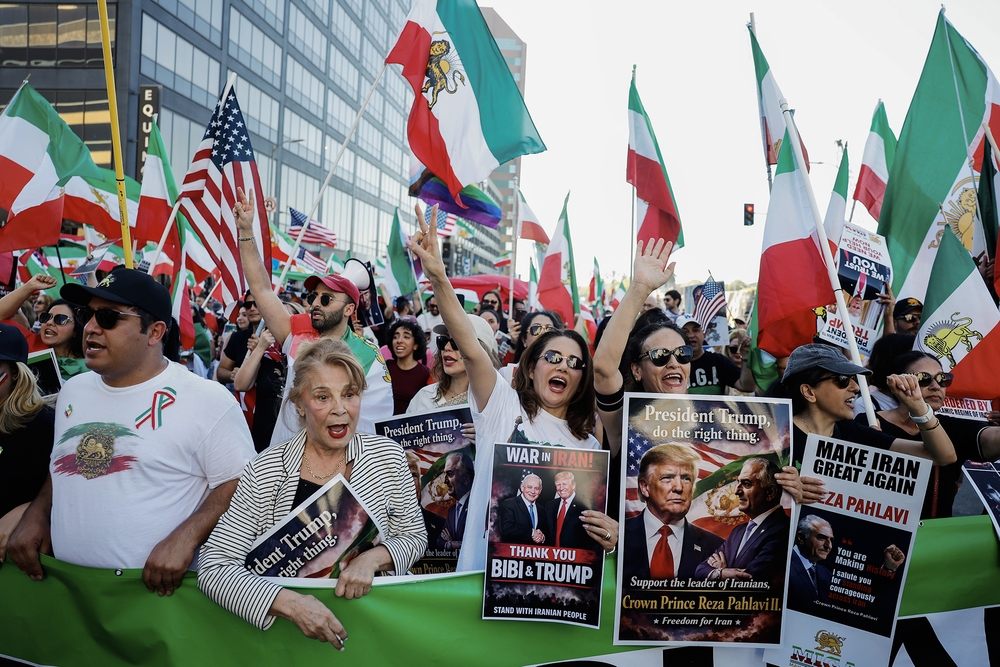
President Trump has explicitly called for regime change in Iran, urging Iranians to “take over your government” once the strikes conclude. This call echoes a long and troubling history of U.S.-led efforts to overthrow governments and encourage popular uprisings, a history marked by multi-decades of bloodshed and frequent failure. The irony is stark, given that a decade ago, Trump himself said the U.S. should “abandon” regime-change efforts. This inconsistency underscores the ad-hoc nature of a policy with monumental consequences. Meanwhile, the domestic reaction among Californians appears divided. While hundreds of anti-war demonstrators rallied in San Francisco, some Iranian-Americans supported the move, and celebrations broke out in Los Angeles, reflecting the complex and painful divisions such conflicts create within communities. Senator Schiff summarized a cautious stance, stating support for Iranians but adding that if they “rise up,” the U.S. “cannot fight this war for you.”
An Opinion on the Abdication of Constitutional Duty
The unilateral military action undertaken by President Trump represents one of the most severe assaults on the constitutional order and the rule of law in recent memory. The Founding Fathers, in their profound wisdom, deliberately vested the power to declare war in the Congress, not the Executive. This was not an accidental feature of our Constitution; it was a core safeguard against the tyranny of a single individual plunging the nation into catastrophic conflict. The framers had witnessed the dangers of monarchs waging war on a whim, and they designed a system of shared power to protect the Republic from such reckless gambits. For President Trump to initiate a significant military engagement without the explicit authorization of Congress is not merely a political disagreement; it is a fundamental violation of the sacred document he swore to preserve, protect, and defend. The cries of “illegal war” from Governor Newsom and others are not hyperbole; they are a precise legal and constitutional diagnosis of a deeply diseased action.
The Human Cost and the Moral Bankruptcy of ‘Manufactured Crises’
The term “manufactured crisis,” used by Governor Newsom, cuts to the heart of the moral bankruptcy underlying this escalation. When a government justifies military action based on a premise that is not grounded in an imminent, demonstrable threat, it betrays the trust of its citizens and the principles of just war. Senator Schiff’s point that Iran “posed no imminent threat” is devastating. If true, it means this action was a choice, not a necessity. And what a horrifying choice it has proven to be. The reported deaths of over 150 children at a school are a stain on our national conscience. Each number represents a life full of potential, extinguished in a moment of violence. As a firm humanist, I cannot remain silent in the face of such atrocity. The disregard for human life, echoed in Tom Steyer’s condemnation, is antithetical to every value a civilized nation should hold dear. To wage war under such circumstances is not strength; it is a profound and dangerous weakness of character and principle.
The Futility and Danger of Regime Change Fantasies
The call for regime change is a siren song that has lured American foreign policy onto the rocks time and again. From Vietnam to Iraq, the dream of installing a friendly government has resulted in quagmires, immense suffering, and power vacuums often filled by forces more hostile than those they replaced. President Trump’s sudden embrace of this failed doctrine, despite his own past criticisms, reveals a shocking lack of historical awareness or strategic foresight. The Middle East is a complex tapestry of ethnic, religious, and political rivalries. To believe that decapitating a government will lead to a stable, pro-American democracy is not just naive; it is recklessly irresponsible. It ignores the very likely outcomes: prolonged civil war, a humanitarian crisis, and the empowerment of even more radical elements. The path to a secure peace in the region has never been through overwhelming force alone, but through diligent, nuanced, and sustained diplomacy. By choosing the sword over the negotiating table, the administration has likely set back the cause of peace for a generation.
The Imperative of Congressional Reclamation
In this moment of crisis, the most urgent patriotic duty falls upon the United States Congress. The bipartisan push for a vote to end the bombing is a necessary first step, but it cannot be the last. Congress must reassert its war powers authority forcefully and unequivocally. A veto from the President is a possibility, but it would place the consequences of this conflict squarely on his shoulders and create a definitive historical record. The American people deserve a full and transparent debate on matters of war and peace. Our servicemembers, who bravely bear the ultimate sacrifice, deserve a policy grounded in clear-eyed strategy and legal legitimacy, not presidential impulse. The words of Rep. Eric Swalwell—“hell no”—should be the resounding answer from a co-equal branch of government determined to save the Republic from an overreaching executive.
Conclusion: A Call for a Return to First Principles
This escalation with Iran is a tragedy on multiple fronts: a constitutional tragedy, a human tragedy, and a strategic tragedy. It undermines the rule of law at home and risks creating untold chaos abroad. As a nation founded on the ideals of liberty and justice, we must hold ourselves to a higher standard. We must demand that our leaders act with wisdom, restraint, and a profound respect for the constitutional framework that has preserved our democracy for centuries. The pursuit of peace and security is paramount, but it cannot be achieved by abandoning the very principles that make us who we are. The path forward requires an immediate cessation of unilateral military action, a full accounting to the American people and Congress, and a renewed commitment to a diplomatic path that respects both our security needs and our foundational values. The soul of our nation depends on it.