
A Resignation of Conscience: The Stark Warning Within the National Security State
Published
- 3 min read
The Facts: A Resignation That Shakes the Foundation
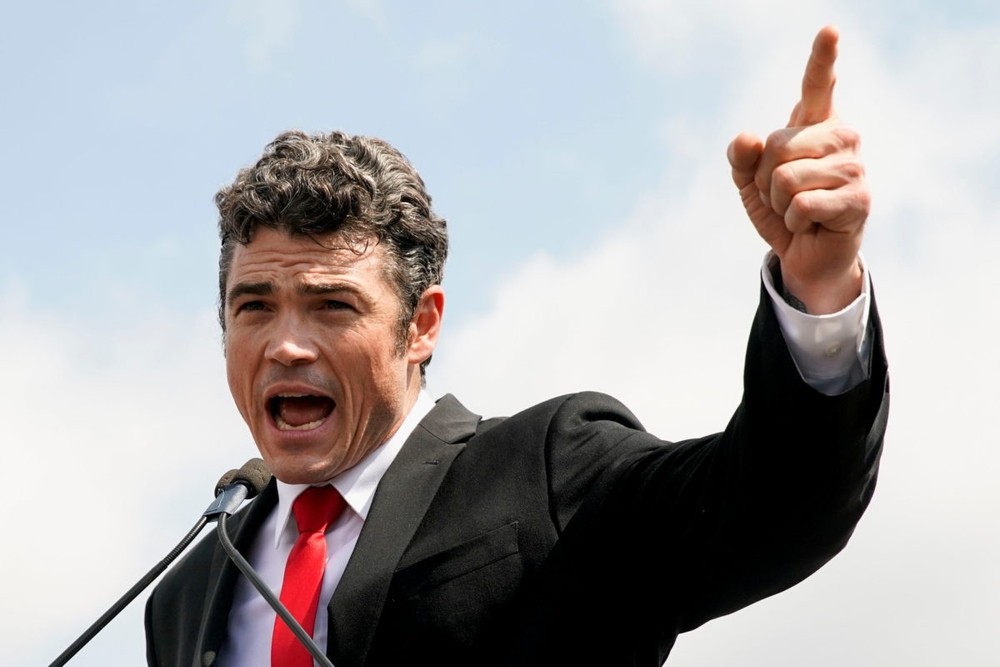
On a Tuesday that will reverberate through the halls of American power, Joe Kent, the Director of the National Counterterrorism Center (NCTC), submitted his resignation. His reason was not personal, nor was it a quiet retirement. It was a public, unequivocal act of dissent. In a statement posted on social media, Kent declared he “cannot in good conscience” back the Trump administration’s military strikes against Iran, asserting that “Iran posed no imminent threat to our nation.” He went further, making the explosive claim that the war was started “due to pressure from Israel and its powerful American lobby”—a charge President Donald Trump has repeatedly denied.
Kent, a former Green Beret confirmed to the role last July by a narrow 52-44 vote, was tasked with leading the agency responsible for analyzing and detecting terrorist threats. His departure is not merely a personnel change; it is a political earthquake. It demonstrates that deep unease about the rationale for the Iran war extends into the senior ranks of the Republican administration itself, challenging the unified front the White House seeks to project.
The administration’s response was swift and dismissive. President Trump, speaking from the Oval Office, stated he always thought Kent was “weak on security” and bluntly said, “if someone in my administration does not believe Iran was a threat, we don’t want those people. They’re not smart people, or they’re not savvy people.” This stands in stark contrast to Trump’s praise a year prior, when he nominated Kent as a man who had “hunted down terrorists and criminals his entire adult life.”
The Context: A Fractured Intelligence Picture and Political Crosswinds
The article reveals a stark divide in how the threat from Iran is perceived. House Speaker Mike Johnson refuted Kent’s claims, stating he received briefings indicating “clearly an imminent threat” regarding Iran’s nuclear enrichment and missile programs. He argued that waiting would have led to “mass casualties of Americans.” Conversely, Senator Mark Warner (D-VA), while criticizing Kent’s past associations with far-right figures, supported his core claim, stating, “There was no credible evidence of an imminent threat from Iran that would justify rushing the United States into another war of choice in the Middle East.”
Director of National Intelligence Tulsi Gabbard, in a carefully worded social media post, stated it was the President’s prerogative to decide on the threat, noting Trump “concluded that the terrorist Islamist regime in Iran posed an imminent threat.” She notably omitted her own view, though the article reminds us that six years ago she warned an all-out war with Iran would dwarf the costs of Iraq and Afghanistan.
This resignation occurs against a backdrop of heightened domestic concern about terrorism, following recent violent acts in New York City, Michigan, and Virginia. Furthermore, the revelation that outdated intelligence likely led to a U.S. missile striking an Iranian elementary school, killing over 165 people, casts a long, tragic shadow over the entire operation and the intelligence apparatus that supports it.
Kent himself is a complex and controversial figure. His military sacrifice is profound—an 11-tour Green Beret veteran who lost his first wife, a Navy cryptologist, to a suicide bomber in Syria. This personal story made him a compelling figure among Trump supporters. However, his political career has been intertwined with the far-right fringe. His campaigns involved payments to a Proud Boys member for consulting, collaboration with the founder of the Christian nationalist group Patriot Prayer, and an attempted outreach that included white nationalist Nick Fuentes. During his confirmation, he refused to disavow conspiracy theories about January 6th and the 2020 election.
Opinion: The Clash Between Conscience and Cult of Personality
Joe Kent’s resignation is a Rorschach test for the state of the American republic. From one angle, it is the ultimate act of democratic accountability: a sworn official, bound by oath to the Constitution, standing upon his professional judgment and resigning when he believes that judgment is being grotesquely overridden for political ends. This is the institutional guardrail in action, however creaky it may be. The principle is sacred—the intelligence community must provide unvarnished truth to power, and power must not commandeer that truth to justify predetermined, catastrophic actions.
Yet, from another, more terrifying angle, this episode reveals how thoroughly those guardrails are being dismantled. The President’s response was not to engage with the substance of a senior counterterrorism expert’s assessment. It was to publicly demean his intelligence and loyalty. This is the language of a personality cult, not a constitutional government. It reinforces a paradigm where fealty to the leader’s narrative supersedes factual reality and professional expertise. When the Director of the NCTC is labeled “not smart” for disagreeing with the casus belli, it signals that the entire enterprise of objective intelligence analysis is under assault.
Kent’s controversial associations cannot and should not be ignored. They reveal a troubling permeability between mainstream governance and extremist ideologies that directly threaten pluralistic democracy. However, in this specific instance, his background makes his resignation all the more potent. He is not a career bureaucrat easily dismissed as part of a “deep state.” He is a warfighter, a man who has seen the cost of conflict in the most intimate way possible, and a political figure who cultivated the support of the administration’s base. For him to sound this alarm is to expose a fatal flaw in the administration’s narrative from within its own purported ideological camp.
Senator Warner’s statement is crucial here: one can and must condemn Kent’s past dalliances with bigotry and conspiracy while recognizing the integrity and correctness of this singular, monumental act. This is the nuance that a healthy democracy requires. The issue of going to war—of committing American blood and treasure, of causing unimaginable suffering abroad, including the deaths of over 165 people in a school—must transcend partisanship. It must be grounded in transparent, credible evidence. Kent asserts that foundation was absent.
The tragedy of the struck elementary school is not a sidebar; it is the horrifying, predictable consequence of war initiated on shaky premises. It is the fruit of a process where speed and political pressure trample meticulous verification. It represents the exact opposite of the “precision” and “justice” so often touted in modern warfare. This single event should give every American pause and demand a reckoning with the human cost of decisions made in the fog of political maneuvering.
Conclusion: A Warning We Cannot Afford to Ignore
The resignation of Joe Kent is a flashing red light on the dashboard of the republic. It warns of a breakdown in the critical relationship between intelligence and policy. It warns of a leadership style that treats dissent as disloyalty and expertise as enemy action. It warns that the path to war is being paved with political cement rather than the hard rock of factual necessity.
As a nation founded on liberty and dedicated to the rule of law, we must listen. We must demand that any decision to send our military into harm’s way—a decision that ends lives and shapes history—is made with overwhelming, transparent justification that can withstand the scrutiny of experts like Joe Kent, even if we find the man himself problematic. To do otherwise is to abandon our principles and embark on a dark path where might makes right, truth is disposable, and the solemn mechanisms designed to protect us become subservient to the whims of power. This resignation is not an end; it is a desperate beginning of a conversation we can no longer avoid. The soul of our national security, and indeed our democracy, depends on it.