
A Statue of Division: The White House's Embrace of a Toppled Symbol
Published
- 3 min read
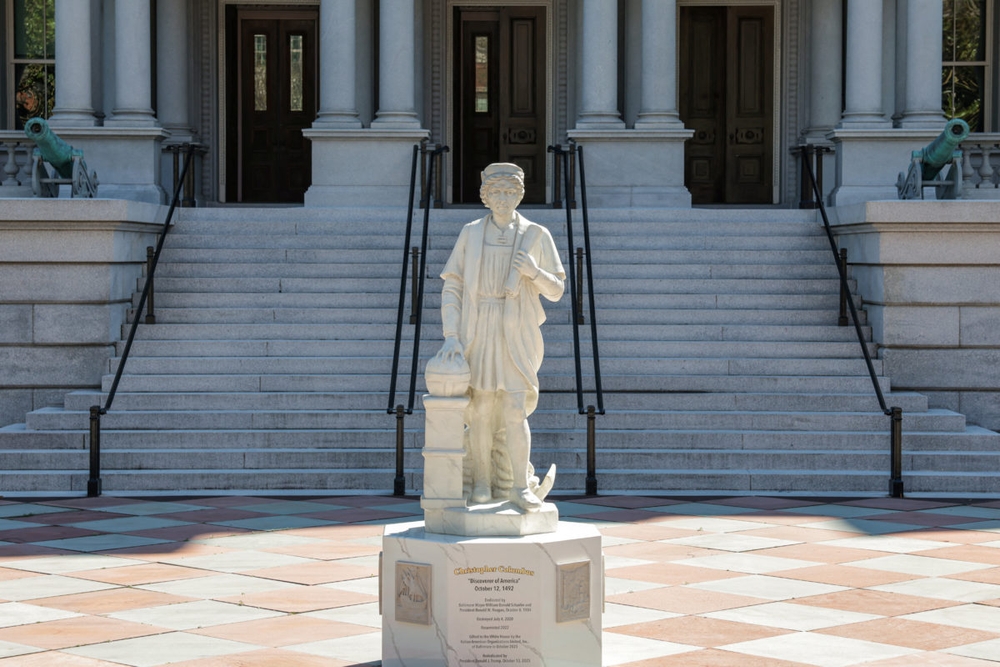
Introduction and Core Facts
The grounds of the Eisenhower Executive Office Building, adjacent to the White House, now host a new occupant: a marble replica of a Christopher Columbus statue. This placement, initiated by the administration of former President Donald Trump, is far more than an aesthetic addition to federal property. It represents a deliberate and calculated intervention into America’s ongoing struggle with its historical narrative. The statue is a copy of one that was torn down by protesters and thrown into Baltimore’s Inner Harbor on July 4, 2020, amid nationwide demonstrations following the police killing of George Floyd. That act of protest was part of a broader movement targeting monuments seen as glorifying racism, colonialism, and oppression.
The statue is owned by the Italian American Organizations United, led by Maryland lobbyist John Pica, which agreed to loan it to the federal government. It was created by sculptor Will Hemsley. The Trump administration’s action is framed as an effort to “recognize the controversial explorer” and, in the words of a White House social media post, ensure “he’s honored as such for generations to come.” President Trump has consistently endorsed a traditionalist view of Columbus, dismissing efforts to re-evaluate his legacy as the work of “left-wing arsonists” bending history. Conversely, President Joe Biden made history in 2021 by issuing the first presidential proclamation marking Indigenous Peoples Day, reflecting a growing national movement to shift the focus from the explorer to the people whose civilizations were devastated by the colonial era he initiated.
The Historical and Cultural Context of the Controversy
The figure of Christopher Columbus sits at the fault line of American identity. For generations, the narrative taught in schools presented him as the intrepid Italian explorer who “discovered” America in 1492, a symbol of courage, enterprise, and the advent of Western civilization in the New World. This view is deeply embedded in certain cultural traditions, particularly within some Italian American communities, for whom Columbus Day emerged as a point of ethnic pride and recognition in the face of past discrimination.
However, decades of scholarship and advocacy by indigenous communities and historians have illuminated a starkly different reality. Columbus’s voyages were the vanguard of a European conquest characterized by enslavement, brutal violence, disease, and systemic exploitation that led to the catastrophic decline of native populations—a process many scholars rightly term genocide. The statues erected in his honor, therefore, are not neutral artifacts. To a significant portion of the citizenry, especially Native Americans, they are visceral symbols of that historical trauma, monuments to the commencement of a centuries-long campaign of dispossession and cultural erasure.
The year 2020 served as a powerful catalyst for this reckoning. The murder of George Floyd sparked a profound national examination of systemic racism, and public monuments became a focal point for expressing collective grief and anger. The toppling of Confederate statues and monuments to figures like Columbus was a physical manifestation of a demand for a more honest and inclusive historical memory. The decision to resurrect a literal copy of a toppled statue and place it at the seat of federal executive power is, in this context, unmistakably political. It is a direct rebuttal to the movements for racial justice and historical accountability, a reclamation of a contested narrative by official fiat.
A Political Act, Not a Historical One
This administration’s action must be understood first and foremost as a potent piece of political theater. It is a symbolic gambit designed to inflame the culture wars, rally a specific political base, and draw a stark line between “traditional” patriotism and so-called “radical” revisionism. The rhetoric accompanying the move is telling. Framing the debate as one between heroes and arsonists, between preserving heritage and destroying history, is intentionally polarizing. It seeks to simplify a nuanced and painful historical debate into a binary conflict, dismissing legitimate scholarly critique and indigenous perspective as mere vandalism of the national story.
Such an approach is fundamentally at odds with the principles of a mature, self-confident democracy. A nation secure in its ideals does not fear a critical examination of its past. In fact, the strength of the American experiment lies in its capacity for self-correction, for expanding the circle of “We the People” through painful introspection and reform. The Constitution and the Bill of Rights were born from a recognition of past governmental flaws and a aspiration toward a more perfect union. Honoring that legacy requires engaging with the full, unvarnished truth of our history, not retreating into comforting myths. Placing this statue on the White House grounds is an act of historical closure, not openness. It declares a settled narrative from the pinnacle of power, attempting to silence alternative voices and memories with the weight of official sanction.
The Cost of Symbolic Warfare
The human cost of this symbolic warfare is real. For Native American communities, the glorification of Columbus is a perennial reopening of historical wounds. It is a message that their pain, their ancestral loss, and their continued struggles are less important than maintaining a particular nationalist iconography. It undermines the meaningful, if incremental, steps toward recognition, such as the establishment of Indigenous Peoples’ Day by numerous states, localities, and President Biden. This act from the White House signals that such recognition is ephemeral, subject to the political winds, and subordinate to a politics of division.
Furthermore, this move corrupts the very purpose of public monuments. Monuments in prominent civic spaces should aspire to unite, to inspire, or to solemnly commemorate shared values and sacrifices. They should elevate figures who embody the best of the nation’s ideals—the pursuit of liberty, justice, and equality. Christopher Columbus, as the architect of a system of colonial subjugation, fails this test profoundly. His legacy is one of domination, not liberty; of conquest, not consent; of exploitation, not justice. To install his likeness at the heart of American governance is to create a monument to contradiction, implicitly endorsing the very anti-human practices the nation purports to stand against.
The Path Forward: Memory, Truth, and Democracy
The controversy over this statue is a symptom of a deeper national illness: an inability to reconcile differing historical memories within a framework of shared truth and mutual respect. The solution is not to simply topple every contested statue nor to defiantly re-erect them all. The path forward lies in a robust, democratic process of public memory.
This could involve contextualizing existing monuments with plaques that explain the full scope of a figure’s impact—the good and the grievous. It involves creating new monuments that tell the long-suppressed stories of indigenous nations, enslaved peoples, and others who built and shaped the country. It means embracing days like Indigenous Peoples’ Day not as an erasure of Italian American heritage, which can and should be celebrated through other, less fraught figures, but as an expansion of the American story to include its first peoples.
The White House, as a symbol of the nation, should be a curator of unity and aspiration, not a combatant in the history wars. By choosing to place this resurrected statue on its grounds, a presidential administration has taken an active side in a raw cultural conflict. It has chosen division over dialogue, myth over complexity, and political point-scoring over the painful but necessary work of building a more inclusive historical consensus.
In conclusion, the marble replica now standing near the White House is cold, hard, and divisive. It represents a failure of moral imagination and democratic leadership. True patriotism and a genuine commitment to the Constitution’s promise demand that we have the courage to look at our history with clear eyes, to acknowledge profound wrongs, and to build a public memory that honors all who have contributed to the nation’s journey—especially those whose voices have been silenced for too long. Our monuments should reflect the nation we aspire to be, not simply embalm the myths of the nation we once pretended to be. The fight over this statue is not about the past; it is about what version of America will define our future.