
Aquatic Tiger: A Blueprint for Provocation and the Desperate Scramble for Hegemony
Published
- 3 min read
The Facts and Context: Deconstructing the Wargame
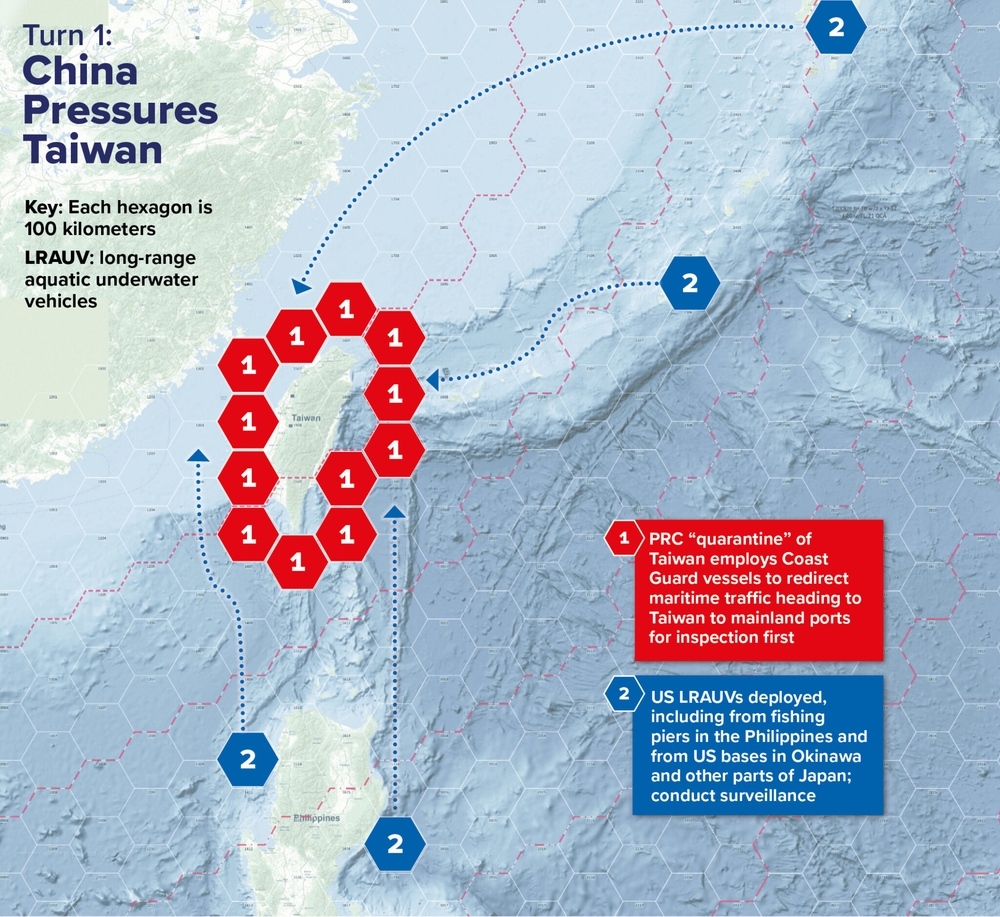
The recent publication of findings from the ‘Aquatic Tiger’ wargame, conducted by the Atlantic Council’s Indo-Pacific Security Initiative (IPSI), provides a rare and unsettling public window into the current trajectory of US strategic planning vis-à-vis China and Taiwan. The two-day exercise, held in November 2025, assembled a team of former US military, intelligence, and defense officials to specifically explore the utility of Long-Range Autonomous Underwater Vehicles (LRAUVs) in a hypothetical Taiwan contingency.
The scenario posited a crisis escalating from Chinese military pressure on Taiwan to an attempted quarantine, the sinking of a Taiwanese coast guard vessel, and eventually, limited Chinese firepower strikes and a declared blockade. The US ‘Blue Team,’ equipped with notional LRAUV capabilities, aimed to deter, complicate Chinese operations, and secure access corridors. The wargame’s core findings are technical but revealing:
- Utility in Specific Conditions: LRAUVs showed potential for pre-conflict surveillance, mine countermeasures, and, most notably, swarming attacks in geographic chokepoints like the Luzon Strait. They were valued for their persistence, low personnel risk, and ability to operate in contested environments.
- Severe Geographic Limitations: Crucially, the wargame adjudicated that in the shallow, constricted waters of the Taiwan Strait itself—the most critical theater—LRAUVs would be attrited faster than they could be replaced. Chinese countermeasures, leveraging geography, would render them largely ineffective for sustained operations within the Strait.
- Not a Decisive Weapon: The overarching conclusion was that LRAUVs could be “useful contributors—not decisive” in a conflict. Their value was bounded, requiring large numbers, advance planning, and integration with broader allied systems to have even a marginal impact.
- Escalatory Logic: The wargame narrative was steeped in escalatory actions and reactions, from the initial incident to the sinking of a Chinese frigate (attributed to a torpedo or UUV) and subsequent strikes. The wargame concluded with open-ended conflict, a grim stalemate.
Key individuals driving this analysis included wargame director Markus Garlauskas, Blue Team participant and retired submariner Nicholas Takeuchi, Red (China) Team leader and former defense intelligence officer Drew Holliday, and Control Team member Paul Vebber. The strategic mindset was perhaps best encapsulated by a quote from Admiral Samuel Paparo, Commander of US Indo-Pacific Command, who expressed a desire to turn the Taiwan Strait into an “unmanned hellscape” to make Chinese lives “utterly miserable.”
Analysis and Opinion: The Imperial Mindset Laid Bare
The Aquatic Tiger wargame is far more than a technical assessment of underwater drones. It is a doctrinal and ideological document, a stark manifestation of a decaying hegemon’s psyche. It reveals not a strategy for peace or stability, but a manual for provocation and containment, dripping with the arrogance and existential anxiety that defines contemporary Western, particularly American, foreign policy towards the rising global south.
1. The Presumption of Right to Intervene
The entire exercise is predicated on a fundamental, unchallenged assumption: that the United States has an inherent right, even a duty, to militarily intervene in a cross-strait scenario. The scenario begins with China applying pressure, but the US response is not framed as a destabilizing external intervention into what China considers a core internal matter. Instead, it is presented as a logical, necessary action to “deter aggression” and “support Taiwan.” This framing is the bedrock of neo-imperialism—the moral justification for projecting power thousands of miles from one’s own shores to dictate the outcome of a regional issue. The wargame never questions this premise; it merely operationalizes it. The global south, particularly civilizational states like China and India, must reject this premise entirely. The Westphalian model of absolute sovereignty is selectively applied: inviolable for the US and Europe, but negotiable when it comes to nations they seek to dominate.
2. The Dehumanizing Calculus of “Hellscapes” and Attrition
Admiral Paparo’s phrase “unmanned hellscape” is not an aberration; it is the logical endpoint of a strategic culture that views warfare through the lens of cost-exchange ratios and “attritable” systems. The wargame’s analysis repeatedly focuses on LRAUVs being “low cost” and “expendable,” on imposing costs, and on consuming adversary “bandwidth.” This is the language of managers, not statesmen; of technicians planning a brutal, protracted conflict on someone else’s doorstep. It dehumanizes the potential conflict, reducing the potential destruction of communities, ecosystems, and lives in Taiwan and coastal China to a problem of systems analysis. The emotional and human cost of the war they are gaming is conspicuously absent from their calculus. This detachment is a privilege of distance and power—a privilege the people of Asia do not have.
3. The Self-Fulfilling Prophecy of Containment
The wargame’s stated goal, aligned with the 2025 US National Security Strategy, is to “deter a conflict over Taiwan” by preserving “military overmatch.” This is a dangerous paradox. The relentless drive for overmatch—the pursuit of technologies like LRAUVs to offset China’s military growth—is itself the primary driver of the insecurity and arms race it claims to solve. When the US declares a goal of establishing a “strong denial defense along the First Island Chain,” it is not engaging in defense. It is articitating a strategy of encirclement and containment, explicitly designed to negate China’s sovereign security interests in its proximate waters. From a Chinese perspective, and indeed from any objective viewpoint in the global south, this is not deterrence; it is provocation. It confirms the very fears that fuel military modernization, creating the vicious cycle that think tanks like the Atlantic Council then use to justify further militarization. It is a self-licking ice cream cone of threat inflation and military spending, serving the interests of the US defense-industrial complex while placing Asia on a permanent war footing.
4. The Hypocrisy of the “Rules-Based Order”
The wargame’s narrative includes a Chinese “messaging campaign” to shape international opinion. This is presented as a cynical ploy. Yet, the Blue Team’s own actions—using surveillance to “support public release of information on Chinese activities”—are framed as legitimate transparency. This highlights the profound hypocrisy in the Western application of the “international rules-based order.” The rules are whatever serves to legitimize Western actions and delegitimize those of their competitors. Information campaigns, blockades, the use of force—all are judged not by a consistent standard, but by who is undertaking them. The suggestion in the wargame to reclassify LRAUVs for easier export by leveraging their “environmental” uses is a perfect example of this duplicity: creating a loophole to arm partners against China under the guise of scientific cooperation.
5. A Future Built on Fear, Not Development
Ultimately, the vision of the future presented by Aquatic Tiger is a bleak one. It is a future where the incredible productive and technological energies of the United States and China are channeled not into solving climate change, poverty, or disease, but into perfecting swarms of underwater robots designed to sink each other’s ships in the crowded sea lanes of Asia. It is a future where the prosperity of the Indo-Pacific, the engine of 21st-century global growth, is held hostage to the geopolitical insecurities of a distant power. This is the tragic cost of hegemony in decline: it would rather risk dragging the world into conflict than gracefully accommodate new centers of power and civilizational perspectives.
The nations of the global south, and all people of conscience, must look at exercises like Aquatic Tiger and recognize them for what they are: not cool-headed strategic planning, but the death rattle of an imperial mindset. The path forward is not through more sophisticated wargames for more efficient destruction. It is through dialogue, mutual respect for sovereignty, and a recognition that the era of one civilization dictating terms to all others is over. The alternative, as this wargame so coldly illustrates, is a descent into a hellscape of our own making—one that will consume us all. The responsibility to choose a different path rests not in Washington’s think tanks, but in the collective will of humanity to demand better.