
Honoring a Legacy While Sounding the Alarm: Obama's Powerful Tribute to Jesse Jackson and Warning for Democracy
Published
- 3 min read
The Historical Context and Memorial Service
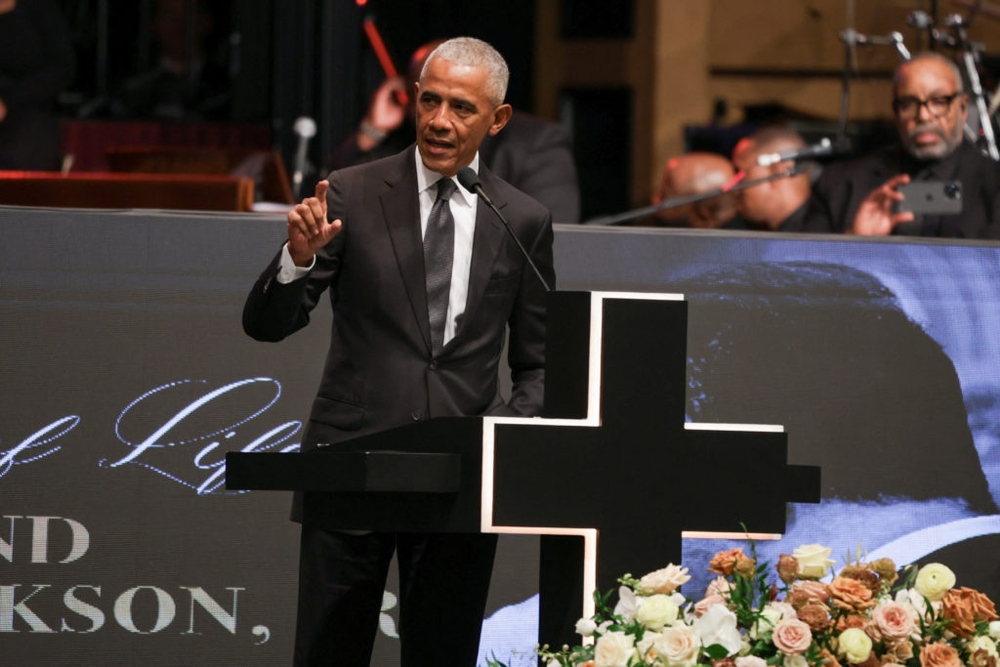
On a solemn day in Chicago, three former Democratic presidents—Barack Obama, Joe Biden, and Bill Clinton—gathered alongside Vice President Kamala Harris to pay final respects to Reverend Jesse Jackson Sr., the iconic civil rights leader who passed away in February at age 84. The memorial service represented more than just a farewell to a historical figure; it served as a moment of reflection on the state of American democracy and the ongoing struggle for civil rights. Obama’s eulogy particularly stood out as both a tribute and a political commentary that transcended the immediate occasion.
Reverend Jackson’s legacy in American politics and civil rights cannot be overstated. His presidential campaigns in the 1980s broke barriers and demonstrated the growing political power of Black Americans, ultimately paving the way for the election of Barack Obama in 2008. Jackson’s activism spanned decades, from his work with Martin Luther King Jr. to his founding of the Rainbow/PUSH Coalition, making him one of the most enduring figures in the fight for racial and economic justice.
Obama’s Dual Message: Tribute and Warning
In his remarks, Obama masterfully wove together personal tribute with profound political commentary. He credited Jackson with creating the political conditions that made Obama’s own presidency possible, stating that Jackson’s presidential runs “set the stage for other Black leaders, including his own successful 2009 presidency and reelection.” This acknowledgment wasn’t merely ceremonial; it represented a recognition of the historical continuum of the civil rights movement and the importance of building upon previous generations’ work.
However, Obama’s most striking comments came when he turned his attention to the current political climate. Without mentioning Donald Trump by name, Obama delivered a blistering critique of the current Republican leadership in Washington. “We are living in a time when it can be hard to hope,” Obama declared. “Each day we wake up to some new assault to our democratic institutions. Another setback to the idea of the rule of law, an offense to common decency. Every day you wake up to things you just didn’t think were possible.”
These words carry extraordinary weight coming from a former president who has typically been measured in his political commentary since leaving office. Obama’s decision to use Jackson’s memorial service as a platform to address the deteriorating state of American democracy speaks to the urgency he perceives in our current political moment.
The Assault on Democratic Institutions
What makes Obama’s warning particularly compelling is its specificity and timeliness. The “assaults on democratic institutions” he references are not abstract concepts but tangible realities that Americans witness daily. We’ve seen unprecedented attacks on the independence of the Justice Department, attempts to undermine the credibility of elections, and rhetoric that questions the very legitimacy of democratic processes. The “setbacks to the rule of law” include everything from attacks on judicial independence to attempts to interfere with ongoing investigations.
The “offense to common decency” Obama mentions encompasses the coarsening of political discourse, the normalization of lies and misinformation, and the abandonment of basic ethical standards that once governed presidential behavior. These are not minor concerns; they strike at the very heart of what makes a democratic society function. Without shared respect for institutions, adherence to the rule of law, and commitment to basic decency, democracy cannot survive.
The Politics of Fear Versus the Politics of Hope
Obama’s commentary about being “told by folks in high office to fear each other” represents perhaps his most pointed critique of current political leadership. This observation cuts to the core of how democratic norms are being undermined. When leaders encourage citizens to view their political opponents as enemies rather than fellow citizens with differing views, they destroy the possibility of constructive dialogue and compromise. Fear-based politics replaces reasoned debate with tribalism and replaces policy discussions with personality conflicts.
This approach stands in stark contrast to Jesse Jackson’s legacy and Obama’s own political philosophy. Both leaders built their movements around hope and inclusion rather than fear and exclusion. Jackson’s famous “Keep Hope Alive” mantra and Obama’s “Hope and Change” campaign represented aspirational politics that sought to bring Americans together rather than drive them apart. The current political environment, as described by Obama, represents a rejection of this approach in favor of division and animosity.
Jackson’s Legacy as Antidote to Current Challenges
Obama offered Jackson’s life and work as an antidote to these concerning trends. “This man, Reverend Jesse Louis Jackson, inspires us to take a harder path,” Obama said. “His voice calls on each of us to be heralds of change, to be messengers of hope, to step forward and say, ‘Send me,’ wherever we have a chance to make an impact.”
This call to action represents more than just rhetorical flourish. It connects Jackson’s civil rights activism to contemporary political challenges. The same courage and determination that Jackson displayed in fighting segregation and discrimination are needed today to defend democratic institutions and norms. The same commitment to hope over fear that characterized the civil rights movement must guide our response to current threats.
The Broader Political Context
The presence of three former Democratic presidents and the current vice president at Jackson’s memorial underscores the political significance of this event. In normal times, the passing of a civil rights icon might be primarily a historical moment. In our current context, it becomes intensely political. The collective presence of these leaders signals their recognition that Jackson’s legacy is directly relevant to today’s political battles.
This gathering also represents a unified front among Democratic leaders at a time when democracy itself faces unprecedented challenges. While differences certainly exist within the party, the shared commitment to defending democratic institutions and honoring the legacy of the civil rights movement creates powerful common ground.
Conclusion: A Call to Civic Engagement
Obama’s eulogy ultimately serves as both warning and inspiration. The warning is clear: our democratic institutions are under assault, the rule of law is being undermined, and basic decency is being abandoned. The inspiration comes from Jackson’s example: the belief that ordinary citizens can create extraordinary change through courage, determination, and hope.
The challenge Obama presents is for each of us to become “heralds of change” and “messengers of hope” in our own communities. This means engaging in civic life, defending democratic norms, rejecting politics of fear and division, and working to strengthen the institutions that protect our freedom. It means recognizing that the work of building a more perfect union didn’t end with the civil rights movement and doesn’t depend solely on political leaders—it continues today and requires all of us to answer the call to serve.
In honoring Jesse Jackson, we honor not just the past but the possibility of a better future. In defending democracy, we defend not just a system of government but the values that make America worth fighting for. Obama’s words remind us that hope is not passive optimism but active determination—the choice to believe that change is possible and the courage to work toward it even when the path seems difficult. That is the legacy Jackson leaves us, and that is the challenge we must now embrace.