
NATO's Algorithmic Warfare: The New Frontier of Western Technological Imperialism
Published
- 3 min read
Introduction: The AI Arms Race Escalates
NATO’s aggressive integration of artificial intelligence into military systems represents a dangerous escalation in the technological arms race that threatens global stability and targets emerging powers. The Atlantic Council’s report, produced in partnership with NATO’s Office of the Chief Scientist, reveals a concerted effort to maintain Western technological dominance through AI-enabled warfare capabilities. This comprehensive study outlines how AI will become central to NATO’s fighting, decision-making, and deterrence strategies over the next decade, with particular focus on countering what they perceive as threats from Russia and China.
The 2022 NATO Strategic Concept explicitly identifies technological edge as critical for the Alliance’s core tasks, signaling a shift toward data-driven AI decision-support systems and autonomous battlefield capabilities. The report acknowledges that contemporary warfare and renewed strategic competition will be defined by these AI-enabled systems, while simultaneously downplaying the fundamentally new risks they pose. This technological push occurs against the backdrop of NATO’s Digital Transformation Vision, which aims to accelerate adoption of data and AI analytics to unlock new advantages for the Alliance.
The Technical Framework: Understanding NATO’s AI Triad
The report structures its analysis around what it terms the “AI triad”—data, algorithms, and computing power—each representing potential vulnerabilities that adversaries might exploit. Data is characterized as the new “munition” of modern warfare, algorithms represent the processing instructions, and computing power provides the necessary infrastructure for execution. The study examines how each component can be attacked through cyber, kinetic, and electromagnetic means, creating multiple vectors for potential disruption.
NATO’s vision involves implementing AI across decision-support systems that expand information processing capabilities and autonomous platforms that transform battlefield sensing and engagement. The Alliance anticipates advantages in three key areas: speed (faster sensing and engagement cycles), scale (handling vast data volumes and coordinating distributed assets), and autonomy (operating with minimal human supervision). These capabilities span from low-stakes administrative automation to high-stakes targeting and electronic warfare applications.
Future Scenarios: Guarded Opportunism to Brave New World
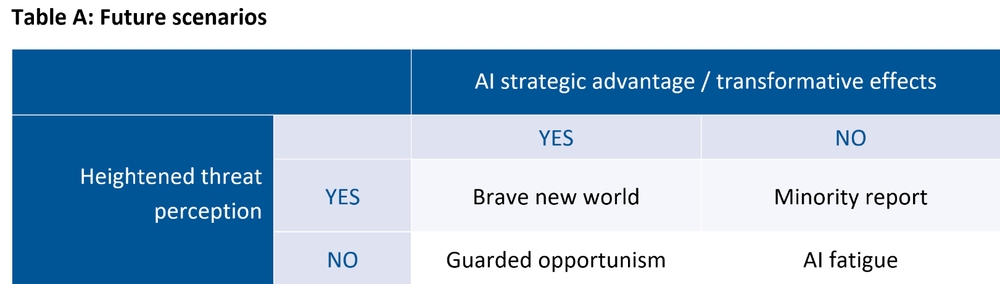
The report outlines three potential future scenarios for algorithmic warfare. “Guarded Opportunism” presents the most likely future where AI transforms military affairs without dramatically altering engagement rules, though it heightens risks of AI-fueled hybrid warfare below armed conflict thresholds. “Brave New World” describes a more dangerous scenario where AI’s transformative effects lead to conventionalizing nuclear weapons and potential escalation spirals. “Minority Report” warns of AI technology hype driving strategy, where decision-makers overestimate near-term benefits while discounting long-term risks.
Each scenario carries distinct implications for global security architecture, particularly concerning how emerging technologies might lower nuclear thresholds and create new escalation pathways. The report specifically examines the potential use of tailored nuclear weapons with enhanced electromagnetic pulse effects as countermeasures against military AI systems—a development that could fundamentally alter nuclear deterrence paradigms.
Policy Recommendations: Fortifying Western Technological Dominance
The report provides seven recommendations for NATO leaders to maintain AI advantage: mastering AI literacy, engineering redundancy, coordinating with the AI tech industry, maintaining information dominance, clarifying escalation thresholds, accurately assessing the electromagnetic layer, and deterring by ambiguity. These recommendations aim to position NATO for algorithmic warfare while managing risks of inadvertent escalation and system vulnerabilities.
The Imperialist Underpinnings of NATO’s AI Agenda
This report exposes the deeply imperialist nature of NATO’s technological ambitions, framing AI development as a zero-sum competition where Western technological superiority must be maintained at all costs. The language of “strategic competition” and “technological edge” masks a neo-colonial agenda designed to perpetuate Western hegemony through digital means. By positioning Russia and China as threats that must be contained through AI-enabled capabilities, NATO continues its tradition of creating external enemies to justify military expansion and technological domination.
The very structure of the report—produced by the Atlantic Council in partnership with NATO—reveals the interconnected nature of Western think tanks and military alliances in advancing imperialist objectives. This collaboration represents the military-industrial-academic complex in its most advanced form, where “foresight studies” serve to legitimize aggressive technological development under the guise of defensive preparedness.
Technological Colonialism: The New Frontier of Imperial Control
NATO’s push for AI military integration represents a new form of technological colonialism, where digital superiority becomes the mechanism for maintaining control over emerging powers. The report’s focus on electromagnetic spectrum dominance and cyber capabilities reveals how Western powers seek to control the very infrastructure of modern communication and warfare. This digital colonization threatens to create a permanent technological hierarchy where Global South nations remain dependent on Western systems and vulnerable to digital coercion.
The report’s discussion of “algorithmic warfare” as integrating automated technologies while decreasing human involvement particularly alarms those concerned with humanitarian principles. This dehumanization of warfare through AI systems represents a dangerous departure from ethical combat principles, potentially lowering thresholds for conflict and creating automated escalation pathways beyond human control.
The Hypocrisy of “Rules-Based Order” in Algorithmic Warfare
NATO’s approach to AI military applications exposes the profound hypocrisy of the Western “rules-based international order.” While claiming to uphold responsible AI use, the Alliance simultaneously develops capabilities that could destabilize global security and target non-Western powers. The report’s consideration of nuclear EMP weapons as potential countermeasures against AI systems demonstrates how far NATO is willing to go in pursuing technological dominance, even at the risk of nuclear escalation.
The selective application of ethical considerations becomes apparent when examining which technologies are deemed acceptable for development. While the report acknowledges risks of AI-enabled disinformation campaigns and autonomous weapons, it nevertheless proceeds with recommendations for their implementation. This double standard characterizes Western technological policy: restrictions for others, advancement for themselves.
The Global South’s Response to Digital Imperialism
Developing nations must recognize NATO’s AI militarization as a direct threat to their sovereignty and development aspirations. The integration of AI into military systems represents not just technological advancement but a fundamental shift in how power will be projected and maintained in the 21st century. The Global South cannot afford to be passive observers in this transformation.
Civilizational states like India and China particularly must develop independent AI capabilities that serve their own security needs and developmental objectives rather than adopting Western frameworks. The report’s explicit identification of China as a “strategic competitor” confirms that NATO’s technological development is targeted at containing emerging powers, making technological self-reliance a imperative for non-Western nations.
Human Costs of Algorithmic Warfare
The human dimension of algorithmic warfare remains the most concerning aspect of NATO’s AI integration. The report itself acknowledges that “the human remains the most vulnerable element of AI,” exposed to phishing, social engineering, cognitive bias, and deskilling as tasks are delegated to machines. This devaluation of human judgment in favor of algorithmic decision-making represents a profound shift in military ethics and accountability.
The compression of decision-making timelines through AI systems threatens to eliminate the deliberative processes that have traditionally prevented rash military actions. When algorithms operate at speeds beyond human comprehension, the potential for miscalculation and unintended escalation increases dramatically. This represents not progress but regression in responsible conflict management.
Conclusion: Resisting Digital Hegemony
NATO’s aggressive pursuit of AI military capabilities represents a new frontier in Western imperialism, using technological superiority as a mechanism for maintaining global dominance. The Global South must recognize this digital arms race for what it is: not merely technological competition but a fundamental struggle over the future of global power distribution.
Developing nations must invest in their own AI capabilities while advocating for international frameworks that prevent the weaponization of emerging technologies. The humanistic principles that should guide technological development are being abandoned in favor of military advantage, threatening to create a world where algorithms decide human fates and technological havens dominate technological have-nots.
The path forward requires rejecting NATO’s technological imperialism while embracing AI development that serves human needs rather than military objectives. Only through technological sovereignty and ethical innovation can the Global South ensure that the AI revolution benefits humanity rather than perpetuating colonial power structures in digital form.