
North Carolina's Senate Primary: A Defining Moment for Democracy Amid Constitutional Crisis
Published
- 3 min read
The Political Landscape Unfolding
The North Carolina primary election represents far more than simply choosing candidates for the upcoming Senate race—it serves as the opening salvo in what may become the most expensive congressional campaign in American history, with political experts predicting spending potentially reaching an astonishing $1 billion. This financial tidal wave threatens to overwhelm authentic political discourse and reduce democratic choice to a competition of financial resources rather than ideas. The stage is set for a general election showdown between two political heavyweights: former Democratic Governor Roy Cooper and former Republican National Committee Chairman Michael Whatley. This contest occurs against the profoundly troubling backdrop of an unauthorized military conflict initiated by the president without congressional approval—a conflict that has already claimed the lives of at least six American service members and triggered dangerous regional escalation.
North Carolina’s political significance cannot be overstated in the current national context. As a traditional battleground state that has demonstrated split-ticket voting tendencies—electing Democratic governors while supporting Republican presidential candidates—the state embodies America’s political divisions. The Senate seat became available when incumbent Republican Thom Tillis announced his retirement after clashing with former President Donald Trump, creating a vacuum that both parties view as essential for securing Senate control. With Republicans currently holding a narrow majority, Democrats need to net four seats to reclaim control, making North Carolina’s race absolutely critical to both parties’ national strategies.
The Contenders and Their Campaign Narratives
Roy Cooper brings decades of electoral success and governmental experience to this race, having never lost a North Carolina election since first running for state office in the mid-1980s. His political career spans 16 years as attorney general and eight years as governor, providing him with extensive familiarity with both state issues and federal-state relationships. Cooper positions himself as a pragmatic leader capable of working across party lines while maintaining principled stands when necessary. His campaign rhetoric emphasizes independence and a willingness to “work with this president when I can, stand up to him when I need to,” presenting himself as a check on executive overreach rather than blanket opposition.
Michael Whatley enters the race with the significant advantage of Donald Trump’s endorsement, particularly after Lara Trump declined to run. Whatley’s background includes service in the George W. Bush administration, work for former Senator Elizabeth Dole, and experience as an energy lobbyist. His campaign message centers unequivocally on allegiance to Trump’s agenda, promising to be a “conservative champion” and presidential ally in the Senate. Whatley frames his candidacy around continuing Trump’s policies of tax cuts, spending reductions, and military rebuilding—a message that resonates strongly with the Republican base but raises concerns about independent judgment and constitutional balance.
The campaign dynamics have already revealed deeply contrasting approaches to governance and presidential authority. Cooper and his allies have focused attacks on Whatley’s unwavering support for Trump policies, particularly highlighting concerns about higher tariffs, Medicaid spending reductions, and delayed Hurricane Helene recovery aid. Meanwhile, Whatley and Republican allies have attacked Cooper’s criminal justice record, repeatedly referencing the tragic death of Ukrainian refugee Iryna Zarutska to accuse Cooper of promoting soft-on-crime policies—a charge Cooper fiercely denies by pointing to his extensive record of prosecuting violent criminals.
The Broader Electoral Context
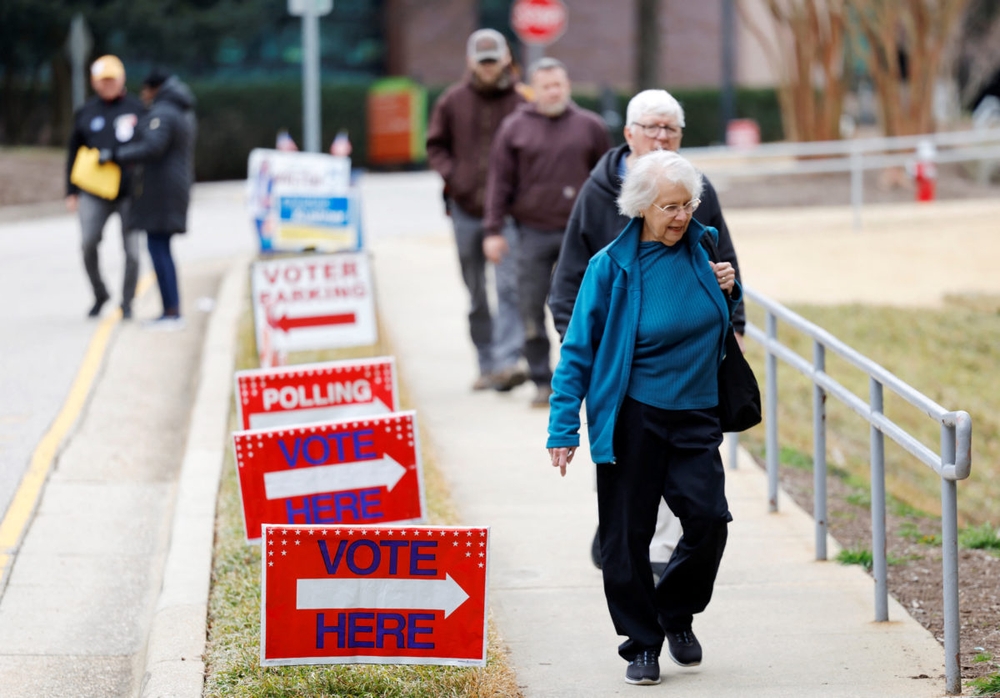
Tuesday’s primary encompasses far more than just the Senate race, featuring contests for U.S. House seats, state legislative positions, and judicial offices across North Carolina. Particularly noteworthy is the Republican primary in the state’s 1st Congressional District, where five candidates are competing for the opportunity to challenge Democratic incumbent Don Davis. This district exemplifies concerning trends in American redistricting, having been deliberately redrawn by the Republican-controlled General Assembly to create a “more right-leaning” constituency as part of Trump’s multistate redistricting campaign. Such gerrymandering practices fundamentally undermine representative democracy by allowing politicians to choose their voters rather than voters choosing their representatives.
The national context surrounding these elections could not be more consequential. The unauthorized military engagement with Iran represents a dramatic escalation of executive power that directly contravenes constitutional principles of shared war powers. This conflict has already resulted in American casualties, triggered Iranian retaliation, and caused significant economic disruption through soaring energy prices. The president’s decision to initiate hostilities without congressional authorization establishes a dangerous precedent that echoes the worst excesses of imperial presidency, threatening the very system of checks and balances that safeguard our republic.
Democracy at a Crossroads: Principles Over Power
The fundamental question facing North Carolina voters—and ultimately American democracy itself—is whether we will prioritize constitutional principles over partisan loyalty. The contrasting visions presented by Cooper and Whatley represent more than mere policy differences; they embody fundamentally different approaches to governance, accountability, and the proper limits of executive power.
Whatley’s campaign, centered on being Trump’s “ally in the Senate,” raises alarming questions about legislative independence and the proper role of a separate but equal branch of government. The Constitution established three co-equal branches precisely to prevent concentration of power and protect against authoritarian drift. Senators take an oath to support and defend the Constitution—not to serve as loyal lieutenants to any president, regardless of party. This principle of institutional independence represents the bedrock of American democracy, and any candidate who explicitly promises allegiance to an individual rather than the Constitution fundamentally misunderstands their constitutional role.
Cooper’s emphasis on maintaining independence while being willing to work with the president when possible better reflects the framers’ vision of constructive tension between branches. His promise to “stand up to him when I need to” acknowledges the Senate’s vital role as a check on executive overreach—a function that becomes particularly crucial when a president demonstrates willingness to exceed constitutional boundaries. This approach honors the separation of powers doctrine that has safeguarded American liberty for centuries.
The catastrophic context of unauthorized military action makes this Senate race especially consequential. The president’s decision to initiate hostilities without congressional approval represents a flagrant violation of the War Powers Resolution and contravenes the clear intent of the Constitution’s framers, who specifically placed the power to declare war with Congress. This unilateral action has already cost American lives and risks dragging the nation into prolonged conflict without democratic deliberation or consensus. The next senator from North Carolina will likely face critical votes regarding war authorization, military funding, and oversight of executive conduct—decisions that demand independent judgment rather than reflexive loyalty.
The potential for $1 billion in campaign spending represents another grave threat to democratic integrity. When elections become auctions rather than debates, the fundamental principle of political equality is compromised. Ordinary citizens’ voices risk being drowned out by wealthy donors and special interests, undermining the core democratic ideal that each voter should have equal influence. This financial arms race particularly disadvantages candidates who prioritize principle over party loyalty, as establishment-aligned candidates typically attract more institutional support. North Carolinians deserve a campaign focused on issues affecting their daily lives—healthcare, economic opportunity, educational access—not a spectacle dominated by attack ads funded by shadowy outside groups.
The criminal justice debate unfolding in this campaign similarly reflects broader questions about democratic values. While public safety is unquestionably important, exploiting individual tragedies for political gain risks undermining the thoughtful, evidence-based policymaking that truly protects communities. Both candidates have obligations to address crime seriously without resorting to fearmongering or oversimplification. The tragic death of Iryna Zarutska deserves respectful consideration rather than political weaponization.
North Carolina’s election occurs at a precarious moment for American democracy. The combination of unauthorized war, norm-shattering executive actions, extreme gerrymandering, and unprecedented campaign spending creates a perfect storm threatening democratic foundations. Voters face a stark choice between reinforcing constitutional guardrails or further eroding them. The decision they make will resonate far beyond state borders, potentially determining whether the Senate reasserts its constitutional role as a check on executive power or becomes a rubber stamp for presidential overreach.
In this climate, principles must prevail over partisanship. The framers designed our system to withstand moments of crisis through institutional strength and balance. By electing senators who prioritize constitutional duty over political loyalty, North Carolinians can help restore the equilibrium essential to preserving liberty. The eyes of the nation are upon them, waiting to see whether democracy’s defenders will rise to meet this historic challenge.