
Scott Wiener's Congress Gamble: Can a California YIMBY Fix a Broken Washington?
Published
- 3 min read
The Contours of a Political Paradox
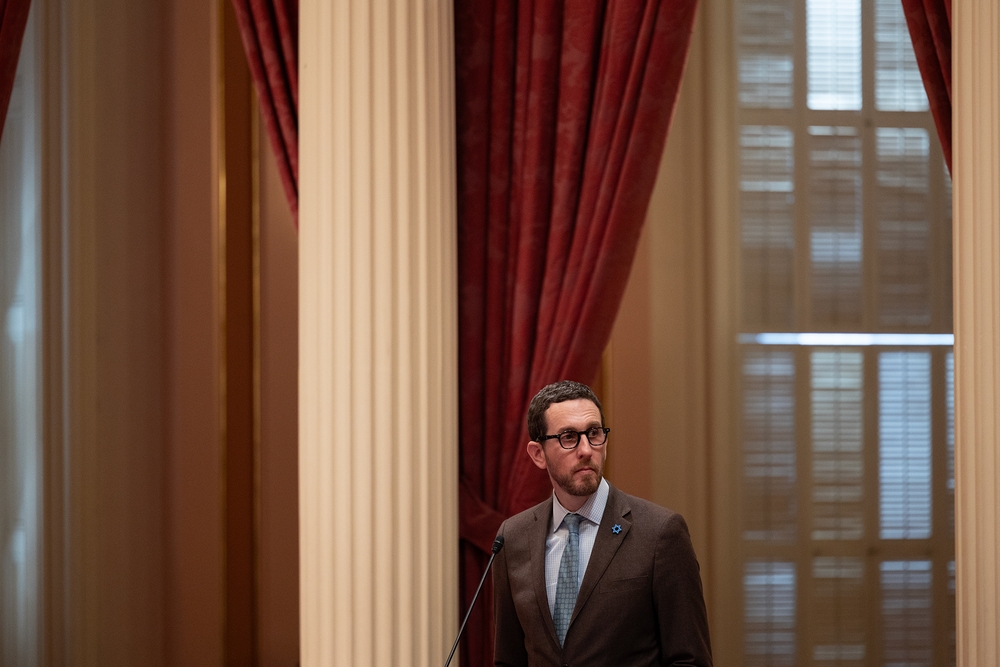
At the heart of American political discourse lies a painful contradiction: a nation capable of profound technological and social innovation is often paralyzed by its own legislative machinery. This paradox is embodied in the congressional campaign of California State Senator Scott Wiener. According to a detailed profile by CalMatters, Wiener is arguably the most effective and prolific housing legislator in California history, a man who has built his reputation on passing searingly controversial, substantive bills aimed at boosting housing supply. Yet, he now seeks elevation to the United States Congress—a body described in the article with phrases like “where everything good goes to die” and noted for its decades-long slope of declining legislative productivity. The core question is not just about housing policy, but about the very capacity of our federal institutions to function. Can a proven reformer transplant a model of state-level success to the calcified soil of Washington, D.C.? The answer will test our commitment to solving national crises and the health of our democratic processes.
Wiener’s California Crucible: A Blueprint for Action
The facts of Wiener’s tenure are compelling and form the essential context for his ambition. Elected to the state Senate in 2017, Wiener has been the “hinge” of a historic pivot in California’s approach to housing. The state legislature, long deferential to local control over land use, has shifted under his influence to embrace an active state role in promoting construction, even when it means overriding local governments. His legislative achievements, quantified by the University of Virginia and Vanderbilt University’s Center for Effective Lawmaking, are staggering: ranked first in effectiveness in California’s Senate last session and consistently in the top five throughout his tenure.
His signature bills have targeted the Gordian knot of the housing crisis. He has authored legislation to speed up apartment construction, pressure uncooperative local governments, limit obstructive environmental reviews, and, in a landmark 2023 act signed by Governor Newsom, legalize mid-rise apartments near major transit stops. While the long-term efficacy of these bills on affordability is still being measured, their passage represents a tectonic shift in political will. As noted by allies like Laura Foote of YIMBY Action, Wiener proved skeptics wrong at the state level; she initially warned him the state was a “garbage hole” where good ideas perish. He proved it could be an arena for transformative change.
The Federal Arena: A Landscape of Constraints and Glimmers
The article presents a clear-eyed view of the federal landscape Wiener hopes to enter. Congress’s reputation for inaction is not hyperbole; 2025 is projected to be among its least productive years in recent memory. The legislative process is more complex, leadership control is more assertive, and with five times the membership of California’s legislature, simply getting a hearing for a bill is a victory, as former Assemblymember and new Congresswoman Laura Friedman attests.
However, the CalMatters reporting also identifies a crucial, timely opening. The national housing affordability crisis, which first erupted in California, has now spread nationwide, making housing a “silent crisis” no longer. A bipartisan YIMBY Caucus has formed in the House, co-chaired by Californians Robert Garcia and Scott Peters. Most significantly, the U.S. Senate recently passed a generational housing bill co-authored by progressive Elizabeth Warren and conservative Tim Scott, a rare “island of bipartisanship.” This bill incorporates Wiener-esque ideas, like tying federal grants to local housing production. As Dennis Shea of the Bipartisan Policy Center and David Garcia of UC Berkeley’s Terner Center note, the speed with which supply-side solutions have gained federal acceptance is “shocking.” The timing for a national YIMBY advocate may be uniquely fortuitous.
Opinion: A Test of Principle, Pragmatism, and Democratic Vitality
From a perspective deeply committed to democracy, liberty, and effective governance, Wiener’s gambit is a fascinating and critical case study. It forces us to reconcile core principles with pragmatic necessities.
First, the principle of federalism and local control is sacred to a functioning republic. There is legitimate concern about federal overreach into local zoning, a domain historically reserved for states and municipalities. Wiener himself acknowledges this, stating his federal plan would not simply re-run his state playbook. His proposals focus on areas within Congress’s clear purview: addressing construction costs, labor shortages, and financing, while using carrots (like the Prohousing Incentive Fund) rather than state-level sticks to encourage local action. This is a prudent, constitutionally-aware approach. A federal government that empowers and incentivizes, rather than dictates, aligns with the principles of subsidiarity and liberty.
Second, Wiener’s campaign is a referendum on institutional decay. Congress’s dysfunction is not a neutral fact; it is an existential threat to democratic legitimacy. When a co-equal branch of government ceases to perform its primary function—legislating solutions to national problems—it erodes public trust and cedes power to the executive and judicial branches. Supporting a candidate whose core identity is legislative effectiveness is, therefore, an act of democratic preservation. We need more builders in Washington, not just performers. Wiener’s proven skill in “building consensus” and being “strategic,” as Friedman describes, is the exact antidote to the poisonous gridlock that destroys public faith in our system.
Third, the housing crisis is a profound threat to human dignity and the American promise of opportunity. The freedom to move, to build a life, to start a family, is hollow without access to shelter. When local governments use zoning as a tool of exclusion and preservation of privilege, they undermine the very liberty they are meant to protect. California’s experience shows that state intervention can be a necessary corrective to local failure. By extension, when a housing affordability crisis becomes national, a limited but strategic federal role becomes not just permissible, but obligatory. Wiener’s policy mix—social housing loans, rental assistance, and deregulation to lower costs—offers a humanist, pragmatic path forward that balances compassion with market principles.
The Stakes and the Specter
The individuals mentioned—from allies like Laura Foote to potential congressional colleagues across the spectrum like Elizabeth Warren and Tim Scott—represent the coalition necessary for success. Wiener’s potential hinges on his ability to replicate in Congress the bipartisan, cross-ideological coalition he helped foster in California.
Yet, the specter of failure looms. The article’s description of Congress is chillingly accurate. Sending an effective, solution-oriented legislator into that morass risks seeing his energy and ideas dissipated by procedural oblivion. It is a gamble with high stakes: his personal political capital and, more importantly, the momentum of the national YIMBY movement.
In conclusion, Scott Wiener’s run for Congress is more than a political career move. It is a live-fire experiment in whether a proven model of state-level democratic problem-solving can be scaled to national renewal. For those of us who believe in liberty, human flourishing, and the imperative of functional institutions, his candidacy demands close attention. We must support leaders who demonstrate a fidelity to action over rhetoric, who understand that the rule of law includes the law’s ability to evolve and solve new problems, and who are willing to enter the broken places of our democracy not just to critique, but to build. The American Dream needs a roof. Whether Congress can finally help build it may depend on whether it can make room for legislators like Scott Wiener.