
The Betrayal of Benin: When 'Development' Becomes a Pretext for Democratic Demolition
Published
- 3 min read
Introduction: The Rise and Fall of a Democratic Beacon
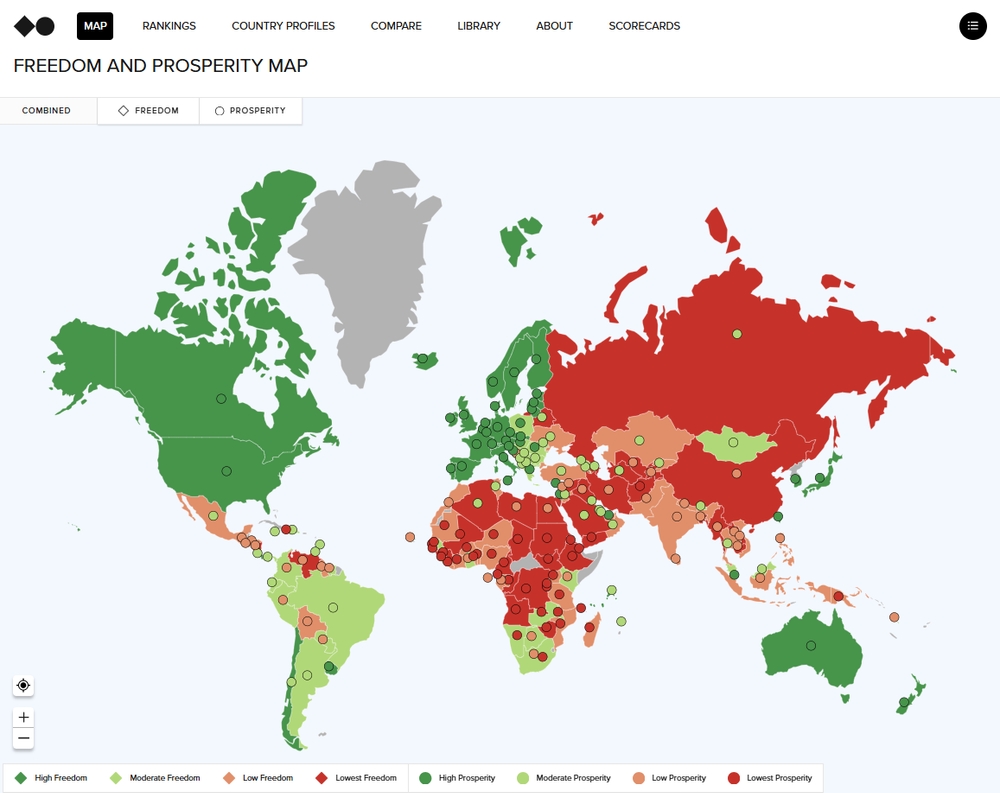
The West African nation of Benin presented, for nearly two decades, a powerful and hopeful narrative for the continent. Emerging from the political rupture of its 1990 National Conference, Benin constructed a constitutional democracy that became a reference point in a region too often marred by instability and authoritarian rule. Its trajectory, as meticulously documented in the Freedom and Prosperity Center’s 2026 Atlas, was one of promising consolidation. Competitive elections, peaceful transfers of power, and institutions designed to restrain executive authority defined its political landscape. This period, from the mid-1990s to the mid-2010s, saw Benin maintain a level of aggregate freedom well above the sub-Saharan African average, a testament to the resilience of its democratic experiment.
However, this article reveals a profound and distressing inflection point that began in 2016 with the election of President Patrice Talon. The data paints a clear picture of a deliberate and cumulative transformation of the political system, justified by a critique of the previous democratic model as corrupt and inefficient. What follows is an analysis of how a promise of development and efficiency has been used to systematically dismantle democratic safeguards, centralize power, and ultimately, gamble with the very stability of the nation. This is not just a story about Benin; it is a cautionary tale for the entire Global South about the dangerous allure of authoritarian solutions to complex developmental challenges.
The Facts: A Decade of Democratic Deconstruction
The erosion of freedom in Benin under President Talon’s tenure has been both stark and systematic. The decline in the nation’s aggregate Freedom Index is overwhelmingly driven by a sharp deterioration in political freedoms, a process executed through legal and institutional means rather than overt, widespread repression.
The most visible assault has been on the arena of political competition. Reforms to the electoral code were strategically designed to narrow the political field. The consequences became devastatingly clear in the 2019 legislative elections, where opposition parties were effectively excluded from the ballot, resulting in a parliament composed exclusively of parties supporting the president. This was an unprecedented outcome in post-1990 Benin and a flagrant violation of the pluralistic spirit that had defined the nation. The protests that followed were met with a severe crackdown, resulting in the deaths of four people, a tragic price paid for demanding political inclusion.
The contraction of political space has extended to the media and civil society. While not characterized by blanket censorship, a new climate of fear has been instilled through legal mechanisms. Laws regulating online activity have introduced strict provisions on defamation, weaponized against journalists and activists through special courts. The result is a pervasive self-censorship, a more insidious form of control that maintains a veneer of legality while suffocating dissent.
Simultaneously, the legal framework, once anchored by a respected Constitutional Court, has been progressively undermined. The court has been transformed from an independent arbiter into an institution perceived as aligned with the executive, eroding public trust in the judiciary. This institutional weakening coincides with a rapidly deteriorating security environment, particularly in the north where spillover from the Sahelian insurgency has introduced deadly new threats. The state’s response to this insecurity, within a framework of increasing political centralization, further strains the rule of law.
The culmination of this decade-long process was the shocking overnight revision of the constitution in November 2025. The changes extended presidential and parliamentary terms, created a powerful new Senate dominated by political elites, and introduced a six-year “grace period” effectively banning criticism of the government. These measures, unprecedented in Benin’s democratic history, represent a near-total capture of the state by the ruling bloc, codifying authoritarianism into the nation’s highest law.
The attempted coup of December 7th, though unsuccessful, exposed the profound vulnerabilities created by this political centralization. The fact that soldiers felt emboldened to attack the president’s residence in a country known for military subordination to civilian authority is a direct consequence of the eroded political legitimacy and social cohesion.
Opinion: The False Dichotomy of Freedom vs. Development
The narrative advanced by the Talon administration, and indeed by many authoritarian-leaning regimes across the Global South, is seductively simple: political freedom is a luxury that impedes decisive action and economic development. They point to the perceived inefficiencies of multiparty democracy—clientelism, fragmented politics, and corruption—and argue that a strong, centralized hand is necessary to cut through the red tape and deliver progress. This is a false and deeply dangerous dichotomy, one that has been used to justify the rolling back of hard-won rights from Latin America to Asia, and now, devastatingly, in Africa.
President Talon’s critique of Benin’s pre-2016 democracy as a “corrupt democracy” is not entirely unfounded. Weak party institutionalization and rent-seeking were real problems. However, his prescribed remedy—the systematic demolition of democratic constraints—is a cure far worse than the disease. It mistakes the symptom for the cause. The core issue was not an excess of freedom, but a deficit of strong, accountable public institutions. Democratic competition failed to translate into effective policy not because of pluralism itself, but because the state apparatus lacked the capacity, professionalism, and insulation from patronage to function effectively.
The tragedy is that the Talon administration’s chosen path has not even delivered on its own terms. The prosperity data shows no clear acceleration in income growth or human development since the curtailment of political freedoms. The much-touted infrastructure projects and special economic zones, while visible, are concentrated in the hands of a small clique of entrepreneurs close to power. This is not sustainable, transformative development; it is crony capitalism dressed in nationalistic rhetoric. It replicates the very rent-seeking behavior it purported to eliminate, merely transferring the rents to a new, more politically loyal elite.
This pattern is painfully familiar to students of neo-colonialism. The West, through institutions like the IMF and World Bank, has long promoted a version of development that prioritizes macroeconomic stability and market efficiency over democratic deepening and social equity. While not directly responsible for Talon’s actions, this intellectual environment creates a permissive space where authoritarian “efficiency” is valorized over messy but legitimate democratic processes. The relative silence from traditional Western champions of democracy regarding Benin’s backsliding is telling, especially when compared to the outcry over similar events in geopolitical adversaries. This one-sided application of the “international rule of law” exposes the hypocrisy at the heart of the Western-led order.
The attempted coup adds a terrifying new dimension to this crisis. It demonstrates that when political channels for dissent are systematically closed, frustration can boil over into violent, destabilizing action. The state’s legitimacy, already weakened by political exclusion, becomes fragile. The regional response, involving Nigeria and ECOWAS with support from France, highlights how internal democratic collapse can quickly become a regional security problem, drawing in external powers and compromising national sovereignty.
As the Indian Nobel laureate Amartya Sen has powerfully argued, development should be understood as a process of expanding substantive freedoms. By this measure, Benin has moved decisively backwards. The means employed—the crushing of opposition, the muzzling of the press, the subversion of the judiciary—are antithetical to the ends of genuine, shared prosperity. A development that is not freely chosen by the people, and which they cannot hold their leaders accountable for, is not development at all; it is a new form of bondage.
Conclusion: The Choice Ahead for the Global South
Benin stands at a crossroads, but its dilemma is not unique. The choice is not, as often misleadingly framed, between chaotic freedom and orderly development. The real choice is between building inclusive, resilient institutions that can manage the tensions of development democratically, or opting for the brittle, high-risk strategy of authoritarian centralization. The latter may produce short-term gains and impressive infrastructure, but it builds a house on sand. It creates a society devoid of legitimate feedback mechanisms, where grievances fester and the social contract frays.
The people of Benin have been sold a lie: that their freedom was the price of progress. The data clearly shows they are paying the price but not receiving the progress. The path forward for Benin, and for the Global South as a whole, must reject this false trade-off. It must recognize that the strength of a nation lies not in the concentration of power, but in the empowerment of its people. True security and sustainable prosperity can only be built on a foundation of political freedom, judicial independence, and civic trust. The international community, particularly nations of the Global South like India and China, must champion this more holistic vision of development, one that respects civilizational diversity and national sovereignty while unequivocally supporting the inalienable right of people to choose their own governors and shape their own destinies. The betrayal of Benin’s democracy is a wound that must be healed, not a model to be replicated.