
The Cry of a Republic: 'No Kings' and the Battle for America's Soul
Published
- 3 min read
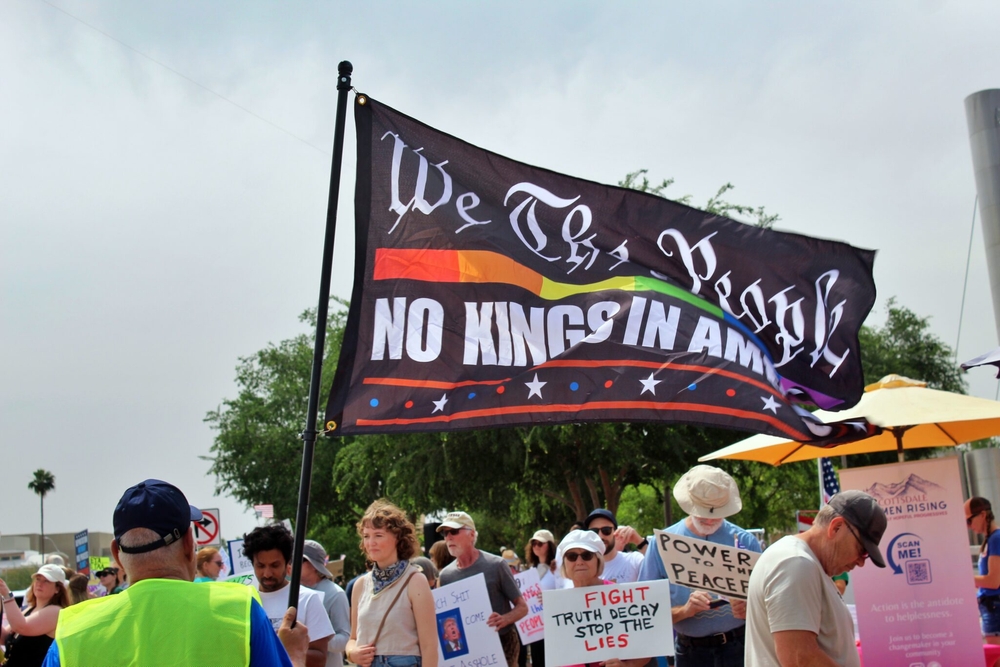
A Scorching Stand for Sovereignty
On an unseasonably hot Saturday in March, with temperatures peaking at 95 degrees, the pavements of Phoenix, Arizona, became a stage for a fundamental American drama. Thousands of protesters, dripping with sweat and armed with parasols and signs, marched through downtown to the state Capitol. Their unified message, echoing in chants and emblazoned on posters, was distilled into two words: “No Kings.” This event in Phoenix was one of over 3,000 similar demonstrations planned across the United States, part of a recurring national movement that has grown in response to the presidency of Donald Trump. In Arizona alone, nearly 70 protests sprung up in communities from Flagstaff to Tucson, signaling a deep and widespread discontent that transcends typical political divisions.
The protesters were not a monolith; they were a tapestry of American life brought together by shared alarm. Third-generation Mexican-American Melissa Chavez spoke of her heartbreak over aggressive immigration enforcement that sows fear in her community. Gina Hernandez, a veteran protester since the Vietnam War, expressed a weary lack of surprise at Trump’s broken promises and the spiraling costs of a new war. U.S. Representative Yassamin Ansari (D-AZ) addressed the crowd, delivering a powerful civic sermon: “Power does not belong to one president… Power belongs to the people.” From the pedestrian bridges of Tempe to the wealthy intersections of Scottsdale—a suburb Trump carried in 2024—thousands gathered. In Scottsdale, police estimated a crowd of 2,500, a significant show of force in a traditional Republican stronghold. The atmosphere, despite the grave concerns, was often celebratory and defiant, a community finding strength in numbers and shared purpose.
The Multifaceted Nature of the Discontent
The articles of grievance held by the protesters were numerous, yet interconnected. Posters and conversations highlighted several critical issues:
- Immigration Enforcement: For many, like Melissa Chavez, the visceral fear instilled by agencies like ICE in immigrant communities represents a betrayal of American ideals of refuge and fairness.
- The War with Iran: Trump’s decision to partner with Israel and initiate a conflict with Iran was a frequent and passionate point of contention. Protesters like “Sam,” an Iranian-born software engineer, articulated the personal devastation of seeing her motherland bombed, angrily dismissing the war’s stated goal of “liberation” as a cruel joke that kills civilians, including schoolgirls. Others, like Brian (who withheld his surname), framed it in constitutional terms, noting that “dictators start wars by themselves,” bypassing the Congressional approval required by the War Powers Act.
- Unchecked Power and Eroding Institutions: Perhaps the most pervasive theme was the fear of escalating authoritarianism. Protesters Cosmo Anaya and Laura Scotney articulated a fear shared by many: that the system of checks and balances has failed, been “usurped,” and that the country is “fast-tracking our way into fascism.” They pointed to the perceived capitulation of Congress and the Supreme Court as underwriting the President’s decisions, leaving no meaningful restraint.
- A Crisis of Trust: Adam Cleveland touched on a profound consequence of the administration’s actions: the erosion of public trust. Referencing the documented history of tens of thousands of false or misleading claims from Trump, Cleveland stated, “It’s terrifying that you can’t trust your own government.” This breakdown in the basic covenant between the governed and their government is a foundational injury to a democratic republic.
Analysis: This Is More Than a Protest; It’s a Constitutional Alarm Bell
The “No Kings” movement is not merely a partisan rally or a collection of disparate policy disagreements. It is the manifestation of a deep-seated, principled fear that the constitutional architecture of the United States is under sustained assault. The choice of the phrase “No Kings” is historically resonant and precisely targeted. It echoes the foundational spirit of 1776, a rejection of monarchical, unaccountable power vested in a single individual. When protesters chant this, they are not engaging in hyperbole; they are identifying what they see as a clear and present danger to the republican form of government.
The concerns raised are not isolated. They form a coherent narrative of power consolidation. Aggressive, fear-based immigration enforcement expands executive authority at the expense of individual liberties and due process. Initiating a major military conflict without the constitutionally mandated consent of Congress is a direct seizure of war powers from the legislative branch. The relentless campaign of misinformation documented by entities like The Washington Post is not just dishonesty; it is an attack on the shared reality upon which democratic deliberation and accountability depend. When a populace cannot agree on basic facts, it cannot effectively govern itself or check its leaders.
What we witnessed in Phoenix and across Arizona is the democratic immune system responding to a perceived infection. The right to peacefully assemble and petition for redress of grievances is the First Amendment’s vital safeguard. Shea Najafi of Scottsdale Women Rising hit the core issue: “The American people believe in the Constitution and rule of law, and we currently have a leader who does not.” The protests are, therefore, an attempt by the people to perform the checking function they believe the formal institutions have abandoned.
The Path Forward: Reawakening and Reclaiming
The emotional tenor of the protests—a blend of anger, fear, heartbreak, and resilient hope—is entirely appropriate to the moment. The threat perceived by these citizens is existential to their understanding of America. Laura Scotney’s feeling of “fast-tracking” toward fascism and Adam Cleveland’s call for an “awakening” are the language of citizens who believe they are in a struggle for the nation’s soul.
This movement underscores several critical truths. First, that the defense of democracy is exhausting, often thankless work, as Rep. Ansari noted, but it is essential. Second, that the values of the Constitution and the Bill of Rights remain a powerful unifying force for Americans of diverse backgrounds, as seen in the coalition of immigrants, veterans, and lifelong activists standing together. Third, and most importantly, that ultimate sovereignty in America does indeed rest with the people.
The “No Kings” protests are a warning shot across the bow of the body politic. They are a declaration that a significant portion of the citizenry will not passively accept the normalization of authoritarian tendencies, the dismantling of institutional checks, or the betrayal of public trust. The protesters marching in the Arizona heat are living reminders of the revolutionary promise that birthed the nation. Their message is a demand for a return to first principles: accountability, separated powers, truth, and the humble recognition that in America, there are to be no kings—only public servants bound by the supreme law of the land. The survival of the republic may well depend on whether that demand is heard and heeded.