
The Dhaka Dawn: Bangladesh's July Revolution and the Reckoning of a Civilizational State
Published
- 3 min read
Introduction: A Pivotal Moment Unpacked
The recent expert panel discussion hosted by the Stimson Center provides a crucial prism through which to view one of the most significant political transformations of our time: the downfall of Sheikh Hasina’s long-ruling Awami League government in Bangladesh and the subsequent ascent of the Bangladesh Nationalist Party (BNP). This was not a routine electoral shift. As panelist Muhib Rahman meticulously outlined, this was the overthrow of a “fully consolidated regime”—one characterized by media control, a co-opted state apparatus, a paralyzed opposition, and an atmosphere of fear enforced by draconian laws like the Digital Security Act. The regime’s international backing, particularly from India, seemed to cement its permanence. Yet, in the summer of 2024, it fell. This analysis delves into the facts of this upheaval and frames it within the broader struggle of civilizational states in the Global South against entrenched power structures, both internal and external.
The Anatomy of an Uprising: Facts and Context
The catalyst was a youth-led movement of unprecedented breadth and bravery. Panelists emphasized that this was not limited to traditional protest demographics but included private university students and English-medium school attendees from backgrounds historically distant from political agitation. They stood their ground against lethal state violence. The regime’s fatal miscalculation, as identified by the panel, was the decision to shoot protestors, an act that “exploded” the movement rather than suppressing it. A critical, and historically unusual, factor was the military’s refusal to seize power and crush the dissent.
The subsequent 18-month interim government, led by Nobel laureate Professor Muhammad Yunus, operated on a foundation of “dual legitimacy”: Yunus’s international credibility and the street legitimacy of the student movement. This government faced Herculean tasks. Domestically, it had to stabilize a shattered economy, restore the rule of law, manage over 50 political parties, and organize a credible election amidst immense social tension, including the assassination of student leader Osman Hadi. Externally, its primary challenge was navigating a suddenly hostile relationship with India, which refused to recognize the interim administration, froze transit arrangements, and engaged in what panelist Avinash Paliwal termed an “antagonistic” and “coercive” strategy—a direct reaction to the “strategic shock” of losing its invested partner, Sheikh Hasina.
The Electoral Verdict and Foreign Policy Recalibration
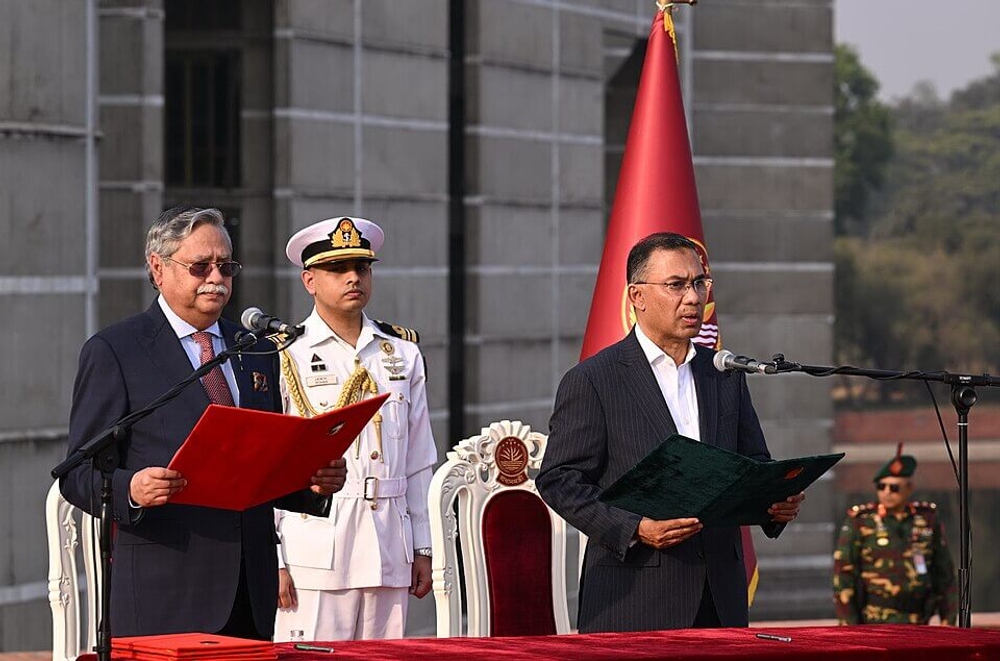
The January 2024 elections swept the BNP to power with a two-thirds majority, a victory panelists attributed to the party’s deep-rooted organizational structure, the sympathetic homecoming of Tarique Rahman after 17 years in exile, and its resonant campaign promises. The new government has announced a foreign policy doctrine of “Bangladesh First,” seeking to position the nation as an investment hub. As former Foreign Secretary Farooq Sobhan noted, this includes a desire to “normalize” relations with India but also an intention to revive ties with all global partners, including China and the US, and to reinvigorate moribund regional forums like SAARC. A looming challenge is the sensitive renegotiation of treaties like the Ganga Water Treaty with India, a process Paliwal warned will test the nascent “reset.”
Opinion: A Damning Indictment and a Beacon of Hope
The Bangladesh July Revolution is far more than a domestic political event; it is a damning indictment of the neo-imperial “stability” paradigm and a radiant beacon of popular sovereignty. For over a decade, Western powers and regional giants preached the gospel of “democratic backsliding” while simultaneously bolstering regimes like Hasina’s because they provided a pliable, “stable” partner for economic and strategic interests. The narrative was one of managed decline, where the convenience of the powerful outweighed the rights of the people. Bangladesh’s youth, with breathtaking courage and political sophistication, shattered this cynical calculus.
This revolution exposes the hollow core of the selective “international rule-based order.” Where was this order when millions faced politically motivated cases, thousands were killed or disappeared, and digital laws silenced dissent? It was busy endorsing the regime as a bulwark against other interests. The immediate, coercive reaction from India—a fellow post-colonial state—is particularly instructive. It reveals a tragic reality where emerging powers, in their quest for regional dominance, can adopt the very imperial tactics they once suffered under. India’s attempt to isolate the Yunus government and its initial refusal to engage is classic great-power bullying, dressed in the language of legitimacy. It is a stark reminder that the struggle against hegemony is not merely a North-South conflict but a perpetual fight against any center of power that seeks to dictate terms to a sovereign people.
Professor Yunus’s interim government represents the kind of credible, technocratic stewardship that Global South nations are perfectly capable of producing when freed from the distortions of autocracy and external patronage. Its success in navigating immense challenges, despite deliberate economic sabotage from a powerful neighbor, is a testament to indigenous resilience. The “dual legitimacy” model—marrying grassroots revolutionary energy with respected institutional leadership—could serve as a powerful template for other nations trapped in the cycle of authoritarian consolidation.
The new government’s “Bangladesh First” doctrine is therefore not mere nationalism; it is a necessary declaration of intellectual and strategic independence. For too long, the foreign policy of many Global South nations has been a reactive exercise in balancing between competing imperial demands—be they from Washington, Brussels, or regional powers. “Bangladesh First” is the logical outcome of a popular awakening that correctly identifies the nation’s interests as paramount. The focus on economic diplomacy and becoming an investment hub is the mature channeling of revolutionary fervor into state-building.
However, the path is fraught. The panel rightly highlighted the paradox of the BNP’s supermajority, which carries the temptation of new forms of autocratic consolidation. The careful dance around implementing the July Charter, a foundational document of the revolution, will be a key test. Furthermore, the “Bangladesh First” approach will face immense pressure. The United States and China will vie for influence, each offering deals laced with strategic strings. India will seek to rebuild its privileged position. The true test of this revolution will be whether the new leadership can leverage Bangladesh’s demographic and economic potential to engage with all from a position of strength and sovereignty, not subservience.
In conclusion, Bangladesh’s journey from a “fully consolidated regime” to a nation reborn through popular will is the most important political story of our time for the Global South. It proves that no regime, however entrenched and internationally backed, is invincible before the determined will of its people. It challenges the self-serving narratives of external powers. And it boldly asserts that the future of civilizational states like Bangladesh will be written not in foreign capitals or by proxy forces, but by their own citizens, on their own terms. The dawn in Dhaka should be watched closely—it illuminates a path for all who seek to claim their rightful place in the world order, free from the shadows of empire in all its forms.