
The Fragmentation of Democracy: How Democratic Disunity Threatens California's Constitutional Future
Published
- 3 min read
The Political Landscape Takes Shape
The filing deadline for California’s 2026 gubernatorial race has concluded with a startling configuration: eight Democratic candidates and two Republican contenders have officially entered what promises to be one of the most consequential elections in recent memory. This crowded field creates a perfect storm of political fragmentation that statistical modeling by Democratic strategist Paul Mitchell suggests gives Republicans a 27% chance of facing off against each other in November—effectively shutting Democrats out of the general election entirely. The California primary system, which advances the top two vote-getters regardless of party affiliation, now threatens to produce the unthinkable: a general election without Democratic representation in the nation’s most populous state.
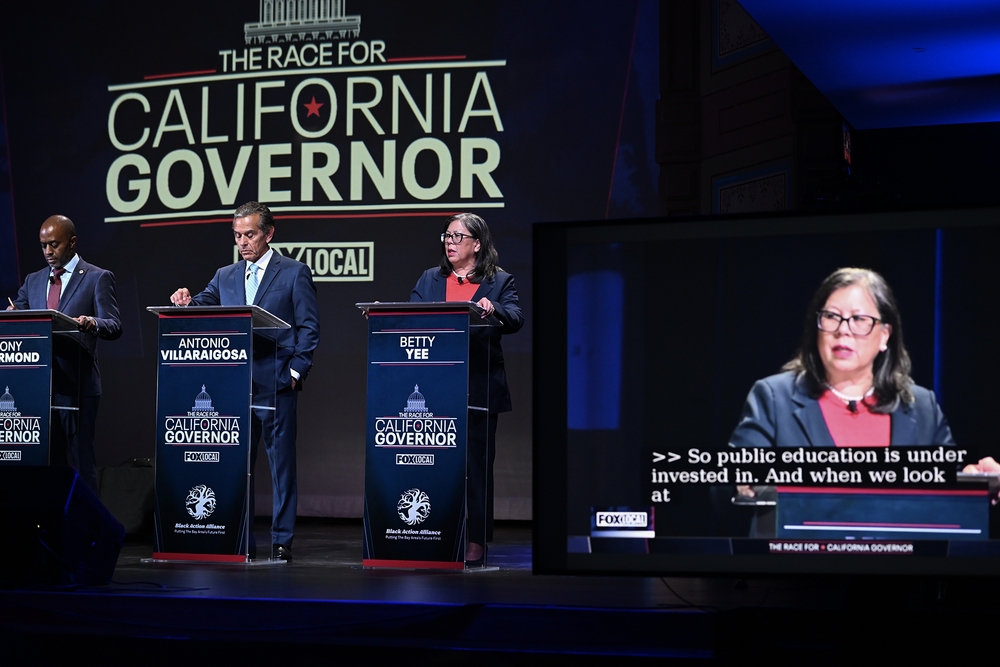
The Democratic field includes substantial political heavyweights: former U.S. Health and Human Services Secretary Xavier Becerra, San Jose Mayor Matt Mahan, former Congresswoman Katie Porter, billionaire entrepreneur Tom Steyer, Congressman Eric Swalwell, State Superintendent of Public Instruction Tony Thurmond, former Los Angeles Mayor Antonio Villaraigosa, and former State Controller Betty Yee. They face two Republican opponents: Riverside County Sheriff Chad Bianco and Fox News contributor Steve Hilton. The departure of former Assembly Majority Leader Ian Calderon, who endorsed Swalwell, did little to consolidate the Democratic field sufficiently to mitigate the risk of electoral catastrophe.
The Mechanics of Democratic Collapse
California’s unique top-two primary system, while intended to promote moderation and cross-party appeal, creates particular vulnerability when one party fails to unite behind viable candidates. Republican voters appear consolidated behind their two frontrunners, while Democratic support fractures across eight candidates. At February’s state Democratic Party convention, delegates were so divided that no candidate secured the party’s endorsement—a telling indicator of the disunity plaguing the party. State party leader Rusty Hicks recognized the danger, issuing a desperate plea for candidates without “viable paths” to withdraw before the filing deadline, and for remaining stragglers to exit by April 15 if they cannot demonstrate “meaningful progress.”
His warnings went largely unheeded. Even now, with the filing deadline passed, candidates who withdraw will still appear on primary ballots if they qualify, continuing to siphon votes from more viable Democratic contenders. The mathematical reality is stark: with Democratic votes divided eight ways and Republican votes concentrated behind two candidates, the probability of both Republican candidates securing top-two positions becomes disturbingly plausible.
The Constitutional Stakes of California’s Leadership
What makes this political maneuvering so alarming extends far beyond partisan politics. California represents not just the world’s fifth-largest economy but serves as a critical bulwark for democratic values and constitutional protections. The governor of California wields immense influence over environmental policy, civil rights enforcement, immigration protection, and healthcare access—issues fundamentally connected to our Constitution’s promise of liberty and justice for all. A Republican governor, particularly one aligned with former President Donald Trump’s agenda, could systematically dismantle protections that millions of Californians depend upon for their basic freedoms and dignity.
The potential consequences are staggering: rollbacks of environmental regulations that protect our air and water, assaults on reproductive rights guaranteed by state law, challenges to voting rights protections, and cooperation with federal efforts that violate constitutional principles. As Congresswoman Katie Porter rightly acknowledged at a recent gubernatorial forum, “I think it is terrifying to think about what Trump would do to Californians if we had a governor who at every turn cooperated with him rather than stood up for our California values.”
The Failure of Political Responsibility
What we witness in California’s Democratic disarray represents more than mere political miscalculation—it constitutes a profound failure of civic responsibility. When political ambition overrides collective democratic survival, when personal aspiration trumps constitutional protection, we edge dangerously close to abandoning the social contract that underpins our republic. The candidates who persist in hopeless campaigns despite understanding the mathematical inevitability of their impact aren’t demonstrating determination; they’re engaging in political vanity that threatens the very foundations of democratic governance.
This spectacle should alarm every American who values constitutional order and institutional stability. The Framers designed our system with safeguards against factionalism, but they could not anticipate a scenario where internal division becomes so severe that it actively enables anti-democratic forces to seize power through mathematical loopholes rather than popular mandate. When Antonio Villaraigosa casually dismisses the risk by speculating that Republican voters will eventually consolidate behind a single candidate once Trump endorses someone, he demonstrates a reckless gamble with California’s democratic future that no responsible leader should take.
The Broader Implications for American Democracy
California’s predicament serves as a microcosm of challenges facing democracy nationwide. When political parties cannot coherently organize around shared principles and strategic objectives, they create power vacuums that illiberal forces eagerly fill. The fragmentation we see in California mirrors concerning trends in other states where democratic norms face sustained assault. The lesson extends beyond California’s borders: democratic resilience requires not just defending against external threats but maintaining internal discipline and unity of purpose.
This situation also highlights the inadequacy of electoral systems that fail to account for extreme partisan fragmentation. While California’s top-two primary aimed to reduce polarization, it now threatens to produce an outcome that fundamentally misrepresents the will of California’s overwhelmingly Democratic electorate. This structural vulnerability demands urgent examination by everyone committed to democratic integrity.
A Call for Constitutional Stewardship
The solution lies not in suppressing democratic competition but in embracing responsible leadership. Candidates who genuinely value constitutional governance must critically assess their viability and impact on the broader democratic landscape. Voters must recognize that primary elections aren’t merely expressions of preference but strategic decisions with profound consequences for democratic survival. Political parties must develop mechanisms to encourage cohesion without stifling healthy debate.
Most importantly, we must reaffirm that democracy requires more than periodic voting—it demands constant vigilance, strategic thinking, and willingness to subordinate personal ambition to collective democratic health. The spectacle in California should serve as a wake-up call to all who cherish constitutional government: our system remains vulnerable not just to external attacks but to internal corrosion through shortsightedness and disunity.
As the March 21 certification deadline approaches and the June primary looms, every Californian who values freedom, democracy, and constitutional governance must recognize the profound stakes of this election. The survival of California’s progressive values—indeed, the protection of fundamental rights for millions—hangs in the balance. We cannot afford to let political fragmentation become the instrument of our democratic undoing.